Contact Us
Lishuangdian Industrial Zone, Zhengding County, Shijiazhuang City, Hebei Province, China.
info@hsspcflooring.com
Whatsapp/Wechat: +86 15933619081

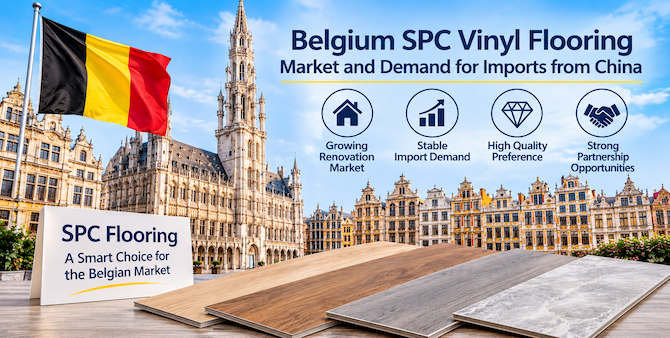
Belgium is an important market for flooring products in Western Europe. Its position at the centre of the European Union, well-developed logistics infrastructure and close commercial connections with neighbouring countries make it an attractive destination for flooring manufacturers, importers and distributors. Alongside traditional flooring materials such as ceramic tiles, laminate and wood, vinyl flooring has become an established option for residential renovation, commercial interiors and property development.
Within this market, Stone Plastic Composite (SPC) flooring has attracted attention as part of the wider development of rigid-core vinyl flooring. In Belgium, buyers may search for products using terms such as SPC vloeren, while French-speaking customers are more likely to use sols SPC or descriptions such as rigid PVC flooring. Understanding these local search habits is important for Chinese manufacturers seeking to reach Belgian wholesalers, flooring distributors, importers and private-label brands.
China is already a major supplier of vinyl flooring to Belgium. Its manufacturing capacity, product variety and established export network provide opportunities for Belgian buyers looking for competitive sourcing and flexible product development. However, the market is also competitive, with European manufacturers, regional suppliers and international brands serving different customer segments.
This article examines the Belgian flooring market, the development of SPC flooring, import demand from China, product specifications, European compliance requirements and the opportunities available to businesses working with Chinese SPC flooring manufacturers.
Belgium has a mature construction and renovation sector supported by residential housing, commercial buildings, offices, retail properties and public infrastructure. Flooring demand comes from both new construction and the replacement of existing floor coverings.
The Belgian market is particularly interesting because of its location. It borders France, Germany, the Netherlands and Luxembourg, and has access to major European transport networks. The Port of Antwerp-Bruges and the country’s road and rail connections support international trade and distribution. For flooring importers, Belgium can serve not only domestic customers but also provide a logistical base for supplying other European markets.
However, Belgium should not be viewed simply as a transit market. Its own residential and commercial flooring demand is significant, with local distributors, wholesalers, retailers, installers and project contractors serving customers across the country.
Market research companies generally include Belgium within broader European flooring, resilient flooring or vinyl flooring studies rather than publishing a complete and consistently defined national SPC market figure. For this reason, it is important to distinguish the total flooring market from the much narrower SPC category. A national figure for all flooring products should not be presented as the market size of SPC flooring alone.
The European vinyl flooring industry has developed through several product generations, from traditional vinyl sheet and flexible LVT to WPC and rigid-core SPC. As manufacturing technology has improved, buyers have gained access to more realistic wood and stone designs, different core constructions, click-lock installation systems and a wider range of surface treatments.
SPC is now an established part of this broader product landscape. Its rigid core construction and floating installation system make it relevant to distributors looking for alternatives to laminate, traditional vinyl and certain other flooring materials.
Belgium’s flooring demand is closely connected to its construction and renovation activity. New residential developments create demand for flooring materials, but renovation is particularly important because homeowners and property owners regularly update kitchens, living rooms, bedrooms, apartments and commercial interiors.
Recent European Construction Observatory analysis indicates that renovation activity in Belgium has been more resilient than new construction. Renovation permits have exceeded new-build permits since 2019, while new-build permits have remained below their pre-pandemic levels. The construction sector has also faced cost pressures, labour shortages and changing investment conditions.
This environment has implications for flooring suppliers. When customers renovate existing properties, they may prefer products that can be installed efficiently, offer attractive designs and provide a practical balance between cost and performance.
SPC flooring can be relevant to these projects because it is available in floating click-lock formats and does not normally require full-surface adhesive installation. This can be attractive where renovation time, installation convenience and disruption to the property are important considerations. Nevertheless, the subfloor must still be properly prepared, and installation requirements must be followed.
For wholesalers and distributors, renovation demand creates opportunities to develop a range of SPC products for different customer groups. A practical residential collection may focus on natural wood designs and competitive pricing, while a premium collection may include enhanced textures, longer planks and herringbone patterns.
Commercial renovation also provides opportunities, particularly in offices, retail spaces, hospitality interiors and selected public buildings. However, product suitability must be assessed against the intended traffic level, safety requirements, acoustic performance and project specifications.
SPC stands for Stone Plastic Composite or Stone Polymer Composite. It is a rigid-core vinyl flooring product generally manufactured using mineral filler and PVC-based materials, together with decorative, wear-resistant and protective layers.
The rigid core gives the plank its structure and helps it maintain its shape under normal service conditions. A decorative film provides the wood or stone appearance, while the transparent wear layer protects the surface against everyday abrasion. Depending on the product construction, a UV coating and attached acoustic underlay may also be included.
In Belgium, the keyword SPC vloeren is useful for reaching Dutch-speaking buyers, especially in Flanders. It refers to SPC flooring and is a natural search term for product pages, catalogues and online marketing content.
In French-speaking Wallonia and Brussels, buyers may use sols SPC, sol SPC, revêtement de sol SPC or revêtement de sol PVC rigide. These terms help manufacturers communicate with a wider range of potential customers.
The terminology is not merely a translation issue. Local buyers often search using familiar product names rather than the technical terminology used by manufacturers. A Chinese factory that wants to attract Belgian importers should therefore consider Dutch and French keywords alongside English product descriptions.
SPC should also be distinguished from conventional flexible LVT and WPC flooring. LVT can refer to flexible or rigid-core luxury vinyl tile and plank products, while WPC normally describes a different core construction. These products may compete in similar applications, but they are not technically identical.
One of the main reasons for the development of SPC flooring is its rigid-core construction. Compared with flexible vinyl products, SPC provides a firmer plank structure and is commonly supplied with a click-lock system for floating installation.
Water resistance is another important selling point. SPC flooring is generally designed to resist water exposure at the flooring surface, making it attractive for many everyday residential applications. However, buyers should not assume that the entire installed floor is waterproof under all conditions. Water can still enter through joints, perimeter gaps or poorly sealed installation details, and the subfloor may require separate moisture protection.
The wear layer is an important part of the product’s surface construction. Different thicknesses are available for different market segments and expected traffic levels. A thicker wear layer can provide additional surface protection, but it should not be treated as the only indicator of overall flooring quality.
The locking system is equally important. Poorly manufactured joints can lead to installation difficulties, gaps or locking failures. For this reason, Belgian importers should pay attention to click-profile accuracy, joint strength and consistency between production batches.
Design is another major factor. SPC flooring is available in natural oak, walnut, ash and other wood-inspired appearances, as well as stone and concrete designs. Embossed surfaces, matte finishes and registered textures can make the product more realistic and help retailers create a more attractive collection.
Many SPC products also include attached IXPE or EVA underlay. This can simplify installation and contribute to acoustic performance, depending on the complete floor construction and test conditions. Importers should request relevant acoustic test reports for the exact product combination rather than relying on general claims about sound reduction.
The wider LVT industry provides useful context for understanding the direction of SPC flooring.
Floor Focus’s April 2025 LVT industry report describes a market that has moved beyond relying on one dominant residential rigid-core format. The product category has expanded toward thicker SPC constructions, enhanced cores, WPC, hybrid products, loose-lay vinyl and flexible glue-down LVT.
This development reflects changing buyer expectations. Customers are not necessarily looking for the same flooring construction for every application. Some want rigid-core products with attached underlay, while others prefer flexible LVT for renovation or commercial installations. Retailers and distributors therefore need to offer products that match different budgets, installation requirements and customer preferences.
The same report also highlights the consequences of low-quality products entering the market. Problems such as delamination, locking-system failure and inconsistent material composition can damage confidence in SPC flooring. As a result, the market has increasingly placed attention on product quality, performance and improved construction rather than volume and low prices alone.
This is an important lesson for the Belgian market. Importers should not select SPC flooring purely on the basis of the lowest factory quotation. The product’s core formulation, locking system, wear layer, surface finish and production consistency all affect its performance.
For Chinese manufacturers, this creates an opportunity to differentiate themselves through reliable raw materials, controlled production, accurate machining and consistent quality inspection.
International trade statistics provide a useful way to understand Belgium’s sourcing relationship with China.
According to World Bank WITS data based on UN Comtrade statistics, Belgium imported approximately USD 247.8 million of floor coverings classified under HS code 391810 in 2024. This category covers floor coverings of polymers of vinyl chloride.
China was the largest reported supplier, accounting for approximately USD 113.5 million. Luxembourg supplied approximately USD 45.1 million, followed by Slovenia at around USD 17.5 million, Vietnam at approximately USD 14.1 million and the Netherlands at approximately USD 10.0 million.
China therefore represented approximately 45.8% of Belgium’s reported imports in this category by value in 2024.
The figures demonstrate the importance of China in Belgium’s imported PVC flooring supply chain. They also show that Belgian buyers have established commercial relationships with Chinese suppliers and that Chinese manufacturers already serve the market on a substantial scale.
However, the HS 391810 classification does not identify SPC flooring separately. It includes a wider range of PVC floor coverings, so the figures cannot be interpreted as Belgium’s exact SPC import value. They are best understood as an indicator of the wider vinyl flooring trade relationship between Belgium and China.
This distinction matters when evaluating market potential. SPC is one part of the broader PVC flooring market, and its actual share cannot be calculated from this customs category alone without more detailed product-level trade information.
Even with this limitation, the data provides a strong indication that Chinese manufacturers are already competitive suppliers to the Belgian market. For factories with reliable quality, flexible specifications and professional export services, there is a foundation for developing additional business with Belgian distributors and importers.
Belgium has an unusual position in the European vinyl flooring trade. It is not only an importer but also a major exporter of PVC floor coverings.
WITS data shows that Belgium exported approximately USD 724.2 million of products under HS 391810 in 2024. This is substantially higher than its reported imports of approximately USD 247.8 million in the same category.
These figures indicate that Belgium has an important role in the European flooring supply chain. Imported products may enter the country for local consumption, distribution, processing or onward trade, while Belgian manufacturers and trading companies also supply customers in other markets.
For Chinese manufacturers, this creates two potential routes to market. The first is direct supply to Belgian wholesalers, flooring distributors, retailers and brand owners. The second is cooperation with Belgian importers and distributors that serve customers in neighbouring European countries.
The second route may be particularly relevant for manufacturers seeking broader European distribution. Belgium’s location offers access to the Netherlands, France, Germany and Luxembourg, although each destination has its own customer requirements, logistics costs and commercial conditions.
Importers should also distinguish between goods consumed in Belgium and goods imported for re-export. Trade statistics record cross-border movements and do not necessarily indicate the final country of consumption.
China has developed a large and diversified flooring manufacturing industry. Its factories offer a broad range of SPC constructions, decorative designs, surface treatments and click-lock systems.
For Belgian buyers, this manufacturing base provides flexibility. Importers may be able to source several thicknesses, wear-layer options, plank formats and surface designs from one supplier, depending on the factory’s production capabilities.
OEM and private-label services are also important. Belgian distributors may want their own brand name, packaging design, product labels, colour collections and marketing materials. Working directly with a manufacturer can make it easier to coordinate these requirements and maintain consistency across repeat orders.
Another advantage is the ability to develop product collections for different price segments. A distributor may require a standard residential range, a more premium collection with enhanced textures and a special herringbone series. A capable manufacturer can help coordinate the product specifications and production schedule.
Factory-direct sourcing may also reduce intermediary costs and improve communication between the buyer and the production team. However, direct purchasing does not automatically guarantee the lowest landed cost. Importers should compare the complete cost, including product price, international freight, insurance, customs duty, VAT, port charges, customs clearance, warehousing and inland delivery.
The most suitable supplier is not necessarily the factory offering the lowest initial price. Long-term buyers need consistent production, accurate specifications, clear documentation and reliable delivery.
Belgian importers operate in a competitive European market. They can source products from China and other Asian countries, but they also have access to established European flooring manufacturers and regional distribution networks.
Baier Floor’s European SPC market overview identifies established manufacturers such as Gerflor and Tarkett, whose broad flooring portfolios and European presence support their position in the regional market. European manufacturers may offer local production, established brand recognition, technical support and distribution networks.
These advantages can be important for projects requiring local availability, specific technical documentation or established brand specifications. However, European-made products may not always provide the same level of price flexibility, design customisation or OEM options as a direct factory relationship with an Asian manufacturer.
Chinese factories therefore need to compete on more than price. They should demonstrate reliable production, flexible product development, accurate technical information and the ability to support customers over multiple orders.
For Belgian importers, a balanced sourcing strategy may involve combining established European brands with selected imported products. This can allow distributors to serve different customer groups and price levels without relying on one product origin.
The correct SPC construction depends on the intended application, customer expectations and target selling price. Importers should confirm the complete product specification before requesting a quotation.
Total thickness and core construction are among the first details to check. SPC products are available in different thicknesses, with or without attached acoustic underlay. Buyers should distinguish between the rigid-core thickness and the total thickness including the backing. A product described as 6mm may include the core and an attached underlay, so the construction should be clearly stated.
Wear-layer thickness should match the expected use. Common options include 0.3mm, 0.5mm and 0.7mm, depending on the product range and manufacturer. A thicker wear layer may be appropriate for a more demanding application, but the overall quality also depends on the core, surface treatment and locking system.
Attached IXPE or EVA underlay is often requested for floating SPC flooring. Buyers should confirm the underlay material, thickness, density, bonding quality and acoustic performance. Test reports should correspond to the actual flooring construction.
Click-lock system quality is essential for installation and long-term performance. Importers should evaluate locking accuracy, joint strength and dimensional consistency. Samples should be checked before mass production, particularly when a new locking profile or plank size is being introduced.
Plank dimensions affect appearance and installation. Standard planks, extra-long boards, wide planks and herringbone formats can help distributors create differentiated collections. The choice should reflect local retail preferences and the installation requirements of the target market.
Surface treatment is another way to differentiate products. Options may include matte finishes, light or deep embossing, EIR textures and wood-grain designs. Physical samples are important because digital images cannot fully represent colour, gloss and surface texture.
Raw materials and quality control should be evaluated as part of the supplier approval process. Buyers should request information about the core formulation, material consistency, production procedures and inspection methods. If a supplier claims to use 100% virgin raw materials, that claim should be supported by suitable documentation and quality-control procedures.
Compliance is a major consideration for SPC flooring imported into Belgium because the country is part of the European Union. Products must meet the requirements applicable to their intended use and the relevant European regulatory framework.
The Construction Products Regulation is particularly important for construction products covered by harmonised technical specifications. Belgium’s FPS Economy explains that construction products subject to the applicable harmonised standard must carry CE marking and be accompanied by a Declaration of Performance.
The EU adopted the revised Construction Products Regulation (EU) 2024/3110, which entered into force in part in January 2025, with most provisions applying from January 2026. The transition from the previous Regulation (EU) 305/2011 is being implemented progressively. Importers should therefore check which regulatory provisions and harmonised technical specifications apply to the product at the time it is placed on the market.
For resilient floor coverings, EN 14041 is an important European product standard to investigate. The applicable assessment route depends on the product type, intended use and current harmonised technical specifications. Importers should request the relevant Declaration of Performance and CE documentation where required, rather than assuming that a generic certificate covers every product.
Other technical and regulatory considerations may include:
Not every test is mandatory for every flooring product or application. Buyers should identify the requirements for their intended market segment and project specifications before placing an order.
Belgium’s multilingual market also makes accurate packaging and documentation important. Depending on the sales channel and applicable national rules, product information may need to be available in the appropriate local language or languages. Importers should confirm these obligations before finalising packaging artwork.
The US International Trade Commission’s 2022 investigation into certain luxury vinyl tile products provides a useful reminder that intellectual property issues can affect the flooring industry.
The investigation resulted in a general exclusion order and cease-and-desist orders relating to certain infringing LVT products and components in the United States. The decision is specific to the US Section 337 proceeding and should not be treated as a Belgian or EU import restriction.
Nevertheless, the wider lesson is relevant to international sourcing. Flooring manufacturers and importers should pay attention to patents, registered designs, trademarks and proprietary locking systems. A product that can be manufactured technically is not automatically free from intellectual property risk in every destination market.
Belgian importers should ask suppliers whether the product design and locking system are authorised for the intended market. They should also ensure that private-label packaging, brand names and decorative designs do not infringe third-party rights.
Import costs are an important part of the purchasing decision. Belgian buyers should check the correct customs classification and the current EU TARIC measures applicable to their exact SPC flooring product.
HS 391810 is a useful broad reference for PVC floor coverings, but the final classification should be confirmed according to the product’s material composition and construction. Importers should not assume that every SPC product automatically falls under the same tariff subheading.
The customs duty rate must be checked against the current TARIC database at the time of importation. Import VAT in Belgium is generally 21%, subject to the applicable rules and any available import VAT accounting arrangements.
The landed cost should include the factory price, international freight, insurance, customs duty, import VAT where applicable, customs clearance, port charges, handling, warehousing and inland transport.
For repeat orders, importers should also consider exchange-rate movements, freight-market changes and raw-material price fluctuations. A competitive quotation is useful, but a stable supply arrangement and predictable landed cost are equally important.
Belgium’s logistics infrastructure makes it an important destination for containerised flooring shipments from Asia. The Port of Antwerp-Bruges is a major entry point for international cargo, while other European ports may also be used depending on the shipping route and final delivery location.
For full-container shipments, buyers should confirm the carton dimensions, square metres per carton, pallet quantity, gross weight, net weight and container loading plan. SPC flooring is relatively dense, so both container volume and payload limits must be considered.
Packaging quality is also important. Strong cartons, appropriate pallet arrangements, moisture protection and clear product labels can reduce handling risks during long-distance transportation.
Importers should agree on the Incoterms, shipping documents, production lead time and inspection arrangements before confirming the order. Production time is not the same as total delivery time. Sample approval, packaging confirmation, manufacturing, inspection, vessel booking, ocean transit, customs clearance and inland delivery all need to be included in the purchasing schedule.
For Belgian distributors supplying neighbouring countries, warehouse location and onward transport costs should also be considered. A shipment that arrives at a major Belgian port may still require additional transport and handling before reaching the final customer.
Belgian distributors may serve different types of customers, including flooring retailers, independent installers, renovation contractors, builders, architects and project procurement companies. A well-planned SPC range should reflect these different requirements.
A standard residential collection may focus on popular oak and timber-look colours, practical plank dimensions and competitive pricing. A mid-range collection may introduce attached IXPE underlay, enhanced surface textures and additional colour options. A premium range may include longer or wider planks, EIR finishes, herringbone designs and more specialised constructions.
Herringbone SPC can provide an opportunity for retailers seeking more decorative flooring collections. Traditional straight-plank designs remain important for customers who prefer a simple and versatile appearance.
Importers should avoid creating too many similar colours and specifications without a clear sales strategy. Excessive product variation can increase inventory requirements and make stock management difficult. A carefully selected collection with clear product positioning is often easier to market and replenish.
Private-label branding can also help Belgian distributors differentiate themselves. Custom carton design, logos, colour names, product labels, technical data sheets and marketing materials contribute to a more professional product presentation.
Because Belgium has both Dutch- and French-speaking customer groups, distributors may also benefit from multilingual product catalogues and installation instructions. This can make it easier for retailers and installers to communicate product features and technical requirements.
For Belgian importers, supplier selection is one of the most important decisions in building a long-term flooring business.
A reliable manufacturer should be able to explain its product construction clearly, provide physical samples, confirm the exact specifications and support the buyer with appropriate technical documents. Production capacity, quality inspection, delivery performance and communication should also be evaluated.
Price should be considered in relation to the complete product specification. Two SPC products with the same total thickness may have different core formulations, wear layers, locking profiles and underlay constructions. A quotation should therefore be compared on a like-for-like basis.
Importers should also confirm whether the factory can maintain consistent quality across repeat orders. Colour variation, locking accuracy, thickness tolerance and surface finish are particularly important when products are sold under a private label.
A professional manufacturer should be willing to discuss product development, packaging, samples and inspection arrangements before production begins. This helps reduce misunderstandings and gives both parties a clearer basis for long-term cooperation.
The Belgian market offers opportunities for Chinese SPC flooring manufacturers, but competition is well established. Local and European brands have existing distribution networks, while other Asian suppliers compete on product range and price.
Chinese factories can differentiate themselves through manufacturing scale, flexible specifications, OEM support and competitive factory-direct pricing. They can also offer a broad selection of designs and constructions that helps Belgian distributors build collections for different customer groups.
However, the challenges should not be underestimated. European buyers expect reliable technical documentation, consistent quality and compliance with applicable regulations. Poor-quality products can lead to installation complaints, returns and damage to a distributor’s reputation.
The growing importance of product performance means that manufacturers should focus on stable core formulations, reliable locking systems, surface quality and accurate production control. The ability to provide appropriate test reports and respond professionally to technical questions is also essential.
Environmental expectations are another factor. European customers increasingly consider material composition, emissions, product durability, waste management and recycling. Manufacturers should be prepared to provide accurate information about their products rather than relying on broad environmental claims.
For Chinese suppliers, the strongest opportunity is to build a reputation as a dependable manufacturing partner rather than competing solely through low prices.
Belgium’s flooring sector is likely to continue being shaped by renovation demand, construction investment, product innovation and competition between traditional and resilient flooring materials.
SPC flooring has an established position within the wider vinyl flooring category. Its rigid core, click-lock installation system, decorative flexibility and availability in different constructions make it relevant to residential renovation and selected commercial applications.
The country’s central location and extensive trade connections also create opportunities for distributors supplying customers beyond Belgium. At the same time, the market’s multilingual nature and European regulatory framework mean that successful suppliers need to understand local customer requirements and provide appropriate documentation.
China’s strong position in Belgium’s imported PVC flooring supply chain provides a clear foundation for further cooperation. The 2024 trade figures demonstrate that Chinese products already account for a substantial share of Belgium’s imports under HS 391810, although this category is broader than SPC alone.
For Belgian importers, the opportunity lies in selecting manufacturers that can deliver consistent quality, flexible product development and reliable supply. For Chinese manufacturers, the opportunity is to support distributors with well-designed SPC collections, professional OEM services and long-term cooperation.
The Belgian SPC flooring market offers opportunities for Chinese manufacturers and Belgian importers, particularly in the residential renovation and resilient flooring segments. Demand for practical, attractive and easy-to-install flooring products supports the continued development of SPC and other rigid-core vinyl solutions.
China is already an important supplier of PVC floor coverings to Belgium. Its manufacturing capacity, product variety and OEM capabilities provide Belgian buyers with access to a broad range of SPC flooring options.
However, long-term success depends on more than price. Product quality, locking-system performance, technical documentation, European compliance, packaging, delivery reliability and after-sales communication all play an important role.
For Belgian wholesalers, distributors and flooring brands looking to expand their SPC vloeren or sols SPC collections, working directly with a qualified Chinese manufacturer can provide flexible sourcing and competitive factory-direct pricing. Manufacturers that understand the Belgian market and support customers with consistent products and professional service are well positioned to develop lasting business relationships.