Contact Us
Lishuangdian Industrial Zone, Zhengding County, Shijiazhuang City, Hebei Province, China.
info@hsspcflooring.com
Whatsapp/Wechat: +86 15933619081

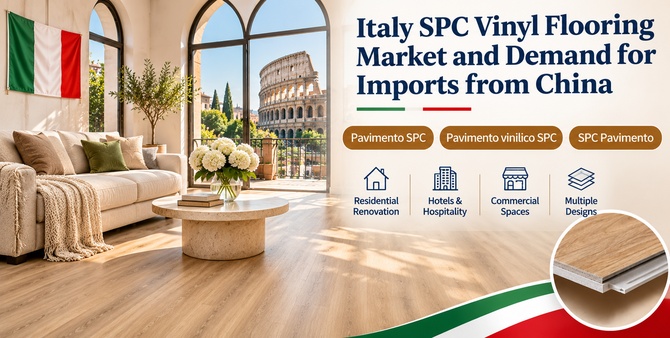
An analysis of Italian flooring trends, import demand, product preferences and opportunities for Chinese SPC flooring manufacturers.
Italy has always had a distinctive flooring market. From the porcelain tiles produced in Sassuolo to traditional oak parquet and natural marble, Italian consumers have a long-established appreciation for the quality, appearance and texture of flooring materials.
However, changing renovation requirements, installation costs and consumer lifestyles have created opportunities for alternative flooring products. SPC vinyl flooring, widely known in Italy as Pavimento SPC, has established a place in residential renovation, commercial decoration and hospitality projects.
As 2026 draws to a close, Italy presents an interesting opportunity for Chinese SPC flooring manufacturers. Import values have risen considerably, although some industry sales indicators have weakened. Understanding this difference is essential when assessing the market and preparing product collections for 2027.
The latest statistics published by the Multilayer Modular Flooring Association (MMFA) in March 2026 reveal an uneven development of the European flooring market.
In 2025, worldwide SPC flooring sales among MMFA members reached approximately 85.74 million square meters, an increase of 26.64% over the previous year. SPC accounted for around 83% of the association’s total reported flooring sales.
Italy, however, followed a different trend. Polymer flooring sales reported by MMFA members in Italy reached approximately 3.9 million square meters, declining by 5.75%. MMFA+1
Global MMFA SPC sales
+26.64% YoY
Italy MMFA polymer flooring sales
−5.75% YoY2025 sales statistics published in March 2026. Figures represent MMFA member sales rather than total market consumption.
This suggests that although SPC continues to strengthen its position internationally, Italian distributors face a more selective market. Simply introducing additional products may not generate higher sales. Design selection, product reliability, inventory management and competitive pricing are becoming particularly important.
The European Commission’s Italian construction market report, published on November 2, 2026, also indicates that construction activity is shifting from residential renovation towards public infrastructure investment. This adjustment may limit short-term growth in certain residential flooring categories. 内部市场与行业发展
International trade statistics provide a different perspective on Italy’s flooring market.
According to the World Bank’s World Integrated Trade Solution (WITS), Italy imported approximately US$379.47 million of PVC floor coverings under HS code 391810 in 2025, compared with US$218.39 million in 2024.
The reported import value increased by approximately 73.8%, while import volume rose by around 47.1%.
Annual import value, USD millions
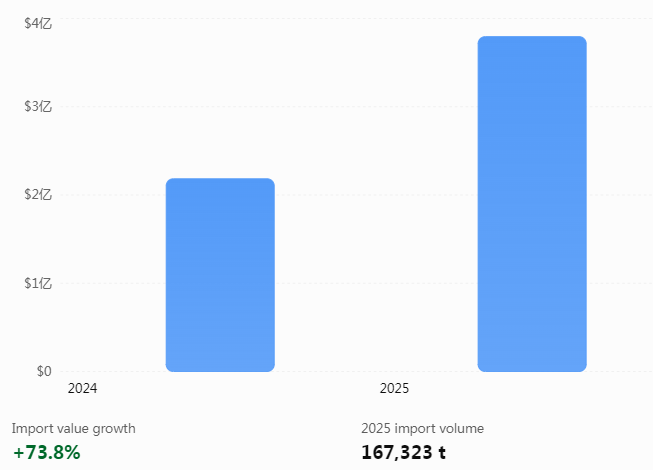
Source: World Bank WITS / UN Comtrade. HS 391810 covers a broader category of PVC floor coverings, not exclusively SPC flooring.
China remains an established supplier to Italy. Chinese export statistics show that approximately US$65.67 million worth of PVC floor coverings were exported to Italy in 2025, with a shipment volume of around 65,581 metric tons.
Compared with China’s reported exports of US$66.96 million in 2024, the export value declined slightly, while shipment weight remained relatively stable. Data+1
The comparison is particularly interesting. Italy’s overall PVC flooring imports increased substantially, but Chinese exports to Italy did not experience equivalent growth.
For Chinese manufacturers, this indicates considerable market potential but also a need to investigate competing supply channels, changing product requirements, and possible shifts in the composition of imported flooring.
One of the main advantages of SPC flooring in Italy is its suitability for renovation projects.
Many Italian homes and apartments already have ceramic or stone flooring. Removing these materials can increase renovation costs, construction waste, and installation time. Where the existing surface is sufficiently flat, dry, and stable, click-lock SPC flooring can often be installed without removing the original floor.
For consumers searching for Pavimento vinilico SPC, the appeal extends beyond installation convenience. Realistic wood textures, moisture resistance, and straightforward maintenance make these products attractive for apartments, kitchens, rental properties, and holiday accommodation.
Italian flooring brands such as Floor Italia SPC already emphasize natural-looking surfaces and adhesive-free click installation in their product offerings, reflecting the importance of both appearance and practicality in the local market. SPC FLOORING ITALY
In cities such as Milan, Rome, Florence and Turin, residential renovation represents a potential source of demand, while hotels, serviced apartments and retail premises provide further opportunities for appropriately specified commercial flooring.
Italy is a design-conscious market, making the decorative appearance of SPC flooring particularly important. Products that simply reproduce a wood pattern without convincing surface textures may struggle to compete with established European collections.
Natural oak (rovere naturale), honey oak, warm beige, walnut and light grey wood designs are worth considering for Italian-oriented collections. Marble, travertine and concrete-effect SPC tiles also offer opportunities for distributors seeking alternatives to traditional ceramic flooring.
Herringbone flooring, known locally as spina di pesce or spina italiana, deserves particular attention when developing new collections for 2027. Italian suppliers such as Italflooring already offer 7 mm herringbone SPC flooring with dimensions of 720 × 120 mm and a 0.55 mm wear layer. Barlinek’s Italian product range also includes long planks, synchronized wood textures and herringbone designs. Pavimenti al passo col futuro+1
The current Italian retail market offers considerable variation in product positioning. In November 2026, Bestlaminate Italia advertised selected 5 mm SPC flooring at €21.90 per square meter, including VAT, while selected 10 mm products were listed at €45.14 per square meter. These are individual retail examples rather than national average prices, but they illustrate opportunities across different price segments. Bestlaminate Italia+1
For Chinese manufacturers, developing economical residential collections alongside premium EIR, herringbone, chevron and large-format SPC products could provide Italian distributors with greater flexibility in 2027.
Any analysis of Italy’s SPC flooring market must consider the strength of its domestic ceramic industry.
According to figures released by Confindustria Ceramica in June 2026, Italian ceramic tile manufacturers produced approximately 390.9 million square meters in 2025, an increase of 5.7%. Domestic sales reached 85.2 million square meters, while the industry’s annual turnover exceeded €6 billion. Confindustria Ceramica
These figures demonstrate that ceramic flooring remains a powerful competitor. Porcelain tiles offer excellent durability and heat resistance, while natural parquet continues to appeal to consumers who value authentic materials.
SPC flooring should therefore be positioned as a practical alternative rather than a universal replacement. Its advantages are particularly relevant where installation speed, reduced renovation disruption, moisture resistance and overall project costs influence purchasing decisions.
Interestingly, companies connected to Italy’s traditional ceramic industry are also expanding into SPC products. The 2026 catalogue from GXG, a brand of Galileo Srl, presents SPC flooring and wall coverings specifically developed for professional distributors, contractors and designers. gxgitalia.it
This development suggests that SPC flooring is becoming a complementary product category within Italy’s established building-material distribution network.
China’s manufacturing advantage extends beyond competitive factory prices. Its developed supply chain provides access to decorative films, wear layers, surface treatments, extrusion technologies, and precision click-lock processing.
Chinese SPC flooring manufacturers are already offering customized specifications, OEM packaging, synchronized embossing, herringbone and chevron flooring, stone-effect tiles and decorative-film matching services. These capabilities correspond closely with the variety of products available in the Italian market. spcfloortech.com+2
For Italian wholesalers developing their own SPC Pavimento collections, direct factory cooperation can offer greater control over product designs, dimensions, thicknesses, wear layers and brand positioning.
However, the lowest factory price is not necessarily the most profitable purchasing decision. Poor locking strength, inconsistent colors, dimensional instability or excessive customer complaints can quickly eliminate the savings achieved during procurement.
Italian importers should also consider ocean freight, customs charges, warehouse costs, repeat-order consistency, and after-sales support when comparing suppliers.
As Italian distributors prepare their 2027 collections, technical documentation and product reliability will remain important purchasing considerations.
SPC flooring imported into Italy must comply with applicable European regulations. Depending on the product and its intended use, relevant requirements may include CE marking, a Declaration of Performance, EN 14041, REACH compliance, and appropriate testing for chemical emissions, fire performance, and slip resistance.
Compatibility with underfloor heating is another consideration, particularly for residential renovation projects. Manufacturers should provide installation instructions and verified operating limitations rather than make unrestricted performance claims.
For Italian importers, consistent raw material formulations, precise click-lock machining, and reliable quality inspection can reduce the risk of installation problems and protect the reputation of their flooring brands.
The outlook for 2027 is promising in certain product segments, although rapid market-wide growth should not be taken for granted.
The European Commission’s November 2026 construction report highlights uncertainty surrounding Italy’s residential renovation activity and the future of investment following the country’s recovery and resilience programme.
Against this background, demand for SPC flooring may increasingly come from cost-conscious renovation projects, property refurbishment, hospitality interiors and distributors looking to expand their private-label collections.
Premium wood textures, herringbone flooring, enhanced scratch resistance, easy-clean surfaces and acoustic-backed SPC products could provide opportunities for manufacturers seeking to move beyond basic price competition.
For Chinese suppliers, the challenge in 2027 will not simply be producing more flooring. It will be producing flooring that Italian distributors can sell confidently, replenish consistently, and support throughout its service life.
Italy remains an attractive European market for Chinese SPC vinyl flooring manufacturers. The latest available annual trade statistics demonstrate substantial demand for imported PVC flooring, while local product collections reveal opportunities across both economical and premium market segments.
Although competition from ceramic tiles, traditional parquet and European flooring brands remains strong, Chinese manufacturers can establish a competitive position through design customization, stable quality, competitive landed costs and professional OEM services.
As the market moves into 2027, successful cooperation between Chinese SPC flooring manufacturers and Italian importers will increasingly depend on product differentiation, technical reliability, and a shared commitment to long-term market development.