Contact Us
Lishuangdian Industrial Zone, Zhengding County, Shijiazhuang City, Hebei Province, China.
info@hsspcflooring.com
Whatsapp/Wechat: +86 15933619081

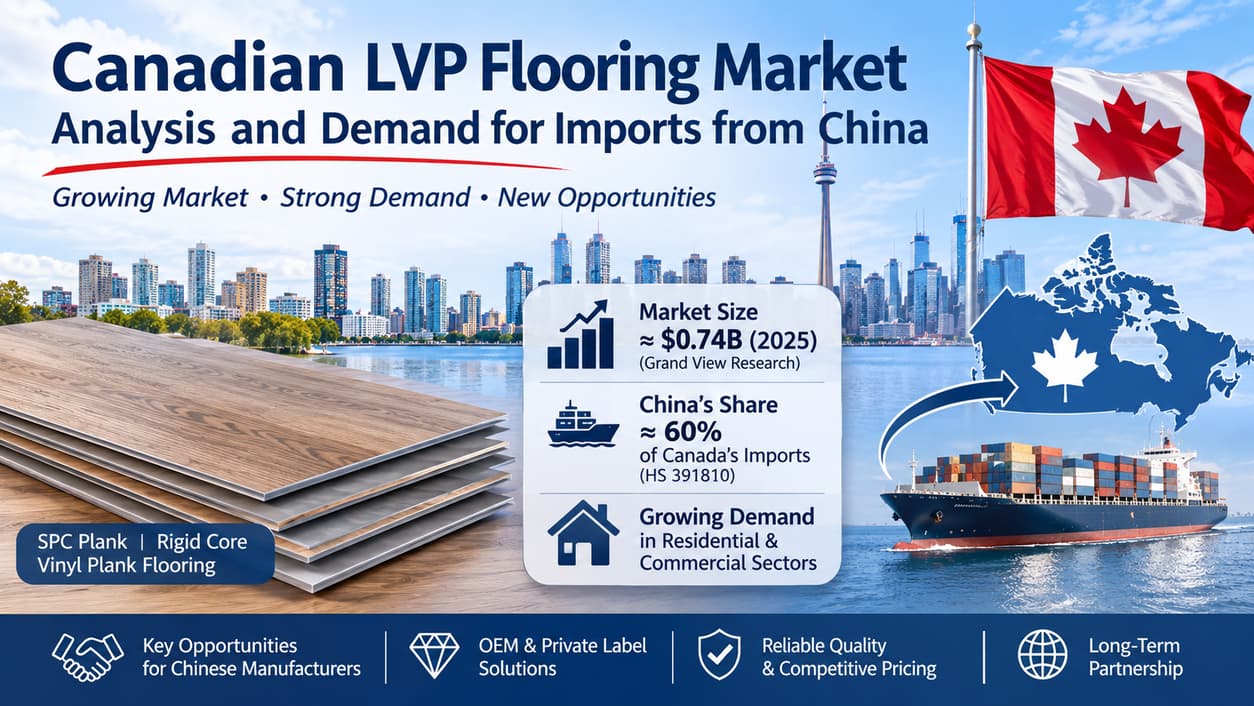
Canada has become an important market for modern resilient flooring products, particularly Luxury Vinyl Plank (LVP), Luxury Vinyl Tile (LVT), and Stone Plastic Composite (SPC) flooring. As consumers, contractors, and commercial property developers look for flooring solutions that combine attractive designs, durability, easy maintenance, and reasonable costs, vinyl flooring continues to strengthen its position in the Canadian flooring industry.
Compared with traditional hardwood, ceramic tile, and some laminate products, Vinyl Plank Flooring offers several practical advantages. It is available in realistic wood and stone designs, is relatively easy to maintain, and provides water-resistant or waterproof options depending on the product construction. These characteristics make it suitable for residential renovations, rental properties, retail spaces, offices, and various commercial applications.
For Chinese flooring manufacturers, Canada represents an established export market rather than an entirely new opportunity. China is already one of Canada’s major suppliers of vinyl floor coverings, and Canadian importers have long-established purchasing relationships with Chinese manufacturers.
However, the market is becoming more competitive. Canadian buyers are increasingly considering product performance, locking-system reliability, design quality, compliance, landed costs, and supply-chain flexibility rather than simply comparing factory prices.
This article examines the Canadian flooring market, the development of LVP and SPC products, import demand from China, competitive conditions, and the opportunities available to Chinese manufacturers and exporters.
Canada has a substantial flooring industry supported by residential construction, home renovation, commercial development, and property improvement projects.
According to Lucintel’s Canadian Flooring Market Report, the Canadian flooring market was valued at approximately USD 3.4 billion in 2024 and is forecast to reach approximately USD 4.5 billion by 2031, representing an estimated compound annual growth rate of 4.2% from 2025 to 2031.
The report identifies residential and commercial applications as the principal end-use markets. Residential demand is expected to remain particularly important, supported by single-family and multi-family housing as well as renovation and remodeling activities.
The market includes several major flooring categories:
Among these categories, resilient flooring is an important growth area because of its durability, relatively low maintenance requirements, and versatility in residential and commercial applications.
Vinyl flooring is particularly attractive to buyers who want the appearance of natural wood or stone without the same maintenance requirements or price level associated with some traditional materials.
To understand the opportunity for Chinese LVP and SPC manufacturers, it is important to distinguish the overall flooring market from the specific vinyl flooring and LVT segments.
Different market research companies use different product definitions and research methodologies, so their market estimates should not be treated as interchangeable.
According to Grand View Research, Canada’s vinyl flooring market generated approximately USD 741.7 million in revenue in 2025. The market is projected to reach approximately USD 1.10 billion by 2033, with an estimated CAGR of 5.1% from 2026 to 2033.
The report also identifies Luxury Vinyl Tiles as the largest product segment in 2025 and one of the most attractive growth segments.
MarketsandMarkets provides a more specific estimate for the Canadian LVT market. Its August 2026 report values the market at approximately USD 666.5 million in 2025 and forecasts growth to USD 784.4 million by 2030, representing a CAGR of approximately 3.31%.
The report attributes market expansion to residential renovation, commercial construction, and increasing demand for durable, cost-effective, water-resistant, and visually versatile flooring solutions.
These estimates indicate that vinyl flooring has an established commercial position in Canada. They also suggest that LVT and related rigid-core products will continue to attract attention from distributors, retailers, and flooring contractors.
It is important to note that the LVT market estimate is not a separate amount that can simply be added to the broader vinyl flooring market estimate. The two reports use different market scopes and segmentation methods.
The popularity of LVP and SPC flooring is closely related to the practical requirements of Canadian homes and commercial buildings.
Water resistance is one of the main selling points of modern vinyl flooring.
In kitchens, bathrooms, basements, laundry rooms, and other areas where occasional moisture exposure is possible, vinyl flooring can offer practical advantages over some traditional flooring materials.
SPC flooring, with its rigid mineral-based composite core, is particularly attractive to buyers looking for a dimensionally stable rigid-core product.
However, waterproof claims should be used carefully. The flooring material itself may be waterproof, but the performance of an installed floor also depends on the locking system, joints, installation quality, subfloor conditions, and perimeter details.
Canadian buyers are becoming increasingly attentive to product construction and long-term performance.
A reliable SPC Plank should offer:
These characteristics are especially important for distributors and contractors who need to minimize installation problems and customer complaints.
Modern printing and surface technologies have significantly improved the appearance of Vinyl Plank Flooring.
Canadian consumers can choose from a wide range of designs, including:
Recent Canadian flooring industry commentary also points to a shift toward warmer natural wood colors, more realistic grain patterns, and improved surface textures.
This creates opportunities for manufacturers that can regularly update their decorative film collections and offer designs suited to Canadian consumer preferences.
Click-lock SPC flooring is attractive to both professional installers and renovation customers because of its floating installation system.
Glue-down LVT also remains important, particularly in commercial applications where project specifications, subfloor conditions, and installation requirements favor adhesive installation.
A manufacturer offering both rigid-core click flooring and flexible LVT products can serve a broader range of Canadian buyers.
Residential renovation is one of the important drivers of Canadian vinyl flooring demand.
Homeowners often consider vinyl flooring when renovating:
For these buyers, appearance, durability, maintenance, installation cost, and overall value are important purchasing considerations.
SPC flooring is particularly suitable for customers looking for a rigid-core product with a wood-look design and a convenient click installation system.
Different price and performance levels can be developed for budget-conscious renovation projects and higher-end residential applications.
Commercial flooring provides another important opportunity.
Potential applications include:
Commercial buyers may place greater emphasis on wear-layer thickness, surface durability, product warranties, installation methods, maintenance requirements, and compliance documentation.
For this segment, manufacturers should avoid offering only a low-price product. A well-developed product range with clear technical specifications and reliable quality control is more attractive to professional buyers.
One of the strongest indicators of the Canadian market’s importance to Chinese manufacturers is the country’s import data.
According to World Bank WITS data based on UN Comtrade statistics, Canada imported approximately USD 545.9 million worth of vinyl chloride polymer floor coverings under HS 391810 in 2024.
China was the largest supplier, accounting for approximately USD 324.9 million, followed by:
China therefore represented approximately 59.5% of Canada’s imports under this HS 6-digit category in 2024.
This is a significant indication of the strength of China’s position in the Canadian vinyl flooring supply chain.
The Canadian government’s Canadian Importers Database provides another useful perspective. Its 2024 data records approximately CAD 781.5 million in total imports under HS 391810, with China accounting for approximately CAD 473.4 million.
The two datasets use different reporting currencies and statistical presentations, but both show that China is a major source of Canadian vinyl flooring imports.
There is an important classification limitation: HS 391810 covers floor coverings made from polymers of vinyl chloride and is not restricted to SPC or LVP alone. It may include other PVC flooring products. Therefore, these figures should be used as an indicator of the broader PVC flooring import market, not as an exact measurement of Chinese SPC flooring imports.
Nevertheless, the data demonstrates that Canadian buyers are already familiar with sourcing vinyl flooring from China.
For Chinese manufacturers, this reduces the need to explain the basic concept of China-made vinyl flooring. The greater challenge is to identify the right Canadian buyers and demonstrate why a particular factory can offer better value, more consistent quality, or a more suitable product range.
China has developed a comprehensive flooring manufacturing and export supply chain.
Its advantages extend beyond production costs and include raw-material sourcing, decorative film development, click-system production, surface treatment, packaging, and international logistics.
Chinese manufacturers have extensive experience producing different types of vinyl flooring, including:
This product diversity allows Canadian importers to work with one manufacturing partner for different market segments.
For importers, wholesalers, and distributors, factory-direct sourcing can provide better control over purchasing costs.
Working directly with a manufacturer may help buyers:
However, the lowest factory price does not necessarily produce the lowest landed cost. Product quality, shipping, customs duties, inventory costs, and after-sales expenses must all be considered.
Private-label products are important for distributors and flooring retailers that want to establish their own brands.
Chinese manufacturers can support this business model through customized:
For Canadian buyers, this flexibility makes it possible to develop products that are different from standard catalog offerings.
A professional factory can help buyers develop different product ranges according to local market requirements.
For example, a distributor may need an entry-level SPC product for price-sensitive customers, a thicker rigid-core product for a premium collection, and a herringbone design for a more specialized market.
Manufacturers that can provide these options while maintaining stable production quality have a stronger opportunity to build long-term partnerships.
Although China remains a major source of vinyl flooring imports, Canadian buyers have several sourcing options.
These include:
One important development is the expansion of domestic SPC production.
In August 2025, Floor Covering News reported that Triforest Floors had opened an SPC manufacturing facility in Ajax, Ontario. The company, which originated as a Chinese flooring manufacturer, established Canadian production capacity to serve North American customers.
According to the report, the new facility was designed to produce approximately 70 containers per month, equivalent to around 21 million square feet annually.
The company highlighted several advantages of local manufacturing, including shorter delivery times, reduced dependence on ocean transportation, and faster responses to customer service issues.
This development shows that Canadian SPC buyers have an increasingly relevant domestic sourcing option.
Local production does not necessarily eliminate demand for imported products. However, it creates stronger competition in areas such as delivery speed, inventory availability, and logistics flexibility.
For Chinese exporters, the most effective approach is not to compete with Canadian factories on every point. Instead, they should emphasize manufacturing scale, product variety, OEM flexibility, factory-direct pricing, and the ability to develop customized products.
A Chinese factory that offers reliable production and a competitive landed cost can still be attractive to distributors, particularly those that do not manufacture their own flooring.
The Canadian vinyl flooring market includes several types of buyers.
Understanding their business models is essential when developing new customers.
These companies purchase products in larger quantities and distribute them to local flooring retailers, contractors, and dealers.
They are important targets for Chinese SPC manufacturers because they may require regular container shipments, private-label products, and customized collections.
Independent flooring stores are active in residential renovation and local project markets.
Some purchase from Canadian distributors, while others may import directly when their purchasing volumes justify it.
For smaller retailers, manufacturers may need to work through a local importer or offer a suitable mixed-product purchasing arrangement.
Building material wholesalers may sell several product categories, including flooring, wall panels, decorative materials, and accessories.
They can be potential buyers for manufacturers offering a broader product range.
Contractors and project suppliers may purchase flooring for residential developments, hotels, commercial renovations, and property management projects.
Their requirements are often more specification-driven than those of retail buyers.
They may request technical data sheets, installation instructions, test reports, product samples, and project-specific quotations.
Canadian flooring brands that outsource manufacturing are another valuable customer group.
These companies may already have established sales channels but rely on overseas manufacturers for production.
For Chinese factories, this can provide a more stable long-term business opportunity than competing for occasional spot orders.
Canada is a geographically large market, and demand is not evenly distributed.
A regional approach can help manufacturers identify more suitable buyers.
Ontario is one of the most important target regions because of its large population, major metropolitan areas, residential renovation activity, and established flooring distribution networks.
Toronto, Mississauga, Markham, Brampton, Ottawa, and surrounding areas are worth considering when searching for importers, wholesalers, and flooring distributors.
Quebec has a substantial residential and commercial construction market.
Montreal and Quebec City are important areas for flooring distributors and building-material suppliers.
French-language product information and marketing materials can be useful when developing customers in this province.
Vancouver and surrounding areas have established residential renovation, property development, and flooring distribution markets.
Importers may also serve customers across Western Canada.
Product appearance, quality, moisture-related performance, and installation suitability are relevant selling points.
Calgary and Edmonton are important markets for residential construction, commercial development, and renovation.
Manufacturers can approach regional flooring wholesalers, building material distributors, and project suppliers.
Manitoba, Saskatchewan, Nova Scotia, New Brunswick, and other provinces also have flooring demand.
Although individual markets may be smaller, regional distributors can provide opportunities for manufacturers willing to develop long-term business relationships.
Canadian buyers do not all purchase the same type of SPC or LVT flooring.
Product specifications should be selected according to the intended market position and application.
For SPC flooring, important factors include:
| Product feature | Purchasing considerations |
|---|---|
| Total thickness | Common options include 4mm, 5mm, 6mm, and thicker products |
| Wear layer | Often selected according to residential or commercial application |
| Attached underlay | IXPE or EVA options |
| Core construction | Consistency, density, and dimensional stability |
| Locking system | Reliable click connection and installation performance |
| Surface finish | EIR, embossed, matte, and other textures |
| Design | Natural oak, warm wood tones, stone, and herringbone |
| Accessories | Matching skirting, profiles, and installation accessories |
For LVT, buyers may also require dry-back, click, loose-lay, and self-adhesive products.
A manufacturer should not assume that one specification fits every Canadian customer. It is better to understand the buyer’s target retail price, preferred installation method, end-user segment, and existing product collection before preparing a quotation.
Quality documentation is becoming increasingly important in international flooring procurement.
Canadian importers may request technical information and independent test reports to support their product selection and local distribution.
Depending on the product and application, relevant considerations may include:
Manufacturers should also understand the difference between general product certificates and certificates required by a specific Canadian building code, project specification, or customer.
For example, FloorScore or similar indoor-air-quality certifications may be requested by buyers, while other projects may require additional testing.
Environmental responsibility is another consideration. Buyers may ask about raw materials, recycled content, production controls, packaging, and product disposal.
Manufacturers should provide accurate documentation rather than making broad claims that a product is completely environmentally harmless or suitable for every building application.
Import duties are an important part of the purchasing decision for Canadian buyers.
Under Canada’s 2026 Customs Tariff, products classified under HS 3918.10.90, covering other floor coverings of polymers of vinyl chloride, have a general Most-Favoured-Nation (MFN) customs duty rate of 6.5%.
The actual tariff treatment depends on the correct tariff classification and the country of origin.
For Chinese-origin products, importers should verify the applicable MFN rate and any additional measures in force at the time of importation.
It is also important not to confuse Canada’s tariffs on Chinese imports with Canadian retaliatory measures against U.S.-origin products. These are different trade-policy measures and do not automatically apply to Chinese SPC flooring.
Before placing an order, Canadian importers should confirm:
For a Chinese SPC flooring manufacturer, the quotation should clearly identify whether the price is FOB, CFR, CIF, or another agreed trade term.
A transparent quotation helps the Canadian buyer calculate the actual landed cost and compare suppliers more accurately.
Shipping from China to Canada requires careful planning.
The main import gateways include Vancouver on the west coast and major eastern Canadian logistics routes serving Toronto, Montreal, and other inland markets.
The most suitable route depends on the buyer’s warehouse location, shipping schedule, freight rate, and final delivery requirements.
Ocean freight is generally suitable for container-volume flooring shipments, but buyers should consider more than the ocean freight quotation.
Other cost and planning factors include:
For Chinese manufacturers, stable production scheduling and accurate shipment documentation are essential.
A reliable supplier should be able to coordinate production, packaging, container loading, inspection, and shipping documents in a professional manner.
Canadian buyers may also prefer suppliers who can support repeat orders and maintain consistent product specifications over time.
Despite China’s strong position in the Canadian vinyl flooring import market, exporters face several challenges.
The expansion of Canadian SPC production gives buyers another sourcing option.
Local factories may have advantages in delivery speed, inventory availability, and customer service.
Chinese manufacturers need to offer competitive product value and reliable supply rather than relying only on low production costs.
The Canadian market includes products at different price levels.
Some buyers focus heavily on purchasing costs, while others prioritize quality, design, and long-term performance.
Manufacturers should avoid competing exclusively on the lowest price because this can reduce margins and create quality risks.
Flooring defects can result in expensive claims, especially after installation.
Issues such as locking-system failure, dimensional instability, surface damage, and inconsistent production quality can affect a supplier’s reputation.
A professional manufacturer should maintain clear quality-control procedures, inspect products before shipment, and provide appropriate technical support.
Compared with domestic Canadian suppliers, Chinese factories require longer production and shipping lead times.
Importers must plan inventory more carefully and maintain sufficient stock for regular sales.
Manufacturers can improve their competitiveness by providing realistic lead times, stable production capacity, and reliable communication.
Despite these challenges, Canada remains an attractive market for Chinese flooring manufacturers.
The country’s established vinyl flooring demand, substantial import activity, and existing relationships with Chinese suppliers provide a solid foundation for future business.
Several opportunities deserve particular attention.
Rather than focusing exclusively on entry-level products, manufacturers can develop higher-value SPC collections featuring:
These products can help Canadian distributors differentiate their collections and target customers seeking higher-quality flooring.
Canadian distributors and retailers may want to build their own flooring brands without investing in manufacturing facilities.
Chinese factories can support these customers through customized specifications, packaging, product development, and stable bulk supply.
This business model can create longer-term cooperation and more predictable order volumes.
A manufacturer capable of producing SPC and different LVT constructions can serve a wider range of customers.
For example, one distributor may need SPC click flooring for residential sales, dry-back LVT for commercial projects, and herringbone designs for premium retail collections.
A broader product portfolio can help manufacturers increase their value to Canadian importers.
Instead of approaching only the largest national flooring companies, Chinese exporters should also consider medium-sized importers, independent distributors, and regional wholesalers.
These buyers may be more flexible when evaluating new suppliers and private-label opportunities.
A focused approach to Ontario, Quebec, British Columbia, and Alberta can help manufacturers build a practical customer-development strategy.
The Canadian LVP and SPC flooring market is supported by several long-term factors:
At the same time, competition from Canadian manufacturers and other international suppliers will continue to influence purchasing decisions.
The future market is unlikely to be determined by price alone.
Buyers will increasingly evaluate product performance, design, technical documentation, delivery reliability, and total landed costs.
For Chinese exporters, this means that the most promising opportunities will come from building stronger relationships with qualified importers and distributors, offering products that meet specific market requirements, and maintaining consistent manufacturing standards.
Canada is an established and attractive market for LVP, LVT, SPC, and other Vinyl Plank Flooring products.
Market research from Lucintel, Grand View Research, and MarketsandMarkets indicates continued opportunities in the broader Canadian flooring and vinyl flooring sectors. Meanwhile, international trade statistics show that China already plays a major role in supplying Canadian vinyl flooring imports.
However, the market is evolving. Canadian domestic SPC manufacturing is developing, buyers have more sourcing options, and competition is becoming increasingly focused on product quality, delivery efficiency, and overall value.
For Chinese SPC flooring manufacturers, Canada should not be viewed simply as a market for low-cost exports. It is a market where reliable manufacturing, product differentiation, OEM services, and long-term cooperation can create sustainable business opportunities.
Manufacturers that combine competitive factory-direct pricing with consistent quality, flexible product development, and dependable international supply will be better positioned to establish lasting relationships with Canadian importers, wholesalers, flooring distributors, and private-label brands.