Contact Us
Lishuangdian Industrial Zone, Zhengding County, Shijiazhuang City, Hebei Province, China.
info@hsspcflooring.com
Whatsapp/Wechat: +86 15933619081

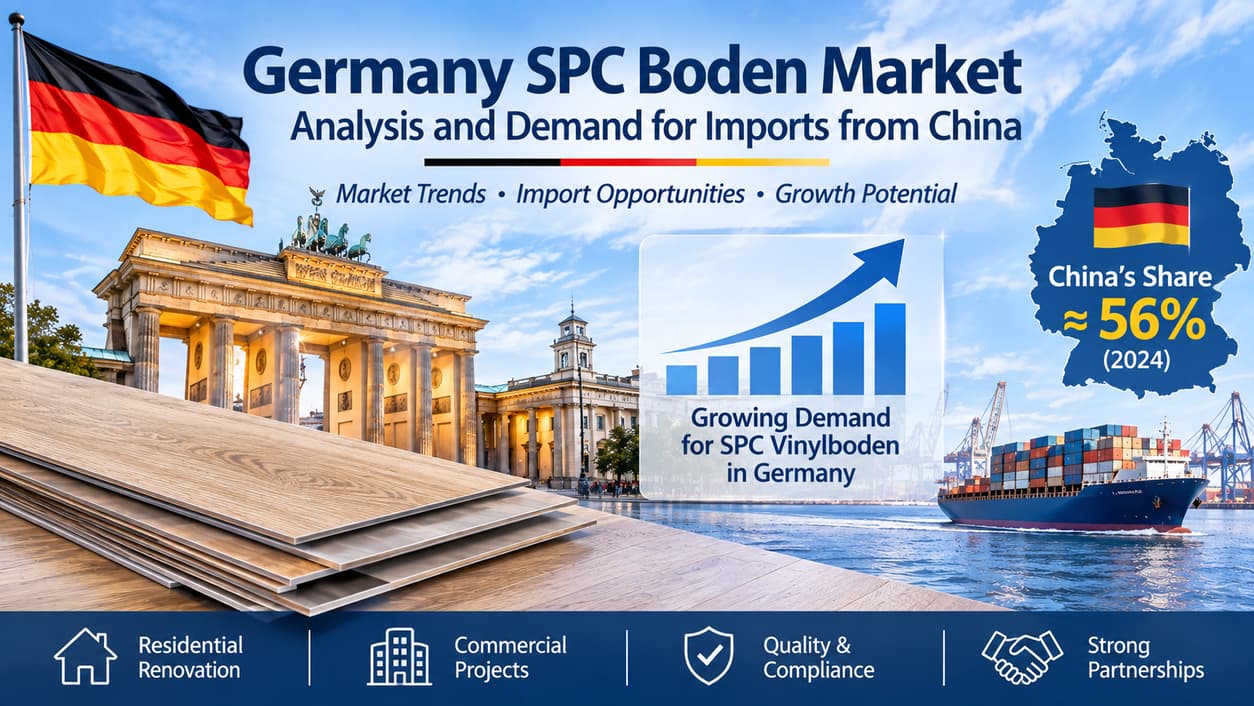
Germany is one of Europe’s most important flooring markets, with an established distribution network, demanding professional buyers, and a strong tradition of quality-oriented product selection. Alongside traditional parquet, laminate, ceramic tiles, and flexible vinyl flooring, SPC (Stone Plastic Composite) flooring has become an increasingly important product category.
Known in Germany as SPC Vinylboden, SPC-Klickvinyl, or Rigid Core Vinylboden, this type of flooring combines a rigid mineral-based core with a decorative surface layer and a click-lock installation system. It offers an alternative for buyers who want the appearance of natural wood or stone with convenient installation and practical everyday performance.
For Chinese SPC flooring manufacturers, Germany is an important market for several reasons. It has a mature flooring distribution industry, established demand for imported PVC flooring, and a large network of wholesalers, retailers, online flooring businesses, and project suppliers.
China is already a major supplier of vinyl flooring to Germany. However, the market is not simply a matter of offering low factory prices. German buyers place considerable importance on product consistency, technical documentation, environmental requirements, surface quality, installation performance, and reliable delivery.
This article examines the German flooring market, the development of SPC and LVT products, import demand from China, purchasing preferences, competition, regulatory considerations, and business opportunities for Chinese flooring manufacturers.
Germany has one of Europe’s largest flooring markets, supported by residential renovation, commercial property improvement, housing maintenance, and new construction.
The market includes several major product categories:
German buyers have traditionally been familiar with laminate and engineered wood flooring. These products remain important, but vinyl flooring has developed a stronger position because it offers a broad range of designs, practical maintenance, and different installation systems.
The market is also influenced by Germany’s relatively high standards for building materials and indoor environments. Buyers increasingly consider not only appearance and price, but also product emissions, technical documentation, durability, and suitability for the intended installation.
For SPC manufacturers, Germany should therefore be viewed as a quality-conscious market where product performance and supplier reliability are essential parts of the purchasing decision.
One of the most useful sources for understanding the European SPC market is the Multilayer Modular Flooring Association (MMFA), which publishes sales statistics from its member companies.
According to the MMFA’s 2025 statistics, sales of polymer-based flooring products among its members reached approximately 95.5 million m² worldwide, representing growth of 16.36% compared with 2024.
SPC was the main growth driver:
The figures indicate a continuing shift toward rigid-core products within the MMFA’s reported product categories.
Germany also recorded positive development. MMFA members’ polymer flooring sales in Germany reached approximately 13.2 million m² in 2025, an increase of 4.20% compared with 2024.
It is important to understand that the 13.2 million m² figure covers the association’s reported polymer flooring categories, not SPC alone and not the entire German flooring market. Likewise, the global SPC figures represent MMFA member sales rather than all manufacturers worldwide.
Nevertheless, the statistics provide useful evidence that Germany remains a substantial market for polymer-based flooring and that SPC continues to gain importance within the broader industry.
For Chinese manufacturers, this is an encouraging signal. German distributors are operating in a market where rigid-core flooring is already an established product category rather than a completely unfamiliar innovation.
SPC flooring offers several characteristics that make it attractive for German residential and commercial applications.
One of the most recognizable advantages of SPC flooring is its resistance to water.
The rigid SPC core is made primarily from mineral filler and PVC, rather than a moisture-sensitive wood-fiber core. This makes it suitable for many areas where occasional moisture exposure is expected, such as kitchens, entrance areas, and certain residential renovation spaces.
However, the waterproof properties of the core should not be confused with the performance of an entire installed floor. Joints, perimeter details, installation quality, and subfloor conditions remain important.
German buyers are likely to appreciate clear and accurate product information rather than exaggerated claims about unlimited waterproof performance.
The rigid core is one of the main differences between SPC and traditional flexible LVT.
A properly manufactured SPC product can provide good dimensional stability under normal indoor conditions. This is important for distributors and installers who want consistent product dimensions and reliable locking connections.
Manufacturers should pay particular attention to:
These factors have a direct influence on installation performance and the long-term satisfaction of end users.
SPC-Klickvinyl is attractive because it can generally be installed as a floating floor without full-surface adhesive application.
This can be useful in residential renovation and certain commercial applications where a click installation system is suitable.
For German distributors, a reliable locking system is particularly important. Poorly manufactured click profiles can lead to installation difficulties, damaged joints, gaps, and customer complaints.
Manufacturers should therefore provide samples that allow buyers and installers to evaluate the locking connection before confirming larger orders.
German consumers have access to a wide range of flooring designs, and appearance remains an important purchasing factor.
Popular design directions for SPC Vinylboden include:
Longer and wider plank formats can also help distributors develop more premium-looking collections.
For Chinese manufacturers, the ability to develop attractive decorative films, realistic surface textures, and coordinated collections can create a competitive advantage.
SPC does not replace every other flooring category. Instead, it offers another product option for buyers with different installation and performance requirements.
| Product category | Main characteristics | Typical positioning |
|---|---|---|
| SPC Vinylboden | Rigid mineral-based core, click installation, water-resistant construction | Residential renovation and selected commercial applications |
| Flexible LVT Click | Flexible vinyl construction with click installation | Residential and selected commercial applications |
| Dry-back LVT | Flexible vinyl flooring installed with adhesive | Commercial projects and professional installation |
| Laminate Flooring | Decorative surface over a wood-based core | Residential and general interior applications |
| Engineered Wood | Real wood surface with a multi-layer construction | Natural-material and premium flooring segments |
SPC’s development is particularly interesting when compared with flexible LVT click products.
MMFA statistics show that member sales of flexible LVT click declined to approximately 4.94 million m² in 2025, a decrease of around 45.98% compared with 2024. By contrast, rigid SPC sales increased substantially.
This suggests a shift in the association’s reported click-flooring product mix toward rigid-core products.
However, it would be inaccurate to conclude that all LVT is disappearing. Flexible LVT includes dry-back products and other constructions that serve different installation requirements and commercial applications.
For Chinese manufacturers, offering both SPC and flexible LVT can therefore be a practical way to serve a wider range of German customers.
Germany’s import statistics provide one of the clearest indicators of the opportunity for Chinese flooring manufacturers.
According to World Bank WITS data based on UN Comtrade statistics, Germany imported approximately USD 679.75 million worth of floor coverings made from polymers of vinyl chloride under HS 391810 in 2024.
China was the largest individual supplier.
| Supplier country | Germany’s imports in 2024 |
|---|---|
| China | Approximately USD 380.77 million |
| Belgium | Approximately USD 86.81 million |
| France | Approximately USD 35.51 million |
| Netherlands | Approximately USD 34.31 million |
| Luxembourg | Approximately USD 28.32 million |
| Total imports | Approximately USD 679.75 million |
China accounted for approximately 56% of Germany’s imports under this HS 6-digit category.
This is a significant result. It demonstrates that Chinese manufacturers already have a strong position in Germany’s imported PVC flooring supply chain.
However, HS 391810 is a broad customs category covering floor coverings of polymers of vinyl chloride. It is not an SPC-only classification and may include different PVC flooring constructions.
Therefore, the figures should not be described as the exact value of German SPC imports from China.
Even with this limitation, the data clearly demonstrates the scale of Germany’s existing trade relationship with Chinese vinyl flooring suppliers.
For Chinese SPC flooring factories, the challenge is not simply to introduce Chinese products to the market. It is to identify suitable buyers, offer products that meet German expectations, and build reliable long-term supply relationships.
China has developed a comprehensive manufacturing and export supply chain for SPC and LVT flooring.
Its advantages include manufacturing capacity, raw-material sourcing, decorative film development, click-system production, surface treatment, packaging, and international shipping experience.
Chinese factories can produce a wide range of flooring specifications and constructions.
These include:
This range allows German importers to work with manufacturers capable of supporting multiple product collections.
For German wholesalers, importers, and private-label brands, buying directly from a manufacturer can provide better control over product specifications and purchasing costs.
Factory-direct cooperation may offer:
However, German buyers should evaluate the complete landed cost rather than factory price alone.
Germany has an established network of flooring brands, wholesalers, and distributors.
Some companies operate their own brands and outsource production to overseas factories.
This creates opportunities for Chinese manufacturers offering OEM and private-label services.
Typical requirements may include:
A factory that can support both product development and stable manufacturing is more likely to become a long-term supplier.
Different German buyers serve different customer groups.
A discount-oriented retailer may focus on competitive entry-level SPC products, while a specialist flooring distributor may require premium EIR surfaces, wider planks, herringbone patterns, or thicker constructions.
Manufacturers that can develop several product levels without sacrificing quality have a better opportunity to serve these different channels.
Germany is a quality-conscious market. Buyers generally expect suppliers to provide clear specifications, consistent products, and professional documentation.
Common SPC product configurations may include 4mm, 5mm, and 6mm constructions, with different wear-layer options.
The correct specification depends on the intended application and price positioning.
For example:
Manufacturers should avoid assuming that a thicker product is automatically better. The complete construction and actual performance are more important than thickness alone.
The click-lock system is a key part of SPC flooring performance.
German importers and installers may pay close attention to:
A professional supplier should be able to provide product samples and technical information to support evaluation.
Underfloor heating is an important consideration in the German flooring market.
However, SPC flooring should not automatically be described as suitable for every underfloor heating system.
Buyers should check the manufacturer’s technical instructions, maximum permitted surface temperature, installation method, and thermal-resistance information.
The complete floor construction, including any attached underlay, must also be considered.
Clear technical guidance can help German distributors reduce installation problems and build confidence in the product.
Sound insulation and impact sound reduction are relevant in multi-family housing and apartment buildings.
An attached IXPE or EVA underlay may improve certain acoustic properties, but the actual result depends on the complete floor assembly and the test method.
German buyers may request acoustic test reports or other technical evidence when supplying products for specific projects.
Manufacturers should provide verified test results rather than relying only on general marketing claims.
Environmental performance and product documentation are important considerations when exporting SPC flooring to Germany.
Germany operates within the wider European Union regulatory framework. Importers and manufacturers should understand the applicable requirements before placing products on the market.
Important areas include:
Products placed on the European market must comply with applicable chemical legislation, including REACH requirements.
Buyers may request information about plasticizers, restricted substances, heavy metals, and other relevant chemical components.
Manufacturers should maintain reliable raw-material records and obtain suitable test reports from qualified laboratories.
Indoor air quality is an important concern in Germany.
Depending on the intended application and customer requirements, buyers may request VOC emission testing and supporting documentation.
Manufacturers should be prepared to provide relevant reports and explain the testing methods and product scope.
Flooring products may fall within applicable European construction-product requirements.
The relevant product standard, harmonized technical specification, and conformity assessment requirements must be checked for the exact product construction and intended use.
Manufacturers should not assume that every SPC product has identical CE marking or declaration requirements.
German importers should confirm the documentation required for the particular flooring product and its application.
German buyers are increasingly interested in environmental responsibility and transparent sourcing.
Potential areas of discussion include:
SPC manufacturers should provide accurate and verifiable environmental information. Claims such as completely recyclable, entirely eco-friendly, or zero emissions should not be made without appropriate supporting evidence.
For manufacturers seeking to develop premium German customers, environmental documentation can become an important part of supplier evaluation.
Import costs are an important part of the purchasing decision for German buyers.
Germany is part of the European Union Customs Union, so imports from China are subject to the applicable EU Common Customs Tariff.
For products classified under the relevant PVC flooring tariff category, HS/CN 3918 10, the standard third-country customs duty shown in the EU tariff information is 6.5%.
The exact classification must be checked against the product’s construction and the current TARIC requirements.
Importers should also consider Germany’s standard import VAT rate of 19%.
For VAT-registered businesses, import VAT is generally recoverable subject to the applicable tax rules and accounting requirements. It is therefore important to distinguish between customs duty, which is normally a cost, and import VAT, which may be recoverable.
A complete landed-cost calculation should include:
German importers should confirm the correct customs classification and current tariff measures with their customs broker before ordering.
For Chinese manufacturers, quotations should clearly identify the agreed Incoterm, such as FOB, CFR, or CIF, so that the buyer can calculate the actual landed cost.
China and Germany have established shipping connections, making containerized flooring shipments a practical option for importers.
Hamburg and Bremerhaven are important German seaports for international container traffic. Depending on the buyer’s location, other European ports may also be considered as part of the overall logistics plan.
For German distributors, the key logistics considerations include:
Flooring is a relatively bulky product, so container loading efficiency and packaging dimensions can have a meaningful effect on landed cost.
Manufacturers should provide accurate carton dimensions, pallet details, loading quantities, and shipping documents.
Reliable production scheduling is equally important. A competitive quotation is of limited value if the supplier cannot maintain the agreed production and shipment schedule.
For repeat business, stable specifications and consistent packaging can help importers manage inventory and avoid unnecessary product variation.
Chinese manufacturers are not the only suppliers serving German buyers.
The competitive landscape includes several groups.
Established German and European flooring companies have advantages in brand recognition, local distribution, product availability, and customer service.
They may also have established relationships with retailers, installers, architects, and project developers.
Chinese manufacturers competing with these brands should focus on manufacturing value, product flexibility, and OEM opportunities.
Some European companies source products from overseas factories and distribute them through local sales networks.
They may compete through warehouse availability, product selection, and established customer relationships.
Chinese manufacturers can work with these companies as OEM suppliers or direct manufacturing partners.
China has a large number of SPC flooring manufacturers with different production capacities and quality levels.
For German buyers, the challenge is identifying factories that can maintain consistent product specifications, provide reliable documentation, and handle repeat orders professionally.
Manufacturers should therefore compete through verifiable product quality and service rather than making unsupported claims about being the largest or cheapest supplier.
Germany also imports vinyl flooring from other European and international suppliers.
The 2024 trade statistics show Belgium, France, the Netherlands, and Luxembourg among its important supplier countries.
Some of these trade flows may reflect intra-European distribution and re-export activity rather than direct manufacturing origins.
This means that competition should be assessed not only by the country shown in import statistics but also by the actual production origin, distribution structure, and final landed cost.
Chinese manufacturers should identify customers according to their business model and purchasing requirements.
These companies are among the most attractive targets for direct factory cooperation.
They may purchase full containers, maintain warehouses, and supply flooring retailers, contractors, and regional dealers.
Their purchasing priorities often include competitive prices, stable quality, repeat-order capability, and a suitable product portfolio.
Retail chains may have established product collections and private-label programs.
They often require detailed technical documents, packaging specifications, product testing, and reliable supply arrangements.
Entering this channel may take longer, but successful cooperation can lead to regular purchasing volumes.
Independent flooring stores serve local residential and renovation customers.
Some buy from domestic wholesalers, while larger businesses may consider direct imports or private-label arrangements.
Chinese factories may approach them with specialized collections, but the order volume and purchasing model should be evaluated carefully.
Online flooring businesses are another potential customer group.
They often require attractive product photography, detailed specifications, accurate packaging information, installation instructions, and reliable stock availability.
Manufacturers that can provide high-quality digital product materials may be more attractive to these businesses.
Project-based customers may require SPC flooring for apartments, offices, hotels, retail spaces, and renovation projects.
They are generally more specification-driven and may request test reports, samples, installation instructions, and project-specific quotations.
For this segment, technical support and product consistency are particularly important.
Germany is a large market with different regional distribution networks and customer structures.
For Chinese exporters, the following regions are worth considering when searching for importers and flooring distributors.
Hamburg and surrounding areas are important logistics and trading locations.
Companies based in this region may have experience importing flooring and distributing products to other parts of Germany.
Cities such as Düsseldorf, Cologne, Dortmund, and Essen are located in one of Germany’s major population and commercial regions.
The area is worth targeting for flooring wholesalers, building-material distributors, and renovation-related businesses.
Munich, Nuremberg, and other Bavarian cities have established construction, property, and interior-material markets.
Distributors serving this region may be interested in premium wood-look SPC collections and decorative flooring options.
Stuttgart and surrounding areas are important business and industrial centers.
Flooring distributors, interior-material suppliers, and project-related businesses are potential customer groups.
Berlin has a large residential renovation and rental-property market.
Regional wholesalers and online flooring retailers may be suitable prospects for SPC click products and other vinyl flooring constructions.
For initial customer development, manufacturers can prioritize importers and wholesalers in major logistics and commercial centers before expanding into smaller regional markets.
Although China has a strong position in Germany’s PVC flooring imports, entering and maintaining business in this market requires careful preparation.
German buyers may pay close attention to product dimensions, surface appearance, locking performance, and production consistency.
A factory must be able to maintain the same specification from samples to bulk production.
Importers may request chemical test reports, VOC information, technical data sheets, installation instructions, and relevant conformity documentation.
Manufacturers should prepare these materials before approaching larger distributors.
German buyers can compare products from European brands, Chinese factories, and other international suppliers.
A supplier needs a clear market position rather than simply offering a low price.
Direct shipments from China require more planning than purchasing from a local warehouse.
Importers need realistic production schedules, accurate shipping information, and sufficient inventory planning.
Flooring complaints can involve product defects, subfloor conditions, installation methods, and environmental factors.
A reliable supplier should have a clear process for investigating quality issues and providing technical assistance.
German-language product instructions and technical support materials can also improve cooperation with local distributors and installers.
Despite the competitive environment, Germany remains an attractive market for Chinese manufacturers with suitable products and professional export capabilities.
Manufacturers can develop products that offer more than basic price competition.
Potential product directions include:
The objective should be to develop collections that help German distributors differentiate their products and serve different customer groups.
Private-label production is a practical opportunity for Chinese manufacturers.
German wholesalers and retailers may already have sales channels but need a reliable overseas manufacturing partner.
A factory that can provide customized products, packaging, technical information, and repeat-order consistency can become a valuable long-term supplier.
SPC is gaining importance, but flexible LVT continues to serve applications that require different installation systems.
Manufacturers with both SPC and LVT capabilities can offer a broader product portfolio.
This can be attractive to distributors who want to source click flooring, dry-back LVT, and other vinyl flooring products from one manufacturing partner.
Quality assurance should be a central part of the supplier’s sales proposition.
Manufacturers can support buyers through:
For German buyers, documented quality control can be more convincing than general claims about factory strength.
The most sustainable opportunity is to build relationships with importers and distributors that have established local sales channels.
Instead of focusing only on one-time orders, manufacturers should understand each buyer’s market positioning, target specifications, and expected annual purchasing volume.
This approach can help create repeat business and more predictable production planning.
The German SPC flooring market is supported by several factors:
At the same time, the market faces challenges.
Germany’s new residential construction activity has weakened in recent years. Destatis data shows that completed dwellings fell to approximately 206,586 in 2025, compared with 251,937 in 2024.
This suggests that manufacturers should not rely exclusively on new construction as a source of flooring demand.
Renovation, replacement, property maintenance, and commercial refurbishment remain important areas to explore, although demand in these segments also depends on economic conditions and consumer confidence.
MMFA’s 2025 statistics provide a more encouraging signal for polymer flooring. Its members recorded 4.2% growth in German polymer flooring sales, while SPC continued to expand strongly in the global member product mix.
For Chinese manufacturers, the most realistic outlook is therefore one of opportunity combined with strong competition.
Success will depend on matching products to customer requirements, maintaining reliable quality, and offering competitive landed costs.
Germany is one of Europe’s important markets for SPC Vinylboden and other vinyl flooring products.
MMFA statistics show that German polymer flooring sales among its members reached approximately 13.2 million m² in 2025, while SPC continued to gain importance within the association’s global product mix.
International trade data also demonstrates that China is already Germany’s largest supplier under the broad HS 391810 PVC flooring category, accounting for approximately 56% of the country’s imports in 2024.
These figures provide a strong foundation for Chinese SPC flooring manufacturers seeking to develop business in Germany.
However, Germany is not a market where price alone determines purchasing decisions. Buyers expect consistent quality, reliable click systems, appropriate technical documentation, environmental compliance, and professional supply arrangements.
For Chinese manufacturers, the most promising strategy is to combine factory-direct pricing with product differentiation, OEM services, strict quality control, and dependable delivery.
Companies that understand the requirements of German importers and distributors will be better positioned to build long-term partnerships and develop sustainable business in the German SPC flooring market.