Contact Us
Lishuangdian Industrial Zone, Zhengding County, Shijiazhuang City, Hebei Province, China.
info@hsspcflooring.com
Whatsapp/Wechat: +86 15933619081

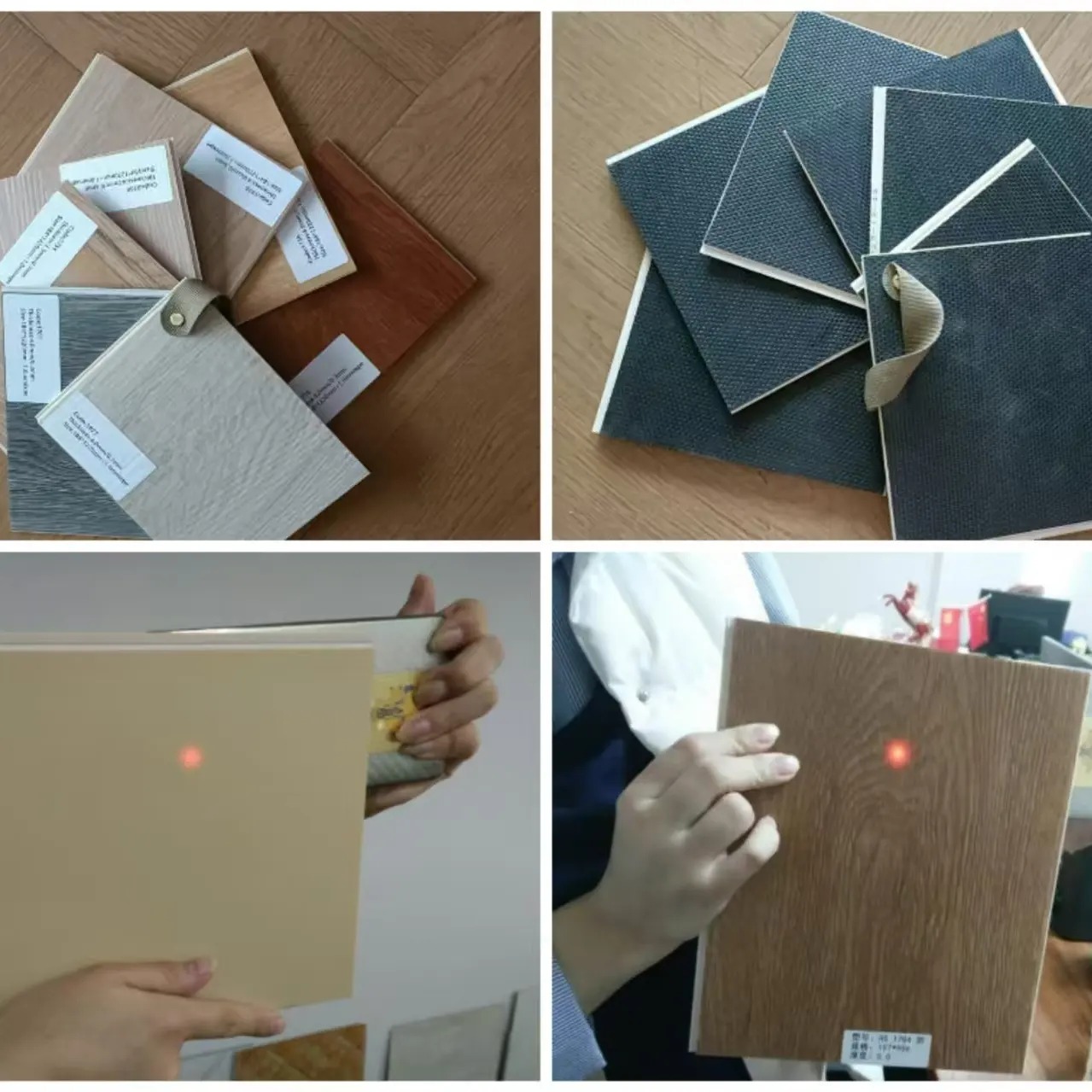
SPC Flooring has changed quite a lot in the last few years.
When rigid-core flooring first became popular, the conversation was relatively simple: waterproof, durable, easy to install and competitively priced.
Those advantages are still important. But for manufacturers, importers, distributors and flooring brands, they are no longer enough on their own.
Today, buyers are looking at the complete product — not just the plank.
They want to know what is inside the SPC core, how stable the product is from one production run to another, whether the click system performs properly, whether the wear layer matches the intended application, how realistic the surface looks, how the product is packaged, and what happens if something goes wrong after delivery.
That is where the real difference between SPC Flooring products begins.
Water resistance and waterproof construction have been major reasons behind the growth of SPC Flooring, particularly in renovation projects, kitchens, bathrooms, rental properties, and commercial interiors.
The rigid SPC core gives the flooring a dense and stable structure, while click-lock installation can make renovation work faster compared with more traditional flooring systems. Current buyer discussions increasingly focus on the complete specification rather than simply asking whether a floor is waterproof.
For an importer or distributor, that means the question is no longer simply:
“Is this SPC Flooring waterproof?”
A better question is:
“Does this particular construction perform consistently in the market I am selling to?”
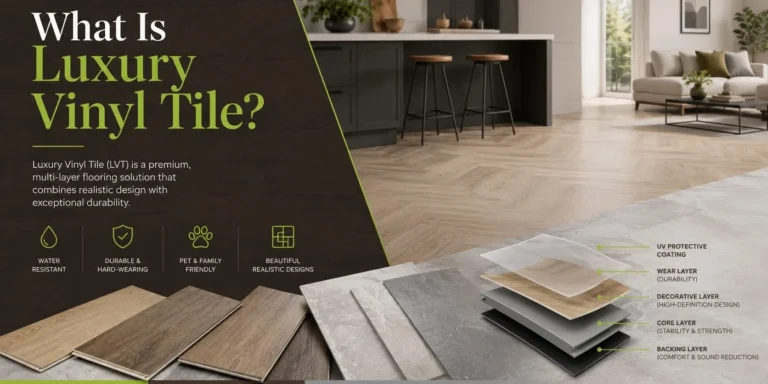
Thickness, wear layer, core construction, backing, click profile, surface treatment and installation requirements all work together.
A 6mm plank is not automatically better than a 5mm plank. A thicker wear layer does not solve every performance issue. And an attached IXPE pad cannot compensate for an unsuitable or poorly prepared subfloor.
The specification needs to make sense as a complete system.
There is another part of SPC Flooring that manufacturers sometimes overlook.
The colour that receives the most attention in a showroom is not necessarily the colour that generates the most orders.
A dramatic dark oak may look fantastic in a catalogue. A highly distinctive stone design may attract attention on social media. A bold colour may become the “showstopper” of a collection.
But distributors need products that customers actually want to put into their homes and projects.
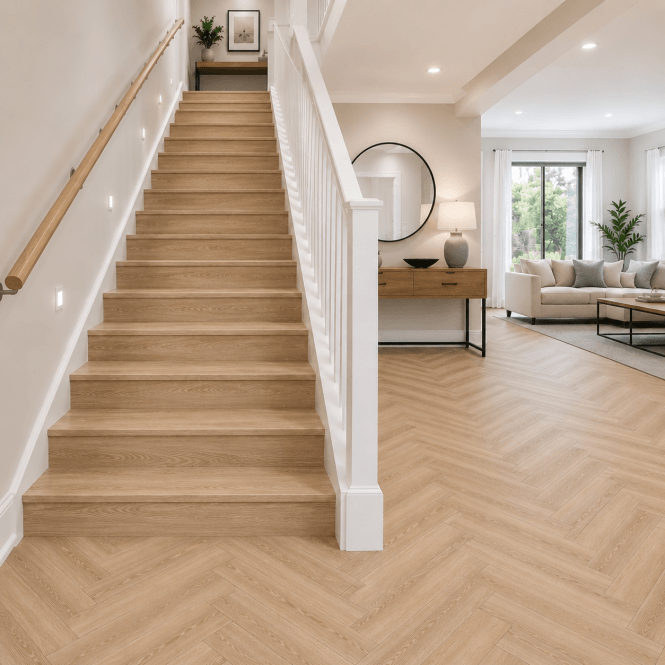
This is why warm natural oak, light oak, beige, taupe, honey and natural brown tones continue to receive attention in current flooring design discussions, alongside more realistic wood textures and EIR surfaces.
The point is not that bold colours are wrong.
The point is that every SKU should have a purpose.
Some colours attract people to the sample wall.
Some are there because retailers need dependable everyday sellers.
Some give architects and designers something distinctive to specify.
And some simply make it easier for a homeowner to say, “Yes, I can live with this floor for the next ten years.”
A successful SPC collection is therefore not just a gallery of attractive colours. It is a balanced sales system.
Digital printing has made it possible to reproduce wood and stone designs with remarkable realism. But buyers increasingly look beyond the printed image.
They want to see and feel the surface.
That is where Embossed-in-Register (EIR) becomes important. When the embossing follows the visual grain of the printed décor, the surface can feel considerably more natural than a flat printed texture.
For premium collections, this combination of colour, grain, texture, bevel and surface finish can make a significant difference when the product is compared physically.
This is also why a supplier’s sample should never be judged only from a digital catalogue.
A screen can show colour.
It cannot show the real click connection, surface texture, edge quality or how the plank feels in your hand.
For importers and distributors, a physical sample remains one of the most important parts of the purchasing process.
One of the most common conversations in SPC Flooring is about wear layer thickness.
0.3mm, 0.5mm, 0.55mm, 0.7mm…
These numbers are useful, but they are only part of the story.
The wear layer protects the decorative surface from everyday wear, but the rigid core, click profile, surface finish, dimensional stability, and manufacturing consistency also influence how the finished floor performs. Current sourcing guides increasingly recommend evaluating the complete construction rather than choosing a product from thickness or wear-layer numbers alone.
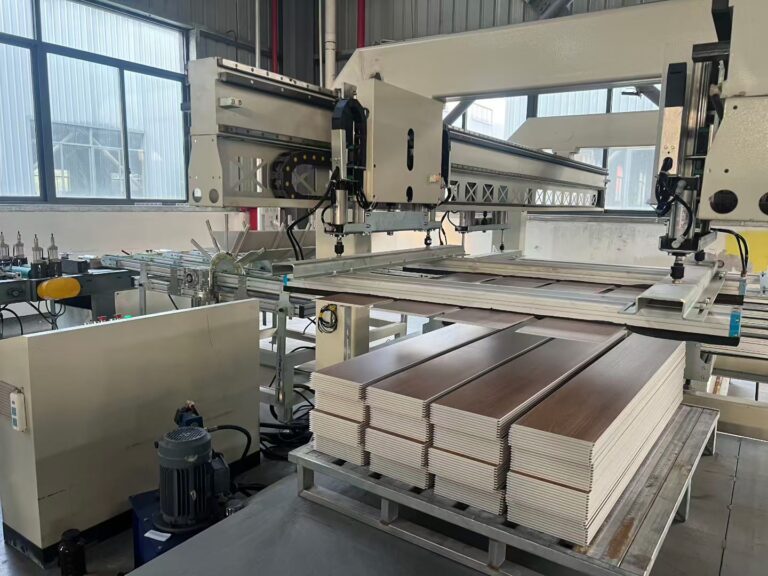
For a manufacturer, this means controlling more than one number during production.
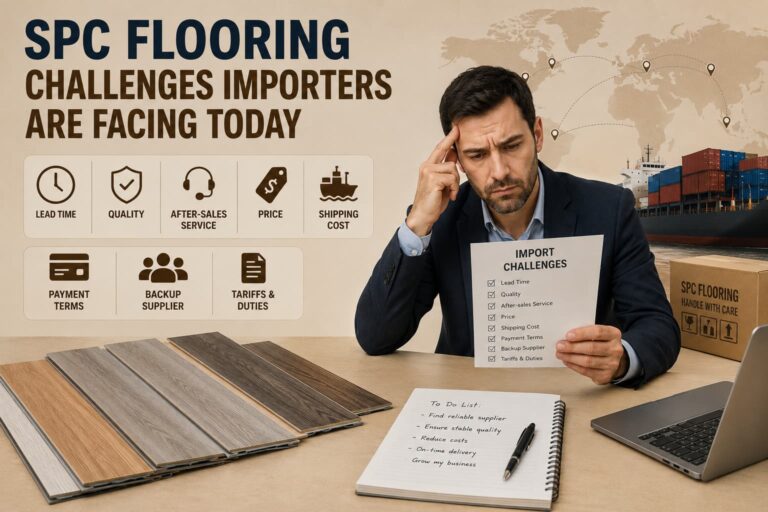
For a distributor, it means asking more than one question before placing a container order.
And for an importer building a private-label brand, it means making sure that the product tested and approved is actually the same product that will be produced repeatedly.
That last point is particularly important.
Nobody signs a purchase order expecting a problem.
But when the colour does not match the approved sample, cartons arrive damaged, click joints become difficult to install, or a product behaves differently on site, the question quickly becomes:
Who approved this product?
That is why experienced buyers rarely compare only price, colour, and wear layer.
There is another question quietly sitting behind the purchase:
“If something goes wrong, can I stand behind this decision?”
Clear specifications reduce that risk.
Approved physical samples reduce it.
Consistent production batches reduce it.
Proper packaging reduces it.
Product-specific technical documents reduce it.
And, perhaps most importantly, a supplier who actually responds when reality differs from expectations reduces it.
The product is being purchased.
But the buyer’s reputation is also involved.
There is an interesting mistake in the flooring business: treating the number of claims as the complete measure of customer satisfaction.
Imagine a distributor reports zero claims this month.
That sounds positive.
Then, three months later, the same distributor buys from another supplier.
No complaint.
No claim.
No angry email.
The customer simply does not reorder.
Perhaps the installer spent too much time dealing with the click system. Perhaps one colour was difficult to sell. Perhaps the packaging created too much damage in the warehouse. Perhaps the distributor simply lost confidence in batch consistency.
There may be no formal claim at all.
This is why reorders can tell a different story from claims.
A successful flooring supplier should not only ask, “How many problems did we have?”
The better question is:
“Did the customer trust us enough to buy again?”
For distributors, repeat orders are ultimately built on that confidence.
This is another area that deserves more attention.
When discussing a new flooring collection, most conversations focus on the plank:
Colour.
Thickness.
Wear layer.
Texture.
Click system.
Price.
Then, often at the end, somebody asks about the carton.
That approach is becoming less practical.
The carton protects the product during transportation, but it also becomes part of the customer’s warehouse operation, showroom presentation, and final retail product.
Carton strength, corner protection, pallet configuration, labels, barcodes, product information and packaging dimensions all affect the real cost of doing business.
For European importers in particular, packaging compliance is becoming increasingly relevant. The EU Packaging and Packaging Waste Regulation began applying on 12 August 2026 and introduces a harmonised framework covering packaging placed on the EU market, with further requirements being phased in over the coming years.
So packaging should not be treated as something to discuss after the flooring collection has already been designed.
The plank and the carton should be developed together.
A damaged carton is not only a logistics problem.
It can become a warehouse problem.
A warehouse problem can become a distributor problem.
And a distributor problem can eventually become a customer-service problem.
This is why experienced flooring manufacturers pay attention to container loading, pallet stability, carton strength, protective materials, and labeling just as carefully as they pay attention to the flooring itself.
For private-label customers, this becomes even more important.
The customer’s brand is printed on the carton.
If the product arrives damaged, inconsistent or poorly presented, it is the customer’s brand that the market sees.
The factory may be thousands of kilometres away.
The distributor is the one facing the customer.
Another important shift is that flooring buyers are paying more attention to indoor-air-quality requirements and documentation.
Low-VOC products, emissions testing, and relevant compliance documents can become important when SPC Flooring is supplied to offices, healthcare facilities, schools, hospitality projects, and markets with specific building requirements.
But there is an important distinction here:
Having a certificate somewhere in a supplier’s file is not the same as having documentation that clearly corresponds to the exact product being purchased.
For importers and project buyers, product-specific test reports, technical data, and installation documentation should be reviewed before the order is finalized.
That is especially important for private-label products, where the specification printed on the packaging must match the actual construction being supplied.
The future of SPC Flooring is not simply about making the plank thicker.
The market is moving toward a more complete product proposition:
better-looking wood designs,
more realistic EIR textures,
reliable click systems,
appropriate wear-layer options,
attached acoustic backing where required,
low-emission product positioning,
better packaging,
clear technical documentation,
and consistent production from the first container to the tenth.
For manufacturers, this means investing in production control rather than simply adding more designs to a catalogue.
For importers, it means looking beyond the lowest FOB price.
For distributors, it means building a collection that has both showroom appeal and repeat-sales potential.
And for flooring brands, it means choosing a manufacturing partner that understands that the product is not finished when it leaves the production line.
It is finished when it reaches the customer’s floor — and when that customer is confident enough to buy the same product again.
Before placing your next SPC Flooring order, it may be worth looking beyond the usual questions about price and MOQ.
Ask what the complete construction is.
Ask whether the approved sample and bulk production are controlled against the same specification.
Ask how colour consistency is managed between production batches.
Ask about the click system and how it performs when assembled.
Ask whether the attached IXPE or EVA backing is part of the tested construction.
Ask which technical documents apply to the exact SKU.
Ask how the product is packed and loaded.
And perhaps ask the most important question of all:
“If we build our market around this product, can you keep supplying the same quality?”
For a serious manufacturer, that question is not difficult to answer.
Because in the long-term flooring business, consistency is often more valuable than a low price on the first container.