Contact Us
Lishuangdian Industrial Zone, Zhengding County, Shijiazhuang City, Hebei Province, China.
info@hsspcflooring.com
Whatsapp/Wechat: +86 15933619081

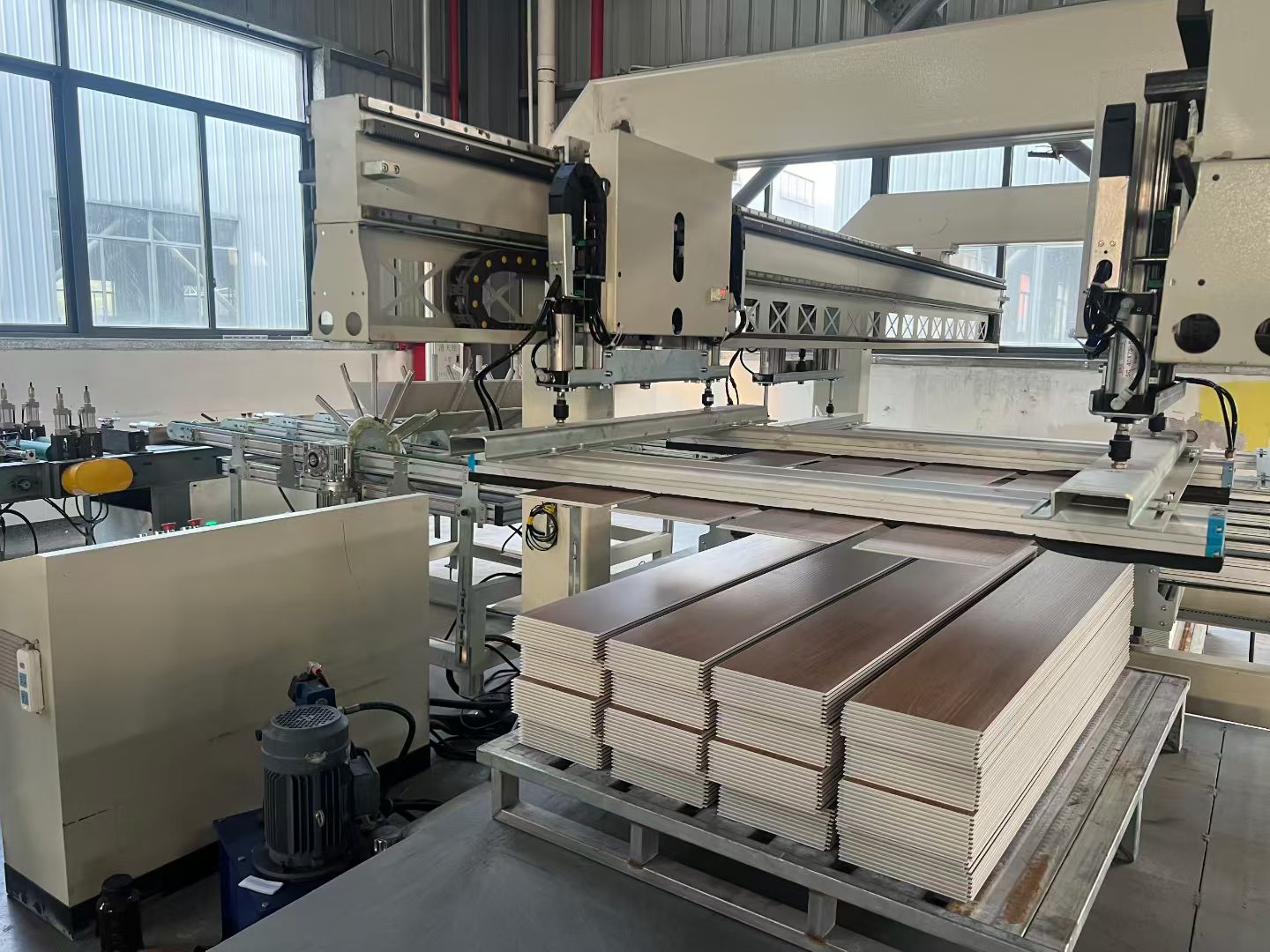
When an importer or distributor starts looking for a reliable SPC Flooring manufacturer in China, the first comparison is often very simple: thickness, wear layer, price and loading quantity.
But after years of manufacturing SPC Flooring for international markets, we have found that these numbers only tell part of the story.
A 5.5mm SPC product from one factory can perform very differently from another 5.5mm product. Two floors may both have a 0.5mm wear layer, EIR surface and click-lock system, yet the actual performance, stability, appearance and installation experience can be completely different.
This is particularly important when the buyer is not simply purchasing flooring for one project, but is planning to develop a private-label SPC flooring brand.
In that situation, the real question is not simply “How much is the flooring?”
It is:
Can the manufacturer consistently produce the product your brand promises to the market?
As an SPC Flooring manufacturer, this is how we look at the product.
SPC stands for Stone Plastic Composite and refers to a rigid flooring core generally made from limestone-based mineral material, PVC resin and other formulation components.
The core is produced through controlled mixing and extrusion processes to create a rigid and stable board.
But simply calling a product “SPC” does not tell you whether it is a high-quality SPC.
For us, one of the most important factors is the raw material.
We manufacture our SPC Flooring using 100% virgin raw materials rather than relying on large quantities of recycled or uncontrolled materials.
Why does this matter?
Because the quality of the core influences many of the characteristics that buyers eventually experience in the finished floor: density, dimensional stability, impact resistance, click-lock performance and long-term consistency.
For residential rental properties, hotels, commercial spaces and other high-use environments, these characteristics become much more important than they may initially appear on a quotation sheet.
A good SPC Flooring product should not only look good when it leaves the factory. It should remain stable after years of normal use.
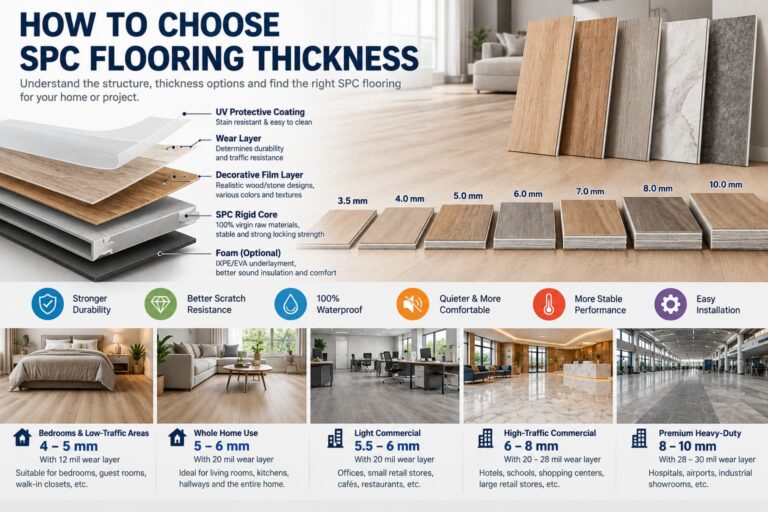
For many residential and commercial applications, a structure such as:
5.0–5.5mm SPC rigid core + approximately 1.0mm IXPE/EVA underlay
can provide a good balance between rigidity, stability, comfort and acoustic performance.
With the surface layers included, the finished product can reach approximately 6.0–6.5mm total thickness.
However, thickness itself should never be treated as the only measure of quality.
A thicker floor is not automatically a better floor.
The relationship between the SPC core, wear layer, decorative film, surface treatment and attached underlay is what determines how the finished product performs.
The attached IXPE or EVA layer also deserves attention. Its density, resilience, uniformity and bonding with the SPC board can affect the final installation and underfoot feel.
So when comparing two products, looking only at “1mm IXPE” is not enough.
A buyer requesting a 0.5mm / 20mil wear layer is generally looking beyond entry-level SPC Flooring.
A 20mil wear layer is widely used for higher-demand residential and commercial applications.
But once again, thickness is only one part of the equation.
The actual wear performance depends on the wear-layer material, production consistency, surface treatment and test results.
Two products can both be described as having a 0.5mm wear layer and still deliver different results.
For this reason, a professional buyer should look beyond the number itself and consider whether the manufacturer can consistently maintain the specified wear-layer thickness and provide appropriate testing for the actual product being supplied.
For a premium wood-look SPC collection, EIR — Embossed in Register — is one of the surface technologies worth paying attention to.
The purpose of EIR is to create a closer relationship between the printed wood grain and the physical embossed texture.
When you look at the floor, you see the wood grain.
When you touch the floor, the texture follows the visual character of the wood more naturally.
This is particularly valuable for European oak designs, where realistic grain, knots and natural variation are an important part of the appearance.
For a private-label brand, this can make a significant difference.
Consumers may never know where the SPC core was produced, but they will immediately notice the colour, grain, texture and overall appearance of the flooring.
The surface of SPC Flooring is exposed to daily wear, cleaning, dirt, furniture movement and foot traffic.
A UV protective coating forms an important part of the surface structure and can contribute to surface protection, stain resistance and overall durability.
A typical premium structure may therefore include:
UV Protective Layer
Wear Layer
Decorative Film
SPC Rigid Core
Attached IXPE/EVA
When combined with EIR and micro-bevel edges, the result is a flooring product designed to provide both practical performance and a more realistic premium appearance.
A micro-bevel or 4V edge may seem like a small detail, but it can significantly influence the finished appearance.
After installation, the subtle edge creates a clearer visual separation between individual planks.
This works particularly well with wood-look SPC Flooring because it gives the installation more of the character associated with real wood flooring.
For a premium collection, these small details can make the difference between a product that looks like a basic vinyl floor and one that has a much more sophisticated appearance.
For SPC Click Flooring, the locking system is one of the areas we believe buyers should examine carefully.
European buyers may specify systems such as Unilin, Välinge or i4F, or another high-quality licensed or equivalent system.
There is a reason for this.
The click system affects installation, plank connection, joint stability and the ability of the floor to withstand repeated loading.
But there is also an important distinction between saying that a product is “compatible with” a particular click system and actually having the appropriate rights or licensing to use a patented technology.
For a company developing its own brand, intellectual-property compliance should not be overlooked.
A good product specification should therefore clearly identify what click system is being used and the legal basis for its use where applicable.
A professional buyer may request documentation such as:
CE / Declaration of Performance
EN 14041
EN 16511
EN 16354
REACH
RoHS where applicable
Formaldehyde emissions
VOC emissions
Fire classification
Slip resistance
Wear resistance
Dimensional stability
Acoustic performance
Underfloor heating compatibility
These are all useful areas to investigate.
But there is one requirement that we consider particularly important:
The test report should correspond to the actual product being offered.
This is something importers should check carefully.
A factory may have many certificates and test reports, but that does not automatically mean every report applies to every product.
For example, if the proposed product is:
5.5mm SPC + 1mm IXPE + 0.5mm wear layer
the buyer should verify that the relevant testing actually relates to that product structure, rather than another thickness, another construction or another product model.
A large number of certificates does not necessarily mean better compliance.
Product-specific documentation is what matters.
When SPC Flooring is intended for commercial projects, fire performance often becomes a much more important consideration.
European buyers may request testing according to EN 13501-1, with Bfl-s1 or better being a preferred target.
The requirements for a residential product may be different from those for a hotel, office, retail or public project.
This is why manufacturers need to understand where the product will actually be used.
A product designed for a general residential market may not necessarily have the same documentation or performance requirements as a flooring system intended for larger commercial projects.
European consumers and professional buyers are increasingly interested in indoor environmental quality.
For flooring used in homes, apartments, hotels and commercial interiors, low VOC emissions and controlled formaldehyde emissions can therefore become important parts of the product specification.
From a manufacturing perspective, this should not simply be treated as something to test after production.
Raw material selection, formulation, production controls and finished-product testing all contribute to the final result.
For a private-label brand, environmental performance should ideally be supported by appropriate documentation rather than simply printed on the packaging.
Underfloor heating is common in many European residential projects.
When a customer specifies that SPC Flooring must be suitable for underfloor heating, the manufacturer needs to consider the entire flooring structure.
Temperature changes can place additional demands on dimensional stability.
This is why dimensional stability, heat resistance and temperature-cycle performance are important considerations.
Simply printing “suitable for underfloor heating” in a catalogue does not tell the whole story.
The actual product construction and supporting test data are much more meaningful.
A commercial floor may experience repeated foot traffic, furniture loads, rolling loads and frequent cleaning.
This is why durability testing can extend well beyond abrasion resistance.
Important areas can include:
Impact resistance
Heavy-load resistance
Static-load resistance
Indentation resistance
Temperature cycling
Heat and cold cycling
Moisture resistance
Water immersion resistance
For multilayer SPC Flooring, we also pay close attention to the relationship between individual layers.
Tests related to:
Interlayer bond strength
Peel strength
Delamination resistance
can help evaluate whether the different layers remain properly bonded during use.
The objective is simple: the floor should not separate, peel, crack, bubble, swell or lose structural integrity under normal conditions.
It is easy to write:
15-year residential warranty
But a serious flooring brand needs to understand what that warranty actually means.
What is covered?
What qualifies as a manufacturing defect?
How are claims submitted?
How are defective products handled?
What happens when a customer reports colour variation between batches?
Is the solution replacement, credit or another form of compensation?
These questions become especially important for private-label businesses.
Once the flooring is sold under your own brand, your customer sees your brand, not the factory behind the product.
A reliable manufacturer therefore needs to provide more than a warranty number. There needs to be a practical system behind it.
For a company launching a new SPC Flooring brand, private-label manufacturing can involve much more than changing the packaging.
A complete OEM program may include:
Custom brand name
Custom packaging
Custom cartons
Custom labels
EAN / barcode printing
Custom article numbers
Private-label production
Custom colours and decors
Branded samples
Marketing images
Technical documentation
The manufacturer therefore needs to have strong capabilities in product development, colour management, packaging and production consistency.
This becomes especially important when a brand launches a collection of 10–12 European oak decors.
The colours need to remain consistent from one production batch to another.
A beautiful colour in the first container is not enough.
The same colour should remain recognisable when the customer reorders several months later.
For a new private-label brand, MOQ should not be treated as one single number.
There can be different requirements for:
Existing decors with private-label packaging
New or custom decors
Custom packaging
Custom product development
An existing production colour may be relatively straightforward to combine with private-label packaging.
A completely new colour or surface design can require additional development and minimum quantities.
For a new brand, starting with proven decors can therefore reduce risk while allowing the business to build sales volume before investing heavily in customized products.
When an importer asks how many square metres can be loaded into a 20ft or 40HQ container, the answer depends on much more than the container’s internal volume.
Actual loading is affected by:
m² per carton
cartons per pallet
m² per pallet
carton dimensions
pallet dimensions
product weight
pallet configuration
container weight limits
This is why professional quotations should provide enough information for the buyer to calculate the actual landed cost.
A supplier saying “one 40HQ can load approximately X m²” is useful, but the underlying packing structure is equally important.
For private-label flooring, packaging represents the brand at the moment the product reaches the customer.
The carton may need to contain:
Brand name
Product name
Article number
Colour name
EAN / barcode
m² per carton
Batch information
Installation information
Required regulatory markings
At the same time, the carton must protect the product during transportation, handling and storage.
This is why packaging inspection and final pre-shipment inspection should be part of a professional quality-control process.
One of the simplest ways to evaluate an SPC Flooring supplier is not to ask:
“Is your quality good?”
Every supplier will say yes.
Instead, ask:
“How do you control your quality?”
A professional manufacturer should be able to explain how it controls:
SPC core density
Total thickness tolerance
Wear-layer thickness tolerance
Width and length tolerance
Squareness
Dimensional stability
Click-lock performance
Surface quality
Colour consistency
Packaging quality
Final inspection before shipment
These details reveal much more about a factory’s actual manufacturing capability than a polished company presentation.
Before committing to a first production order, physical samples are extremely valuable.
Especially for a premium SPC collection, buyers should be able to inspect the actual:
Colour
Wood grain
EIR texture
Surface finish
Edge treatment
Click system
Core
Attached underlay
Overall workmanship
Computer renderings can be useful for presenting a collection, but they cannot replace a physical sample.
This is why we believe the sample stage should be treated as the beginning of cooperation rather than simply a formality before an order.
A buyer can evaluate the product.
The manufacturer can understand the buyer’s expectations.
And both sides can make adjustments before moving into mass production.
For an importer, distributor or new private-label brand, supplier selection should not become a simple price competition.
The better comparison is the complete picture:
Product quality + raw materials + construction + surface technology + click system + testing + environmental compliance + stability + OEM capability + MOQ + loading efficiency + lead time + warranty + after-sales support.
Saving a small amount per square metre can mean very little if the product later develops colour inconsistency, locking problems, dimensional issues or other quality complaints.
For a new brand, the consequences can be even greater because the problem is ultimately associated with the brand itself.
We do not believe that successful SPC Flooring cooperation should begin and end with a quotation.
A serious project usually develops gradually.
It starts with understanding the market and the product positioning.
Then comes product selection and physical samples.
After that, the first trial order allows both sides to evaluate quality, production, packaging and communication.
If everything works well, the relationship can develop into regular container orders, new decors, customized packaging and eventually a complete private-label flooring collection.
That is the kind of cooperation we value.
We manufacture SPC Flooring for businesses that are looking for more than a low-cost product. We focus on consistent quality, 100% virgin raw materials, product development and long-term supply capability.
For importers, distributors and companies considering their own SPC Flooring brand, the right manufacturer can become much more than a supplier.
The right manufacturer can become part of the brand’s foundation.