Contact Us
Lishuangdian Industrial Zone, Zhengding County, Shijiazhuang City, Hebei Province, China.
info@hsspcflooring.com
Whatsapp/Wechat: +86 15933619081

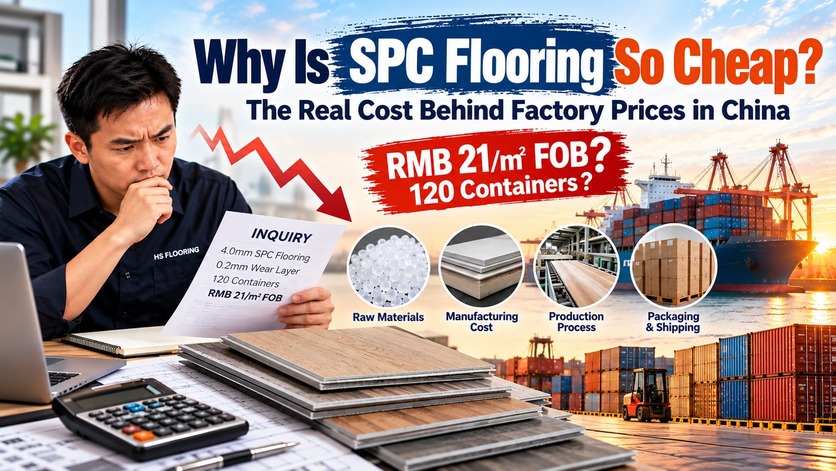
An SPC flooring manufacturer’s perspective on unusually low wholesale prices, raw material costs, factory quotations, and the risks buyers should consider before placing large orders.
For an SPC flooring manufacturer, receiving inquiries from overseas customers is usually one of the most encouraging parts of the business.
Every inquiry represents a potential opportunity. It might lead to a new distributor, a construction project, a long-term wholesale partnership, or an entry into a market where our products have not yet been widely introduced.
Recently, however, several inquiries from Southeast Asia and the Middle East left me feeling something very different.
Instead of excitement, I felt concerned.
The reason was simple: the target SPC flooring prices were extraordinarily low.
At first, I wondered whether the global SPC flooring market had undergone a dramatic change. Had SPC flooring prices in China suddenly fallen across the board? Were other manufacturers obtaining raw materials at significantly lower costs? Had we missed an important development in the supply chain?
For a moment, it almost felt like watching a stock market in which every price indicator had turned green.
We have been manufacturing flooring for nearly 15 years, and our export business has developed alongside the international SPC flooring market. We regularly communicate with overseas customers, monitor manufacturing costs, and follow changes in product demand.
Yet the target prices in these recent inquiries were difficult to understand.
If only one customer had requested an unusually low price, I might have considered it a normal negotiating strategy. But when buyers from different markets began presenting similarly aggressive expectations, I decided to investigate.
I wanted to understand whether the SPC flooring cost structure had genuinely changed or whether these prices reflected something else.
What followed was a detailed review of raw material prices, competing factory quotations, and our own manufacturing expenses.
The findings made me think more seriously about the future of SPC flooring price competition—and about the risks buyers may face when the lowest quotation becomes their only purchasing criterion.
One recent inquiry involved a potential purchase of approximately 120 containers of SPC flooring.
For any Chinese flooring manufacturer, that is an attractive opportunity.
The customer requested a fairly standard product: 4.0mm SPC flooring with a 0.2mm wear layer, in a conventional plank size.
However, the customer’s target was just RMB 21 per square meter, FOB China.
This was not simply a request for a low SPC flooring factory price. It was an FOB quotation, meaning that the price also needed to account for the seller’s obligations to deliver the goods on board the vessel at the agreed Chinese port.
For our factory, the target was extremely difficult to accept.
The customer was not asking for an unusually complicated product. There were no special luxury surface finishes, highly customized dimensions, or unusual decorative requirements.
It was a common construction that many SPC flooring suppliers in China could potentially manufacture.
Nevertheless, after reviewing our costs, we could not see how to supply the requested product at RMB 21/m² FOB while maintaining our established material and manufacturing standards.
The potential order volume was certainly tempting.
But another important detail remained unclear: the customer had not confirmed the period over which the 120 containers would be purchased.
Would the entire quantity be shipped within a few months? Would deliveries be spread over a year? Would orders be released gradually according to individual projects?
These details matter because an inquiry for 120 containers is not the same as a confirmed order for 120 containers.
Production planning, raw material purchasing, payment arrangements, and shipment schedules all influence the final SPC flooring wholesale price.
Even so, we did not immediately reject the customer’s target.
Instead, we decided to investigate whether there was a realistic way to reach it without compromising quality.
To understand the situation, we began collecting information from raw material suppliers and other flooring manufacturers.
Our inquiries covered several important manufacturing and supply regions in China, including Hebei, Henan, Shandong, Shanxi, Zhejiang, Jiangsu, Nanjing, and Shanghai.
We contacted suppliers of PVC resin, calcium carbonate, stabilizers, decorative films, wear layers, packaging materials, and other components used in SPC flooring production.
We also reviewed quotations from other SPC flooring manufacturers in China to understand how different factories were pricing apparently similar products.
The purpose was not merely to find the cheapest raw materials available.
We wanted to determine whether the unusually low SPC flooring price per m² could be supported by a comparable product construction.
That distinction is essential.
Two factories may both quote 4mm SPC flooring, but their products can differ in raw material formulation, wear layer thickness, core density, locking system, manufacturing tolerances, and quality control.
These differences may not be obvious from a product photograph or a short quotation sheet.
After collecting the information, we recalculated our own SPC flooring manufacturing cost.
We included the principal expenses involved in producing and exporting the flooring: raw materials, labor, electricity, equipment operation, maintenance, factory overhead, packaging, internal transportation, and applicable export-related costs.
We even removed our profit margin from the calculation.
The result was disappointing.
Under our current raw material standards, production process, and cost assumptions, we still could not reach RMB 21/m² FOB without making a loss.
This does not mean every SPC flooring manufacturer in China has exactly the same production cost.
Some factories may benefit from different purchasing contracts, more efficient equipment, lower overhead, favorable inventory costs, or other genuine competitive advantages.
But for our factory, the calculation was clear.
We could not accept the target price while promising the same product quality that our customers have come to expect.
We understand the pressure facing both Chinese manufacturers and overseas flooring importers.
Competition is intense. Customers want lower prices, distributors need sufficient margins, and manufacturers need orders to maintain stable production.
Even an order with a modest profit can be worth pursuing if it creates a reliable long-term relationship.
We are not opposed to negotiating prices.
In fact, we regularly review our production methods and product specifications to find ways to offer more competitive SPC flooring wholesale prices.
However, there is an important difference between reducing unnecessary manufacturing costs and reducing product quality.
At HANSHAN Flooring, we have spent nearly 15 years developing our manufacturing business.
Our confidence has always come from two things: consistent product quality and the after-sales relationships we maintain with our customers.
For our high-quality SPC flooring, we use 100% virgin raw materials and follow established production standards.
This is especially important for the rigid core and click-lock system.
A finished SPC plank may look attractive when it leaves the factory. Its true performance becomes apparent after installation, when it experiences temperature changes, daily foot traffic, furniture loads, and other normal service conditions.
If a manufacturer reduces costs by changing the core formulation, using inconsistent raw materials, or relaxing production controls, some problems may not become visible immediately.
They may appear only after the flooring has been installed and used for some time.
By then, the flooring may already have been distributed to retailers, installed in residential developments, or supplied to large construction projects.
For an importer, contractor, or private-label flooring brand, the cost of resolving such problems can be much greater than the original purchasing savings.
This is why we believe a competitive SPC flooring factory price must still be supported by a realistic manufacturing cost and consistent quality standards.
After reviewing these inquiries, I began thinking about why some customers were setting target prices so far below our own cost calculations.
I believe several factors may be contributing to this situation.
The first possibility is that buyers believe a large order should automatically result in a dramatically lower price.
This expectation is understandable.
Large orders can create genuine manufacturing advantages.
When a factory produces substantial quantities of the same flooring specification, it may reduce production changeovers, improve raw material purchasing efficiency, and simplify production scheduling.
For example, producing 100,000 square meters of one standard wood design may be more efficient than manufacturing the same total quantity across dozens of colors.
However, these savings have limits.
The factory must still purchase the raw materials required for every square meter of flooring.
Labor, electricity, packaging, equipment wear, and transportation expenses do not disappear simply because the order becomes larger.
In some cases, large orders can also increase financing pressure because the manufacturer needs to purchase significant quantities of materials before receiving final payment.
Therefore, while volume can help reduce SPC flooring cost per m², it cannot eliminate the fundamental cost of production.
A 120-container inquiry may justify more competitive pricing, but it does not automatically make an unprofitable product profitable.
The actual delivery schedule, number of colors, payment terms, and confirmed purchasing quantity must all be considered.
Another possibility is that certain buyers are purchasing flooring for highly price-sensitive applications.
Not every flooring project requires the same specifications.
A temporary renovation, budget residential development, or low-traffic interior may have different performance requirements from a busy commercial property.
A well-manufactured 3.5mm or 4mm SPC flooring product with a 0.2mm wear layer may be suitable for certain residential applications, provided it meets the intended use requirements.
A high-traffic commercial project may require a more substantial wear layer, stronger locking performance, and additional product testing.
There is nothing wrong with choosing economical SPC flooring.
The problem arises when the product’s actual construction does not match the buyer’s expectations.
If a customer knowingly chooses a basic specification for an appropriate application, that is a reasonable purchasing decision.
But if the buyer believes they are purchasing high-quality flooring and receives a product manufactured to substantially lower standards, the consequences can be serious.
The objective should be to match the product to the project, rather than assume every product advertised as cheap SPC flooring offers the same performance.
The third possibility is the way international buyers compare suppliers.
Today, buyers can easily contact numerous SPC flooring suppliers in China through online marketplaces, manufacturer websites, and international sourcing platforms.
A customer may send the same inquiry to ten or twenty suppliers.
When one factory offers a lower quotation, that price becomes the new benchmark.
Another supplier may then be asked to reduce its price further.
Over time, the negotiation becomes focused almost entirely on the lowest number rather than the actual product construction.
But the quotations may not be comparable.
One supplier may quote virgin material SPC flooring, while another uses a different core formulation.
One may include a genuine 0.3mm wear layer, while another offers a different nominal thickness or tolerance.
One quotation may include attached IXPE underlayment, specialized packaging, or a licensed click-lock system, while another may exclude these items.
Some exceptionally low prices may also be preliminary offers that change once the customer confirms the final specifications.
This is why comparing SPC flooring wholesale prices without examining the underlying product details can be misleading.
A quotation is only meaningful when the specifications and commercial terms are clear.
When overseas buyers search for SPC flooring prices in China, they often expect to find a simple answer.
However, there is no single factory price that applies to every SPC flooring product.
The final cost depends on the materials, product construction, manufacturing process, order requirements, and delivery terms.
Understanding these factors is the first step toward making a meaningful price comparison.
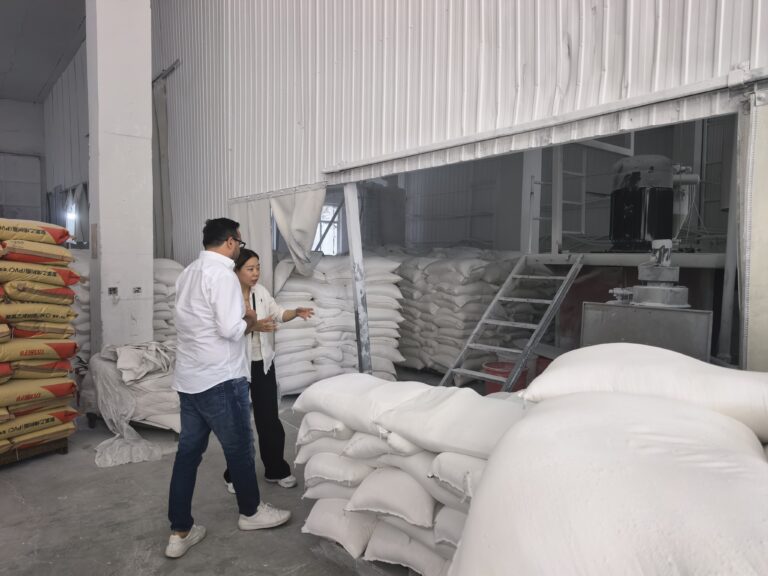
The rigid core of SPC flooring is typically manufactured using PVC resin, calcium carbonate, stabilizers, and other additives.
These materials are central to both production cost and product performance.
PVC resin is an important cost component, and changes in resin prices can directly influence factory quotations.
Calcium carbonate is another major ingredient. Its characteristics, quality, and proportion in the formulation affect the manufacturing process and the properties of the finished core.
The formulation must be carefully balanced.
Increasing the proportion of a lower-cost ingredient does not necessarily produce a better or more economical finished product.
An unsuitable formulation may affect flexibility, impact resistance, extrusion consistency, dimensional stability, and the performance of the locking edges.
Some manufacturers use recycled materials in certain product formulations to reduce costs.
Recycled material is not automatically defective, and its suitability depends on its source, consistency, processing, and the performance requirements of the finished flooring.
However, uncontrolled or inconsistent recycled content can create additional quality risks.
At HANSHAN, our high-quality virgin material SPC flooring is manufactured using carefully selected virgin raw materials because consistent material quality is fundamental to our production standards.
For buyers comparing SPC flooring factory prices, we recommend asking about the core formulation and available product testing rather than judging the flooring solely by appearance.
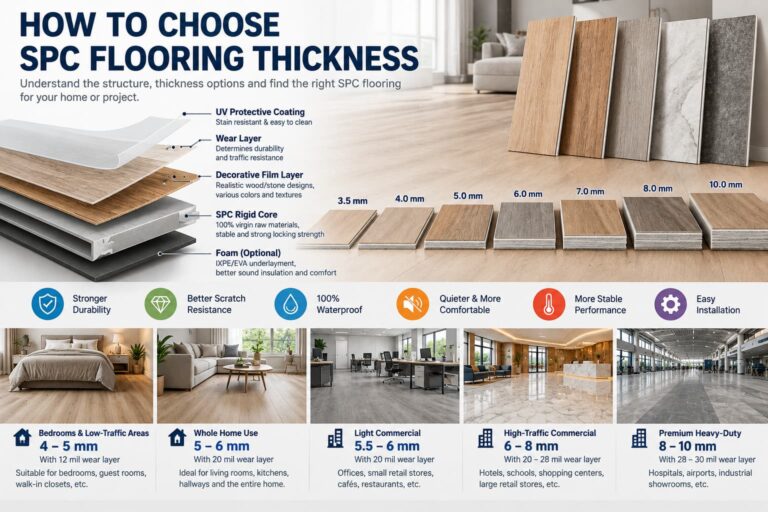
Thickness is one of the most important specifications in an SPC flooring quotation.
Common export constructions include 3.5mm, 3.7mm, 4.0mm, 5.0mm, 6.0mm, and 6.5mm SPC flooring, along with thicker options for specific applications.
Generally, a thicker rigid core requires more material per square meter, increasing manufacturing cost.
It also increases product weight, which can influence packaging and container loading.
However, buyers should distinguish between rigid core thickness and total flooring thickness.
For example, 5.0mm SPC flooring with a 1.0mm IXPE pad is not the same construction as a 6.0mm SPC plank without attached underlayment.
Both may measure approximately 6.0mm overall, but the structural core thickness differs.
This distinction matters when comparing SPC flooring price per m².
A quotation describing only the total thickness may conceal important differences in product construction.
For accurate comparisons, the quotation should identify the plank thickness excluding the pad, wear layer thickness, and attached underlayment separately.
The transparent wear layer protects the decorative film from surface abrasion.
Common wear layer options include 0.2mm, 0.3mm, 0.5mm, and 0.55mm.
A thicker wear layer generally requires more protective material and therefore contributes to manufacturing cost.
However, wear layer thickness and overall structural strength are different characteristics.
A 0.5mm wear layer may provide greater abrasion protection than a thinner alternative, but it cannot compensate for a weak core or poorly manufactured locking system.
For certain residential applications, a 0.2mm wear layer may be appropriate.
For busier homes and commercial environments, buyers often prefer 0.3mm, 0.5mm, or thicker wear layers, depending on the required performance.
Buyers should also verify actual measured thickness and agreed tolerances.
For example, flooring advertised as 20 mil should be assessed against the required wear layer measurement rather than relying only on the product label.
When comparing SPC flooring manufacturers, the wear layer specification should be clearly stated and supported by appropriate quality control.
The click-lock system is another important factor affecting SPC flooring price and performance.
A floating SPC floor relies on accurately machined locking joints to connect the planks and maintain their position during normal use.
The quality of these joints depends on the rigid core formulation, plank thickness, profile design, and machining accuracy.
Poorly manufactured locking edges may cause installation difficulties or become vulnerable to damage under unsuitable loading and movement conditions.
Certain proprietary locking systems may also involve licensing requirements and associated costs.
Buyers requesting licensed click SPC flooring should confirm which locking technology is used and whether the relevant authorization applies to the supplied product.
Two quotations may appear identical in thickness and appearance while offering different locking systems.
These differences deserve attention before the buyer decides which quotation represents the best value.
SPC flooring is available in a wide variety of wood, stone, and decorative designs.
Standard wood-look designs may be more economical when manufactured in large quantities.
Specialized decorative films, synchronized embossing, customized colors, and certain premium surface treatments can involve additional costs.
OEM and private-label requirements may also influence the quotation.
Customized cartons, brand printing, special labels, barcode arrangements, and multiple decorative designs can increase setup costs or affect minimum order quantities.
These requirements are not necessarily expensive, but they should be included in the initial price discussion.
A lower quotation may not include the same customization services offered by another manufacturer.
SPC flooring is relatively heavy because of its mineral-filled core.
For many shipments, container loading is constrained by permissible weight rather than available cubic space.
The thickness, density, plank size, packaging method, and pallet requirements all affect the quantity that can be loaded into a container.
This is particularly important when comparing the total cost of imported SPC flooring.
A lower price per square meter does not always produce the lowest delivered cost if the product requires additional shipping space or has inefficient packaging.
Buyers should compare the actual cartons, pallets, gross weight, and loaded square meters per container.
For larger orders, these details can have a meaningful impact on the overall purchasing cost.
One common mistake in international flooring purchasing is comparing quotations that use different trade terms.
An EXW factory price and an FOB China price are not directly equivalent.
Under EXW terms, the seller generally makes the goods available at the agreed premises, with the allocation of responsibilities governed by the contract and applicable Incoterms rules.
Under FOB terms, the seller has additional obligations associated with delivering the goods on board the vessel at the named port.
A CIF quotation includes further seller obligations concerning ocean freight and insurance, although buyers must still understand the allocation of risk and destination expenses.
This is why a quoted SPC flooring FOB price should not be compared directly with another supplier’s EXW price without accounting for the difference.
The named port also matters.
FOB Tianjin, FOB Qingdao, and FOB Shanghai may involve different domestic transportation and handling costs depending on the factory’s location.
For an accurate comparison, the quotation should clearly identify the currency, trade term, named location, included expenses, and price validity.
One of the most important questions buyers should ask is not simply how low the price can go, but how the supplier has achieved that price.
Manufacturers can legitimately reduce costs through better equipment, efficient production planning, favorable raw material purchasing, lower overhead, and improved container loading.
These are genuine competitive advantages.
However, there are other ways to reduce manufacturing expenses.
A supplier may change the raw material formulation, reduce the actual thickness of certain layers, substitute components, or relax production inspection standards.
Some of these changes may not be immediately visible when examining a finished plank.
Problems can become apparent only after installation.
For example, inconsistent core properties or weak locking edges may increase the risk of damage during installation or subsequent use.
Poor dimensional stability can contribute to movement or distortion under unsuitable environmental conditions.
An inadequate wear layer may also lead to earlier-than-expected surface wear.
These problems are not inevitable simply because a product is inexpensive.
Nevertheless, an unusually low SPC flooring price should encourage buyers to examine the product more carefully.
Consider a distributor purchasing flooring for a large residential development.
A lower factory quotation may initially save a small amount per square meter.
But if a significant number of installed floors later require replacement, the distributor may face additional material costs, installation labor, transportation, customer complaints, and possible compensation claims.
The total cost can quickly exceed the original saving.
For private-label flooring brands, the consequences may extend beyond one project.
Repeated complaints can damage customer confidence and affect future sales.
This is why we believe the best SPC flooring price must be evaluated alongside product reliability and long-term commercial risk.
When buyers receive several SPC flooring quotations, the most useful approach is to make sure every supplier is offering a genuinely comparable product.
The first step is to confirm the construction.
Does the quoted thickness include the attached pad? What is the actual wear layer thickness? What measurement tolerances apply?
Next, buyers should examine the core formulation, locking system, plank dimensions, surface finish, and packaging.
If one manufacturer offers a licensed click-lock system and another does not, the quotations should not be treated as identical.
The same principle applies to laboratory reports and product declarations.
A test report for one SPC flooring construction should not automatically be assumed to cover every thickness, formulation, or wear layer offered by the factory.
Buyers should request relevant documentation for the actual product being considered.
Sample approval is also important, particularly for large-volume orders.
A sample helps confirm the intended appearance and construction, but it does not by itself guarantee that every plank in a large production batch will be identical.
This is why batch quality control, agreed tolerances, traceability, and appropriate pre-shipment inspection arrangements are valuable.
A reliable SPC flooring manufacturer should be willing to discuss these matters before an order is finalized.
The purpose is not to complicate the purchasing process.
It is to make sure the product delivered is the product the buyer expected to receive.
Yes, but the reduction depends on the actual order structure.
A large order containing one or two standard colors may offer better manufacturing efficiency than an order of the same quantity divided into many designs.
A stable purchasing schedule can also help the factory plan raw material procurement and production capacity.
Repeat orders may reduce certain development and communication costs because the product specifications have already been established.
However, buyers should distinguish between a projected annual purchasing volume and a confirmed order.
An inquiry mentioning 120 containers does not necessarily mean that 120 containers will be ordered immediately.
For the manufacturer, the deposit arrangement, shipment frequency, number of designs, and final confirmed quantity all affect production planning.
This is why responsible SPC flooring suppliers may provide different pricing for trial orders, full-container purchases, and confirmed repeat-volume programs.
The price should reflect realistic commercial commitments rather than assumptions about future business.
In our experience, long-term cooperation often creates more sustainable pricing advantages than repeatedly pushing manufacturers toward the lowest possible initial quotation.
No, and this is an important distinction.
A lower-priced SPC flooring product is not automatically a poor-quality product.
There is a genuine difference between an economical product specification and inferior manufacturing.
For example, a well-manufactured 3.7mm SPC flooring product with a 0.2mm wear layer may be a practical option for certain budget-conscious residential projects.
A 3.5mm SPC flooring product with a 0.3mm wear layer may also provide a useful balance between price and surface wear protection for suitable applications.
At HANSHAN Flooring, these economical constructions are part of our experience in supplying large-volume flooring projects.
The objective is to provide a cost-effective specification while maintaining consistent raw material quality and manufacturing control.
The key is matching the flooring to the intended application.
A product designed for a low-traffic residential room should not automatically be promoted as suitable for a busy airport, shopping center, or heavy commercial environment.
Likewise, a premium commercial construction may be unnecessary for a small residential renovation.
Good purchasing does not mean choosing the most expensive flooring.
It means selecting the right product at a reasonable price.
For buyers searching for cheap SPC flooring, we recommend focusing on the construction and performance requirements rather than the lowest advertised number.
One of the most common questions overseas buyers ask is: How much does SPC flooring cost per square meter in China?
The answer depends on the actual product specifications, raw material requirements, order volume, customization, and delivery terms.
Publicly advertised SPC flooring prices can vary considerably, and not every quotation represents the same product construction or commercial arrangement.
For this reason, we prefer to provide a reference based on clearly defined specifications rather than suggest that every SPC floor of the same thickness should have one universal price.
Below is our reference quotation table for selected high-quality SPC flooring constructions between 4.0mm and 6.5mm.
| Quality Tier | Core Thickness | Wear Layer (mil) | Estimated FOB Tianjin Price/m² (2026) | Typical Application |
|---|---|---|---|---|
| Economy | 3.5mm – 4.0mm | 8 – 12 mil | $4.00 – $6.00 | Light Residential (Bedrooms, Closets) |
| Mid-Range | 4.0mm – 5.5mm | 12 – 20 mil | $7.00 – $10.00 | General Residential, Light Commercial |
| Premium | 5.5mm – 7.0mm | 20 – 30 mil | $10.00 – $13.00 | Heavy Residential, General Commercial |
| Ultra-Premium | 7.0mm – 9.0mm | > 30 mil | $13.00+ | Heavy Commercial, High-End Projects |
The table should identify the SPC plank thickness excluding attached underlayment, wear layer thickness, backing material, standard dimensions, quotation currency, EXW or FOB terms, minimum order quantity, and reference price per square meter.
These details are essential for meaningful comparisons.
Prices should also include a quotation date and validity period because raw material costs, exchange rates, freight arrangements, and production conditions can change.
The figures are intended to help international buyers understand realistic purchasing options for the stated product specifications.
They should not be interpreted as a guarantee that every manufacturer will offer the same price or that every construction can be supplied at the same cost.
For customers with different budget requirements, we can discuss alternative thicknesses, wear layers, decorative designs, and packaging arrangements while maintaining agreed quality standards.
For importers, wholesalers, distributors, and contractors, the best SPC flooring price is not necessarily the lowest quotation received.
A more useful question is whether the price offers the right balance between product quality, intended application, and long-term commercial risk.
A flooring distributor serving price-sensitive residential projects may need a different product from a contractor purchasing flooring for a premium hotel.
Both buyers can make sensible decisions, but their priorities will be different.
The first step is to identify the application and required performance.
Once these are clear, the manufacturer can recommend a suitable construction instead of reducing specifications simply to reach an arbitrary target price.
It is also worth discussing which parts of the product can be standardized.
Choosing established plank dimensions, commonly used decorative films, and efficient packaging may help reduce costs without compromising the fundamental quality of the rigid core.
Consolidating colors and planning repeat orders may create further savings.
Buyers should also consider the supplier’s ability to maintain consistency.
A slightly lower SPC flooring factory price offers little benefit if the second shipment differs significantly from the first or if the manufacturer cannot provide reliable after-sales support.
For businesses developing their own flooring brands, consistency is a competitive advantage.
After nearly 15 years in flooring manufacturing, we have learned that a successful order is not simply one that leaves the factory on time.
A successful order is one that allows the customer to sell, install, and use the product with confidence.
When customers return for another order, it tells us something important about the previous shipment.
It means the relationship has continued beyond the initial price negotiation.
We understand that international flooring markets are becoming increasingly competitive.
Importers need attractive purchasing prices. Wholesalers need sufficient distribution margins. Contractors must work within project budgets. Retailers need products that their customers are willing to buy.
SPC flooring manufacturers must respond to these realities.
However, we believe there should be a clear boundary between improving cost efficiency and compromising product quality.
We cannot speak for every factory or every low-priced quotation in the market.
Some SPC flooring suppliers in China may genuinely have manufacturing advantages that we do not possess.
Others may be offering different product specifications or operating under different commercial conditions.
What we can say is that our own cost calculations did not support the exceptionally low target price we recently received for the specified product.
Rather than accept the order and hope to recover the difference elsewhere, we chose to maintain our manufacturing standards.
For us, that is part of being a responsible manufacturer.
The recent inquiries from Southeast Asia and the Middle East have made me think more carefully about the direction of the global SPC flooring market.
I welcome competition.
Competitive pricing encourages manufacturers to improve efficiency, develop better products, and offer customers more choices.
But when a target price falls below a manufacturer’s verified cost of producing the agreed quality, it raises an important question.
What has to change to make that price possible?
Sometimes the answer may be better production efficiency, lower overhead, or more favorable raw material purchasing.
Sometimes it may involve a legitimate change in product specifications.
And sometimes the buyer may need to examine the materials, tolerances, manufacturing controls, and warranty arrangements more carefully.
A large order can be tempting for both buyer and manufacturer.
However, neither party benefits from a price that creates problems after the flooring has been installed.
For overseas importers, wholesalers, distributors, contractors, and private-label flooring brands, our suggestion is simple.
Before accepting an unusually low SPC flooring quotation, confirm exactly what is included in the price and whether the supplier can consistently manufacture the agreed product.
Inspect the samples, review the specifications, establish clear quality requirements, and agree on how production consistency and after-sales issues will be handled.
A few questions before placing an order may prevent far more expensive problems later.
At HANSHAN (HS Flooring), we remain committed to manufacturing high-quality SPC and LVT flooring with carefully controlled raw materials, consistent production standards, and transparent communication.
We are always willing to discuss pricing and explore cost-effective product specifications for different markets.
What we will not do is promise a quality standard that cannot realistically be delivered at the agreed price.
The lowest SPC flooring price may help you win an order today. The right quality at a sustainable price is what helps you keep your customers tomorrow.
For SPC flooring wholesale prices, OEM customization, product specifications, and factory-direct quotations, please visit www.hsspcflooring.com or contact our team to discuss your project requirements.