Contact Us
Lishuangdian Industrial Zone, Zhengding County, Shijiazhuang City, Hebei Province, China.
info@hsspcflooring.com
Whatsapp/Wechat: +86 15933619081

Choosing the right vinyl flooring involves much more than selecting an attractive color or a design that complements your interior. One of the most important factors to consider is SPC flooring thickness, as it can directly influence the floor’s structural performance, walking comfort, installation requirements, and long-term reliability.
In flooring installation, even a difference of one or two millimeters can matter.
Over recent years, SPC flooring, also known as Stone Plastic Composite flooring, has become increasingly popular among homeowners, architects, contractors, and property developers. Its rigid core construction, waterproof materials, realistic decorative finishes, and relatively straightforward installation have made it a practical alternative to many traditional flooring products.
However, not every SPC flooring product is manufactured with the same structure or intended for the same application.
A 4 mm SPC plank designed for a residential bedroom may have very different performance characteristics from a 6 mm product manufactured for a busy retail store. Likewise, two flooring products advertised as 7 mm thick may contain different core thicknesses, wear layers, and attached underlayments.
Understanding these differences is essential before making a purchasing decision.
In this guide, we will explain how SPC flooring thickness affects performance, comfort, pricing, and installation, and how to select the most suitable specifications for residential and commercial projects.
Before comparing different thicknesses, it is helpful to understand how SPC flooring is manufactured.
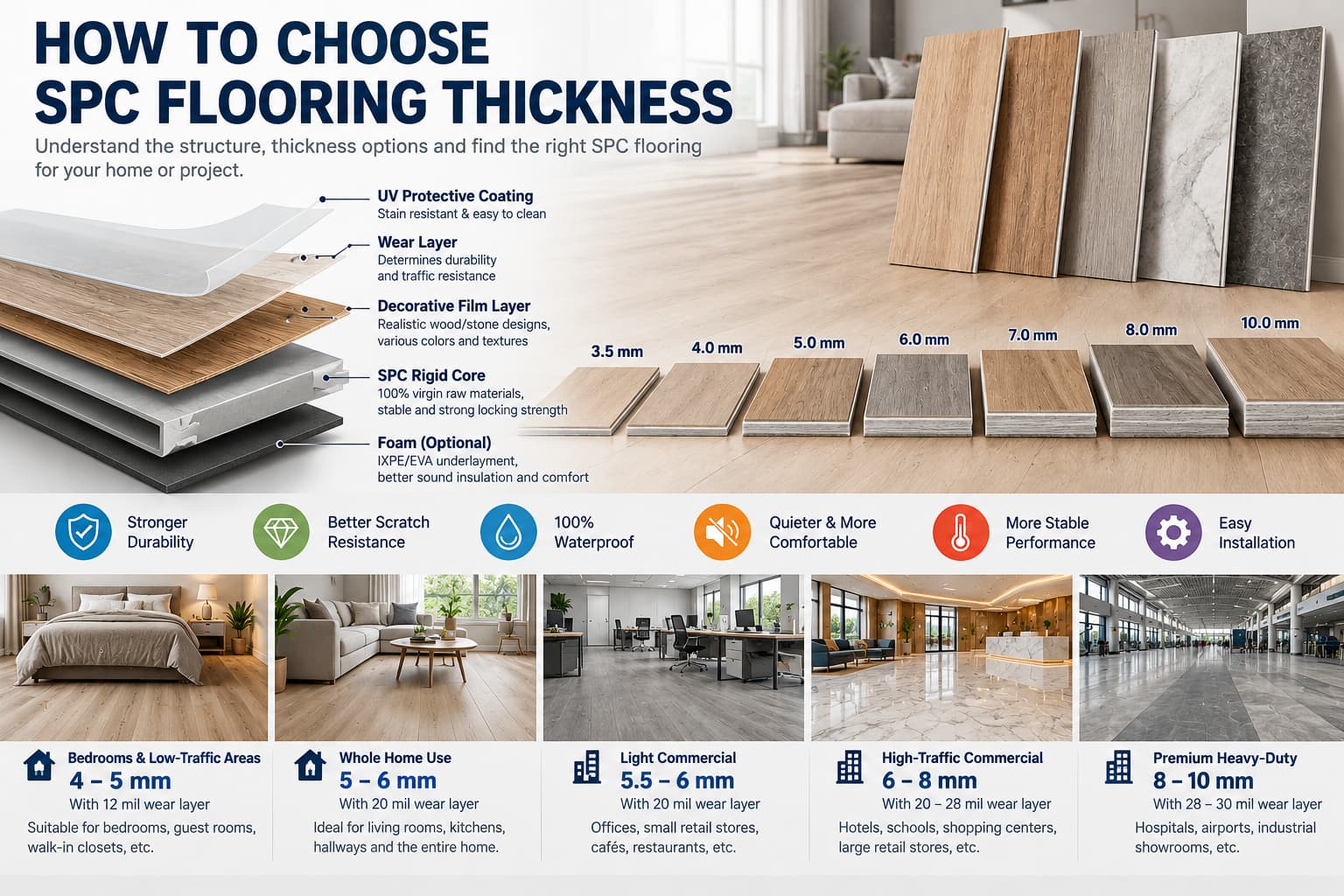
Unlike traditional solid wood flooring, SPC flooring is a multilayer product. Each layer performs a particular function, and the finished floor depends on how these layers work together.
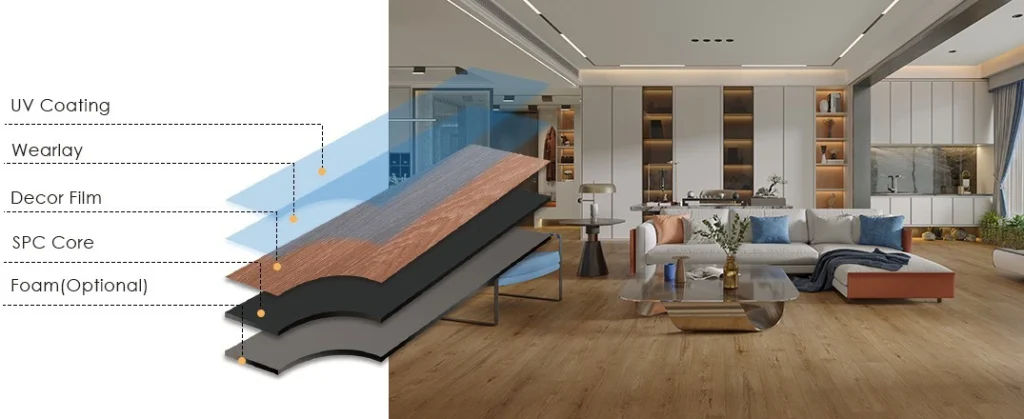
The UV protective coating is the uppermost surface treatment of SPC flooring.
Its main purpose is to help protect the flooring against everyday stains, minor surface abrasion, and general wear. Depending on the coating formulation, it may also improve cleaning performance and provide different surface finishes, such as matte, low-gloss, or other decorative effects.
A properly applied UV coating helps maintain the appearance of the flooring during regular use.
However, its effectiveness depends on the coating formulation, application quality, and curing process.
The transparent wear layer sits directly beneath the UV coating and above the decorative film.
It is one of the most important components affecting the flooring’s resistance to surface abrasion.
In general, thicker wear layers provide more protective material between daily foot traffic and the decorative surface. This is particularly important in commercial environments where the flooring experiences continuous use.
Common wear layer specifications include 0.2 mm, 0.3 mm, 0.5 mm, 0.55 mm, and 0.7 mm, although other specifications are also available.
The appropriate thickness depends on the intended application and required performance standards.
The decorative film is responsible for the appearance of SPC flooring.
It creates the realistic wood grain, natural stone, marble, and other surface designs that make modern SPC flooring so versatile.
Different markets often have different preferences.
Some buyers prefer warm oak colors and traditional wood textures, while others favor contemporary grey tones, light natural wood, darker walnut designs, or stone-inspired finishes.
Most established SPC flooring manufacturers offer extensive decorative film collections to meet these preferences.
At HANSHAN Flooring, we also support customized colors and decorative designs according to customer samples and market requirements, allowing importers and private-label flooring brands to develop products that better suit their local customers.
The rigid core is the structural foundation of SPC flooring.
It is typically manufactured from PVC resin, calcium carbonate, and carefully controlled additives through an extrusion process.
The quality of this core directly influences dimensional stability, bending resistance, locking strength, and the ability of the plank to withstand concentrated loads.
At HANSHAN, we emphasize the use of 100% virgin raw materials in our high-quality SPC flooring production.
A properly formulated and consistently manufactured rigid core provides a more reliable foundation for the locking system and helps maintain product stability over time.
This is why core quality should never be overlooked when comparing flooring prices.
Many SPC flooring products include an attached foam underlayment, commonly made from IXPE or EVA.
This layer is designed primarily to improve walking comfort and certain aspects of acoustic performance.
Common attached underlayment thicknesses include 1.0 mm, 1.5 mm, and 2.0 mm.
Although an attached pad increases the overall thickness of the finished plank, it does not provide the same structural reinforcement as additional rigid core material.
Some customers prefer SPC flooring without an attached pad to reduce purchasing costs or meet specific installation requirements.
For these projects, a separately installed underlayment may be considered, but it must be compatible with the SPC locking system and approved installation method.
SPC flooring thickness generally refers to the total thickness of the finished plank, measured from its upper surface to the bottom of any attached underlayment.
In the international market, common SPC flooring thicknesses range from approximately 3.5 mm to 8 mm, while certain specialized products can reach 10 mm or more.
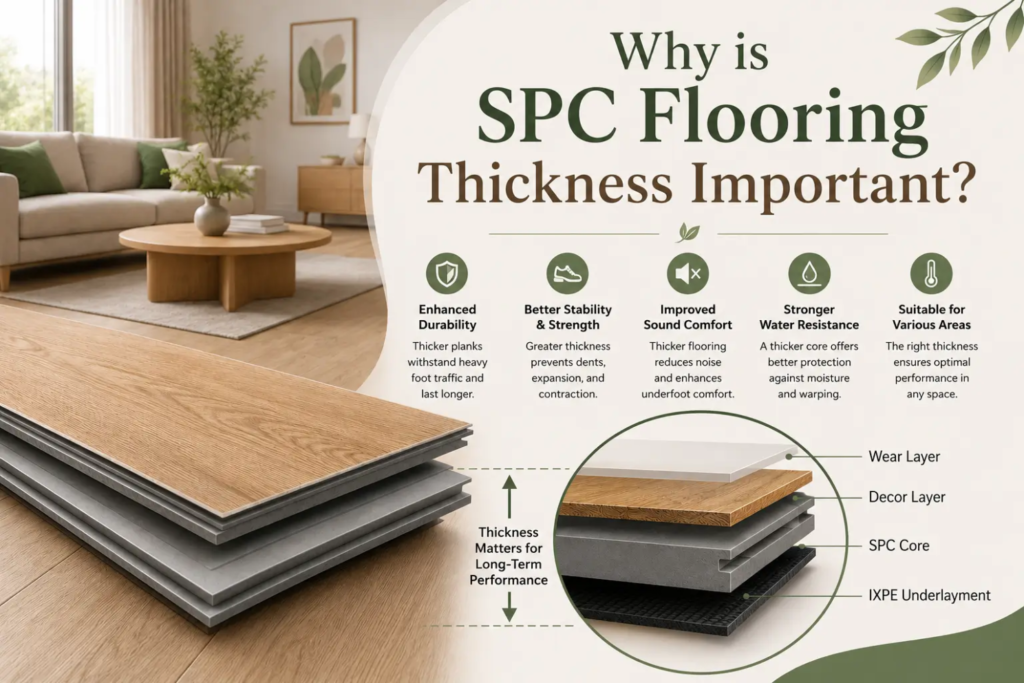
These thicknesses are not chosen randomly.
Different constructions are intended to meet different expectations for rigidity, walking comfort, installation performance, and cost.
For many residential applications, SPC flooring with a total thickness of approximately 5 mm to 6 mm and a 20 mil (approximately 0.5 mm) wear layer can provide a useful balance between durability, pricing, and performance.
Bedrooms and other relatively low-traffic areas may be suitable for products between 4 mm and 5 mm.
Commercial buildings, on the other hand, often require thicker flooring constructions, commonly between 6 mm and 8 mm, together with suitable wear layers and verified performance specifications.
However, thickness alone does not determine flooring quality.
Core density, material formulation, locking precision, wear layer performance, and subfloor preparation are equally important.
A well-manufactured 5 mm SPC plank may perform better than a poorly manufactured 7 mm product.
The correct choice therefore depends on the entire flooring system rather than one number on a product label.
A thicker SPC flooring construction can offer several practical advantages, particularly when the additional thickness comes from the rigid core rather than simply from a thicker foam backing.
One of the most noticeable differences is structural rigidity.
Under otherwise comparable conditions, increasing the rigid core thickness can improve bending resistance and reduce the amount of movement experienced under certain loads.
This is particularly relevant in busy residential spaces and commercial environments where furniture, equipment, and repeated foot traffic place additional demands on the floor.
Thicker flooring constructions may also provide improved impact resistance, although actual performance depends on the formulation and mechanical properties of the core.
Walking comfort is another consideration.
A thicker product, especially when combined with a suitable attached underlayment, may provide a more comfortable feeling underfoot and help reduce certain types of impact noise.
However, SPC remains a relatively rigid flooring material. Increasing its thickness does not automatically make it soft, and acoustic performance should be evaluated using the complete flooring system.
Some thicker SPC products may also be less sensitive to minor subfloor imperfections than very thin products.
Nevertheless, no SPC flooring thickness should be considered a substitute for proper subfloor preparation.
An uneven substrate can place excessive stress on the locking joints, leading to movement, separation, or broken locking edges.
The locking system itself is another important factor.
Because click-lock profiles are machined into the rigid core, the available core thickness affects the geometry that can be used for the locking connection.
A thicker core may allow a more substantial locking profile, but actual locking strength also depends on the profile design, manufacturing accuracy, material formulation, and testing results.
Modern SPC rigid core technology has made it possible to manufacture relatively thin products, including 5 mm constructions, with good stability and reliable installation performance.
In short, SPC flooring thickness affects much more than the finished floor’s appearance. It influences how the plank responds to pressure, how its locking system performs, and how suitable it may be for different installation environments.
In international flooring trade, SPC flooring specifications are often presented using a combination of numbers.
For example:
4.0 mm / 0.3 mm + 1.0 mm IXPE
This specification is commonly interpreted as a 4.0 mm SPC plank, including its protective and decorative layers but excluding the attached pad, with a 0.3 mm wear layer and an additional 1.0 mm IXPE backing.
The finished product therefore has a nominal total thickness of approximately 5.0 mm.
It is important to clarify this point with the supplier because some manufacturers describe the thickness differently.
A product advertised simply as “7 mm SPC Flooring” does not tell the buyer enough about its construction.
It might consist of a 5 mm SPC plank with 2 mm EVA backing, or a 6 mm SPC plank with 1 mm IXPE backing.
Both products may have the same nominal overall thickness, but their structural performance, acoustic characteristics, and material costs can differ considerably.
This is why professional buyers should always request a complete specification rather than relying on the advertised thickness alone.
For detailed specifications or assistance selecting the right rigid core flooring construction, please visit our HANSHAN Flooring Support Center.
Thickness is one of the factors that influences SPC flooring manufacturing costs.
Generally, increasing the rigid core thickness requires more raw materials per square meter.
A thicker plank may also affect production speed, packaging quantities, container loading capacity, and transportation costs.
For large-volume importers, these differences can become significant.
However, selecting SPC flooring should be treated as a long-term investment rather than simply a comparison of initial purchase prices.
A well-manufactured flooring product with the appropriate specifications can provide a longer useful service life, lower maintenance requirements, better resistance to everyday wear, and improved installation reliability.
It can also reduce the risk of unnecessary complaints and after-sales problems.
For homeowners, flooring failures can cause inconvenience, disruption, and additional repair expenses.
For importers, distributors, and flooring brands, product failures may lead to warranty claims, replacement costs, damaged customer relationships, and reputational losses.
These costs can easily outweigh a small saving on the original purchase price.
At HANSHAN, our goal is to manufacture high-quality SPC flooring that combines stable raw material quality, reliable locking performance, and competitive factory-direct pricing.
This is one of the most commonly misunderstood aspects of SPC flooring specifications.
The terms total thickness, wear layer thickness, and core thickness describe different parts of the product.
Confusing them can lead to purchasing the wrong flooring construction and, in some cases, unnecessary financial losses.
Total thickness is the overall measurement of the finished flooring plank, including any attached underlayment.
This measurement is important when planning installation heights, door clearances, transition strips, and connections with adjacent flooring surfaces.
For example, replacing a 4 mm floor with an 8 mm product may require adjustments around doors, thresholds, and other fixed building elements.
The wear layer is the transparent protective film above the decorative surface.
In North America, wear layer thickness is frequently measured in mils.
One mil equals 0.001 inch, or approximately 0.0254 mm.
A 20 mil wear layer is therefore approximately 0.508 mm thick.
Internationally, wear layer specifications are commonly expressed directly in millimeters.
One important distinction is often overlooked: the wear layer primarily protects against surface abrasion and does not provide the main structural strength of the flooring.
A thicker wear layer may improve the floor’s ability to withstand surface wear, but it does not prevent a weak core from denting under heavy furniture or eliminate problems caused by an inadequate locking system.
As expectations for surface durability continue to increase, we have also developed our MSPC flooring series, designed to provide enhanced wear resistance and easier cleaning.
This product range is intended for applications where conventional SPC surface performance may not be sufficient, including busy commercial environments and projects with more demanding abrasion-resistance requirements.
The rigid SPC core is the main structural component beneath the decorative film.
Its thickness influences bending stiffness, locking profile geometry, and resistance to certain concentrated loads.
For a simplified comparison, bending stiffness increases approximately with the cube of thickness when material properties and other relevant conditions remain equal.
This means a core that is 1.5 times thicker may have approximately 3.4 times the bending stiffness under comparable conditions.
However, actual SPC flooring performance depends on the complete plank construction, core formulation, locking geometry, and support from the subfloor.
A 6 mm rigid core should therefore not automatically be described as three or four times stronger than a 4 mm finished flooring product.
The distinction between bending stiffness and overall flooring durability is important.
Attached underlayment is commonly manufactured from IXPE or EVA foam.
Typical thicknesses include 1 mm, 1.5 mm, and 2 mm.
Its primary functions are to improve underfoot comfort and contribute to acoustic performance.
Although a thicker attached pad increases the total thickness shown on the specification sheet, it should not be confused with a thicker structural core.
For cost-sensitive projects, some buyers prefer SPC flooring without attached IXPE or EVA.
A separate EPE foam underlayment or a moisture-control membrane may be considered where the manufacturer permits it.
However, these materials serve different purposes. EPE foam provides a cushioning layer, while a moisture-control membrane is intended to help manage moisture vapor transmission from the substrate.
They should not be treated as interchangeable products.
Any separate underlayment must meet the flooring manufacturer’s requirements, particularly regarding compression resistance and compatibility with the click-lock system.
For a broader understanding of how SPC compares with other vinyl flooring constructions, please refer to our SPC vs LVP Flooring Comparison.
Wear layer thickness is often expressed differently between North American and international markets.
Understanding these conversions helps buyers compare quotations accurately, especially when sourcing flooring from overseas manufacturers.
| MIL | MILLIMETERS | COMMON LABEL |
|---|---|---|
| 6 mil | 0.15 mm | Budget residential |
| 8 mil | 0.20 mm | Entry residential |
| 12 mil | 0.30 mm | Standard residential |
| 20 mil | 0.50 mm | Residential/light commercial |
| 28 mil | 0.70 mm | Commercial |
| 30 mil | 0.75 mm | Heavy commercial |
The chart should help readers compare commonly used wear layer specifications, including 6 mil, 8 mil, 12 mil, 20 mil, 22 mil, 28 mil, and 30 mil.
Most SPC flooring products available in the international market fall within several common thickness ranges.
However, these categories should be understood as general market references rather than fixed industry requirements.
The most suitable thickness can vary depending on the country, climate, expected traffic, installation conditions, and local customer preferences.
For this reason, professional SPC flooring manufacturers often adjust their product specifications according to the requirements of individual importers and distributors.
| TOTAL THICKNESS | TYPICAL CORE | TYPICAL WEAR LAYER | BEST APPLICATION |
|---|---|---|---|
| 3.5 to 4.5 mm | 3.0 to 3.5 mm | 0.2 to 0.3 mm (8 to 12 mil) | Budget residential, rentals, low traffic bedrooms |
| 5.0 to 5.5 mm | 3.5 to 4.0 mm | 0.3 to 0.5 mm (12 to 20 mil) | Standard whole home residential, multifamily |
| 5.5 to 6.0 mm | 4.0 to 4.5 mm | 0.5 mm (20 mil) | Light commercial (offices, boutique retail) |
| 6.0 to 8.0 mm | 4.0 to 5.5 mm | 0.5 to 0.7 mm (20 to 28 mil) | High traffic commercial (corridors, hospitality) |
| 8.0 to 10.0 mm | 5.5 to 8.0 mm | 0.7 mm+ (28 to 30 mil) | Premium and heavy duty commercial |
A comparison chart can help buyers understand which thickness ranges are commonly considered for budget residential projects, standard homes, light commercial spaces, high-traffic commercial buildings, and specialized applications.
To make these specifications easier to understand, consider several practical product constructions.
A nominal 6 mm SPC flooring product may consist of a 4 mm SPC plank with an additional 2 mm EVA backing. One possible plank size is approximately 7.5 inches by 48 inches.
A 7 mm product may consist of a 5 mm SPC plank combined with 2 mm EVA underlayment, manufactured in a wider format such as 9 inches by 60 inches.
For premium applications, a 10 mm product might use a thicker rigid core, a 30 mil (approximately 0.75 mm) wear layer, and an attached IXPE backing.
The exact thickness of each component must be confirmed to ensure that the finished construction meets the advertised total.
These examples demonstrate why overall thickness alone cannot explain the performance or cost of an SPC flooring product.
Two products with similar dimensions and the same nominal thickness may still differ considerably in raw material quality, wear layer performance, locking strength, and manufacturing consistency.
If you are sourcing a mid-range residential flooring product, we can help you evaluate 5.0 mm to 6.5 mm vinyl flooring options and explain how the specifications translate into actual manufacturing constructions.
The following comparison is intended to help homeowners, flooring contractors, and international buyers understand the practical differences between commonly available SPC flooring thicknesses.
🔴 [INSERT CHART: SPC THICKNESS COMPARISON OVERVIEW]
| THICKNESS | BEST FOR | TYPICAL LIFESPAN | RECOMMENDED? |
|---|---|---|---|
| 4mm | Bedrooms, rentals | 5 to 10 years | Budget choice |
| 5mm | Most residential homes | 10 to 20 years | Yes |
| 6mm | Whole home residential, light commercial | 15 to 25 years | Best overall |
| 7mm | Premium residential | 20 to 25 years | Excellent |
| 8mm+ | Commercial, hospitality | 20+ years | Commercial use |
The chart should compare overall thickness, suggested wear layer ranges, typical applications, structural considerations, and relative price positioning.
Keep in mind that the actual performance of any flooring product must be verified through its specifications and relevant test results.
Choosing the correct SPC flooring thickness is ultimately a process of matching the product to the installation environment.
You need to consider core density, wear layer thickness, expected foot traffic, subfloor condition, and even the climate of the region where the flooring will be installed.
The following examples explain how these factors influence purchasing decisions.
For bedrooms, guest rooms, wardrobes, and other spaces with relatively limited daily traffic, SPC flooring between 4 mm and 5 mm can be a practical choice.
A 12 mil wear layer, equivalent to approximately 0.3 mm, is commonly considered for these applications.
These rooms generally experience less concentrated traffic and fewer rolling loads than living rooms, offices, or commercial spaces.
A thinner plank may also help reduce material costs and make transitions between adjacent rooms easier.
However, subfloor flatness becomes especially important with thinner SPC flooring.
A 4 mm product may be less forgiving of uneven substrates, and excessive movement beneath the plank can place additional stress on the locking joints.
For example, if the subfloor has deviations greater than 2 mm over a 2-meter distance, leveling may be necessary, depending on the flooring manufacturer’s installation requirements.
Choosing a thicker product does not automatically eliminate this problem.
Proper subfloor preparation remains essential regardless of plank thickness.
For homes where the same flooring will be installed throughout the living room, kitchen, hallway, and bedrooms, a total thickness between 5 mm and 6 mm is often a good starting point.
Combining this thickness with a 20 mil wear layer can provide a practical balance between surface protection, rigidity, comfort, and price.
This type of construction is particularly attractive to homeowners who want a consistent flooring design throughout the property.
With suitable product quality, correct installation, and appropriate maintenance, SPC flooring in this category may provide 15 years or more of useful service.
However, actual lifespan depends on traffic, environmental conditions, and the product’s performance characteristics.
At HANSHAN Flooring, we provide OEM manufacturing services according to the thickness preferences of different international markets.
Our SPC flooring options cover approximately 3.5 mm to 10.0 mm, with samples available for different product specifications.
Offices, small supermarkets, clothing stores, cafés, and restaurants often require flooring that can withstand more frequent use than a typical residential bedroom.
For these environments, SPC flooring with a total thickness of approximately 5.5 mm to 6 mm and a 20 mil wear layer is commonly considered.
A suitable rigid core can help support everyday commercial use, while the wear layer provides protection against repeated surface abrasion.
However, commercial flooring selection should also consider rolling-chair resistance, concentrated loads, slip resistance, and relevant commercial-use classifications.
A thicker plank alone does not guarantee that a product is suitable for every commercial environment.
Hotel lobbies, busy corridors, schools, large retail stores, transportation facilities, and high-volume restaurants place much greater demands on flooring materials.
For these applications, buyers often consider SPC flooring between 6 mm and 8 mm, with wear layers ranging from approximately 20 mil to 28 mil.
At this level, core density and formulation become just as important as plank thickness.
A strong locking system is also essential because repeated traffic and movement can place stress on plank joints.
For large commercial projects, we recommend reviewing the complete technical specification, including abrasion resistance, dimensional stability, impact performance, and locking strength.
The correct flooring system should be selected according to the actual service conditions rather than thickness alone.
Some projects require higher performance than standard residential or light commercial flooring can provide.
Healthcare facilities, airports, large public buildings, and industrial showrooms may require specialized flooring systems capable of handling demanding traffic, rolling loads, cleaning procedures, and other operational conditions.
For certain applications, thicker SPC products in the 8 mm to 10 mm range with wear layers of approximately 28 mil to 30 mil may be considered.
However, these environments often have additional technical requirements that cannot be satisfied by thickness alone.
For example, healthcare facilities may require specific hygiene and chemical-resistance properties, while airports and industrial environments may involve concentrated loads or heavy rolling equipment.
The flooring should therefore be evaluated against the relevant project requirements and test standards.
For customers seeking higher rigidity and performance, we have also developed our LSPC Flooring Series, designed for applications requiring thicker constructions and enhanced structural characteristics.
This series provides additional options for buyers who need more specialized flooring solutions beyond conventional SPC products.
SPC flooring thickness is an important specification, but it should never be the only factor guiding a purchasing decision.
A thicker product may offer greater rigidity, a more substantial locking profile, or additional comfort when combined with suitable underlayment.
However, wear resistance depends heavily on the protective surface layers, while dimensional stability and structural performance depend on the rigid core formulation, manufacturing quality, and installation conditions.
For residential buyers, choosing the right balance between thickness, wear layer, and price can help achieve a comfortable and reliable floor without unnecessary spending.
For commercial buyers, contractors, and flooring distributors, evaluating the complete technical specification is even more important.
At HANSHAN Flooring, we believe that good flooring should not simply look attractive when it leaves the factory. It should continue to perform reliably after installation and throughout its intended service life.
Through our commitment to virgin raw materials, controlled manufacturing processes, flexible OEM customization, and ongoing product development, we provide SPC Flooring, LVT Flooring, MSPC Flooring, and LSPC Flooring solutions for different markets and project requirements.
Whether you are an importer, wholesaler, distributor, flooring retailer, contractor, or private-label brand, we welcome the opportunity to help you select the right flooring construction for your market.
Explore HANSHAN Flooring’s SPC collections or contact our team to discuss product specifications, customized manufacturing, samples, and factory-direct quotations.