Contact Us
Lishuangdian Industrial Zone, Zhengding County, Shijiazhuang City, Hebei Province, China.
info@hsspcflooring.com
Whatsapp/Wechat: +86 15933619081

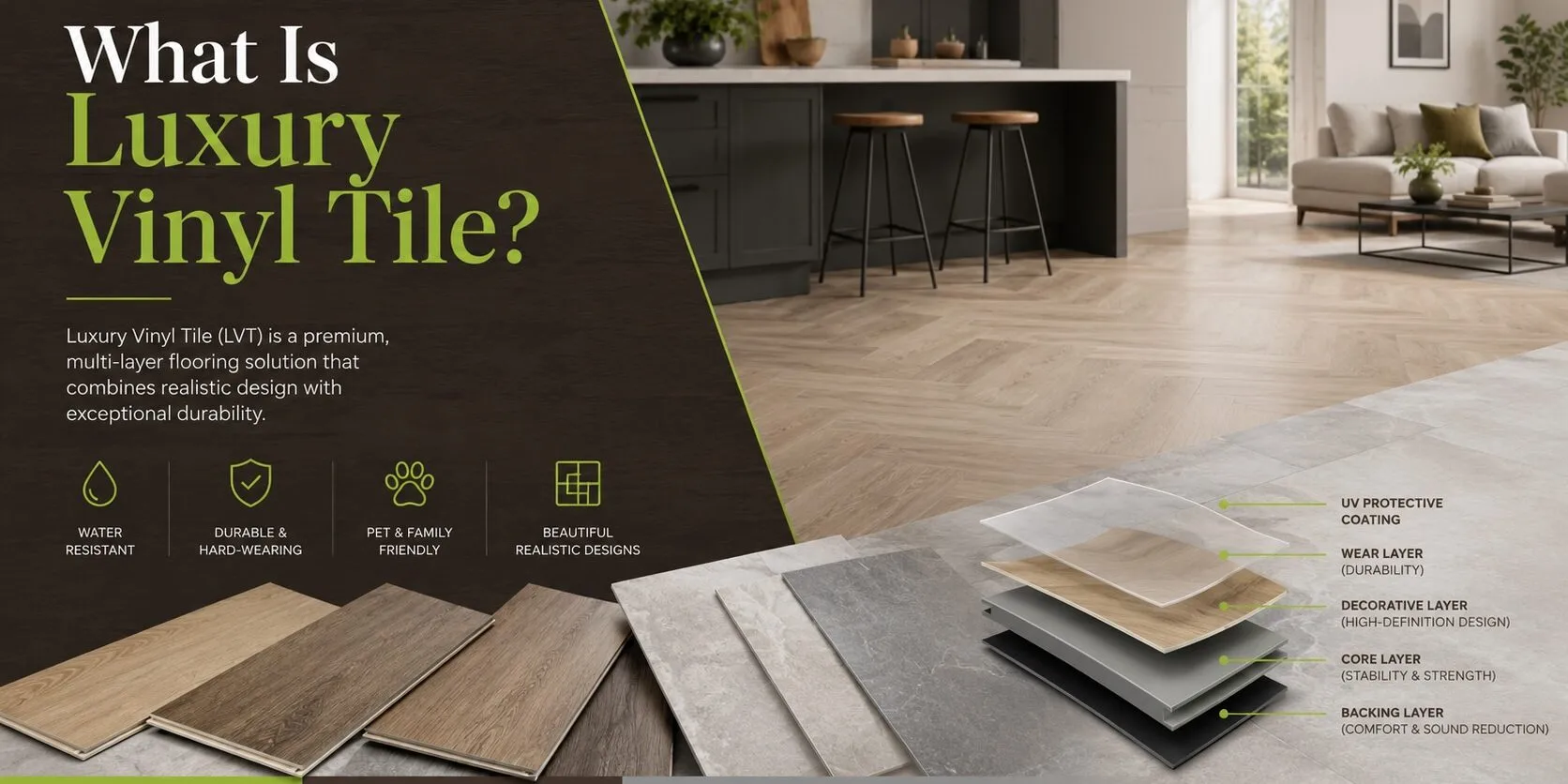
Luxury Vinyl Tile, often shortened to LVT, has become one of the most popular flooring choices worldwide, including in the United States, Canada, Europe, South America, the Middle East, Asia, and Africa. It offers the realistic appearance of natural wood, stone, or ceramic flooring, while providing the practical benefits of a hard-wearing, water-resistant, and easy-to-maintain surface. For many wholesalers, distributors, importers, flooring retailers, and building contractors, LVT flooring has become an attractive product category with strong sales potential and healthy profit margins. Its wide range of designs, installation options, price levels, and applications allows flooring businesses to serve different market segments while building long-term demand for LVT products.
However, not all LVT flooring is manufactured to the same standard. Two products may appear almost identical in photos or online catalogs, yet their performance can be very different after installation and during everyday use. For importers, wholesalers, distributors, and building contractors, understanding the product specification is therefore essential before placing an order. Total thickness, wear layer, core construction, installation method, surface finish, and dimensional stability can all affect the performance and service life of LVT flooring. Different applications also require different specifications. A residential bedroom may have very different requirements from a kitchen, hallway, bathroom, retail store, office, hotel, or high-traffic commercial project. Choosing the right LVT specification for the intended application is just as important as selecting the right color and design.
This is where a basic understanding of LVT flooring specifications can make a significant difference. A quality LVT floor should not only look attractive when it is first installed; it should also be properly matched to the subfloor, expected foot traffic, installation method, and daily maintenance requirements. For importers, wholesalers, distributors, and building contractors, selecting the right LVT product specification can help avoid installation problems and unnecessary costs later. Whether the project requires Glue Down LVT Flooring, Self-Adhesive LVT Flooring, Loose Lay LVT Flooring, or LVT Click Flooring, the best results come from choosing a product according to the actual application rather than focusing on appearance or price alone. A professional LVT flooring manufacturer can also help buyers select the appropriate thickness, wear layer, size, and surface finish for their target market and project requirements.
In this complete LVT flooring buyer’s guide, we will explain what Luxury Vinyl Tile is, how LVT flooring is manufactured, and how its different layers affect overall performance. We will also look at how total thickness, wear layer, surface finish, and construction can influence the suitability of a product for different applications. For importers, wholesalers, distributors, flooring retailers, and building contractors, understanding these details can make it much easier to select the right LVT flooring supplier and product specification for each market. Throughout the guide, we will cover popular LVT formats such as tiles, planks, herringbone, and chevron, as well as different constructions and installation methods, including Dry Back or Glue Down LVT Flooring, Self-Adhesive LVT Flooring, Loose Lay LVT Flooring, and LVT Click Flooring. We will also compare LVT with laminate and engineered wood flooring to help buyers make a more informed purchasing decision.
Whether you are sourcing LVT flooring for a single renovation project, a residential development, or a large commercial property, this guide will help you understand the key factors to consider before making a purchase. By understanding the different LVT constructions, specifications, installation methods, and performance requirements, importers, wholesalers, distributors, retailers, and contractors can make more informed sourcing decisions. The goal is not simply to find an LVT floor that looks attractive, but to select the right product for the intended application, target market, and budget while working with a reliable LVT flooring manufacturer and supplier.
Expert Summary: Luxury Vinyl Tile Flooring
Luxury Vinyl Tile, commonly known as LVT, is a multi-layered vinyl flooring product designed to replicate the natural appearance of wood, stone, concrete, marble, and ceramic tile while providing excellent everyday performance. Its moisture resistance, easy maintenance, design flexibility, and wide range of installation options have made LVT flooring increasingly popular in residential and commercial markets worldwide. For importers, wholesalers, distributors, flooring retailers, contractors, and project buyers, LVT offers an attractive combination of appearance, durability, practical performance, and cost efficiency. As a professional LVT Flooring Manufacturer and Supplier in China, HS Floor provides different LVT constructions and customized solutions to meet the requirements of various international markets and commercial applications.
Luxury Vinyl Tile, commonly known as LVT, is a modern type of vinyl flooring made from multiple functional layers. It is designed to recreate the appearance of natural flooring materials such as wood, stone, slate, marble, concrete, and ceramic tiles while providing the practical benefits of vinyl flooring. Today, LVT flooring is widely used in residential, commercial, and project applications and has become an important product category for flooring importers, wholesalers, distributors, retailers, and contractors worldwide.
Despite the name, “Luxury Vinyl Tile” does not only refer to square or rectangular tiles. LVT is also available in plank formats that imitate natural wood flooring, as well as decorative layouts such as herringbone and chevron. Different sizes, patterns, colors, and surface finishes allow LVT manufacturers to develop products for a wide range of interior styles. This flexibility makes LVT flooring suitable for both traditional and contemporary residential interiors, as well as offices, retail stores, hotels, and other commercial spaces.
The word “luxury” is used to distinguish LVT from older forms of sheet vinyl flooring. Traditional vinyl flooring was commonly supplied in large rolls and often featured a softer and thinner construction. LVT, by contrast, is normally supplied as individual planks or tiles and is manufactured with a more advanced multi-layer structure. Depending on the product, the construction may include a protective wear layer, decorative design layer, vinyl core, and backing layer. These layers contribute to design realism, durability, dimensional stability, and overall performance.
A key reason LVT flooring has grown in popularity is that it can offer the appearance of natural materials without some of their practical drawbacks. For example, wood-effect LVT can reproduce the appearance of oak, walnut, or other wood species while offering excellent water resistance and easier day-to-day maintenance. Stone-effect LVT can create the visual appeal of slate, marble, or concrete without the cold and hard feel often associated with natural stone or ceramic flooring.
LVT is especially useful in rooms where appearance and practicality both matter. Kitchens, bathrooms, utility rooms, hallways, living spaces, offices, retail stores, hotels, and other commercial interiors can all benefit from flooring that is attractive, easy to maintain, and suitable for everyday use. Depending on the project, buyers can choose Dry Back or Glue Down LVT Flooring, Self-Adhesive LVT Flooring, Loose Lay LVT Flooring, or LVT Click Flooring. The right product specification and installation method are important, but when properly selected, LVT can be one of the most versatile flooring solutions available.
For buyers, the main point to understand is that LVT is not a single product type with one fixed level of quality. Different LVT floors can vary significantly in total thickness, wear layer, core construction, surface texture, fitting method, dimensions, and overall performance. A cost-effective flexible LVT tile and a premium rigid-core or SPC flooring product may both be marketed within the wider vinyl flooring category, but they are designed for different applications and performance requirements.
That is why it is worth looking beyond the surface design when sourcing LVT flooring. Color, pattern, and texture are important, particularly for retail and interior design projects, but the technical specification tells buyers much more about how a product is likely to perform after installation. For importers, wholesalers, distributors, and contractors, working with an experienced LVT Flooring Manufacturer and Supplier can also make it easier to select the appropriate construction, thickness, wear layer, installation method, and customized specifications for a particular market or project.
Luxury Vinyl Tile is best understood as a multi-layered flooring product. Rather than being made from one solid piece of material, LVT flooring is constructed from several functional layers, with each layer contributing to the appearance, stability, durability, comfort, and overall performance of the finished floor.
The exact construction can vary depending on whether the product is flexible LVT, rigid core LVT, SPC flooring, click vinyl, or another type of luxury vinyl flooring. However, most LVT products follow the same basic principle: a protective surface, a transparent wear layer, a decorative design layer, a structural core, and a backing layer. The combination and specification of these layers are important factors for an LVT Flooring Manufacturer when developing products for different markets and applications.
At the top of the floor is the protective surface coating. This is the first line of defense against everyday marks, stains, scuffs, and general wear. Depending on the product specification, the surface can be designed with different finishes, including matte, embossed, wood-textured, stone-textured, and other decorative effects. Additional surface treatments may also be used to improve scratch resistance, slip resistance, stain resistance, and ease of cleaning.
Beneath the surface sits the wear layer, which is one of the most important components of LVT flooring. This transparent protective layer covers the printed design and helps protect it from daily traffic and surface damage. Wear layer thickness is therefore an important consideration when choosing LVT. Residential products may require a different specification from flooring designed for offices, retail stores, hotels, public buildings, or other commercial environments with heavier foot traffic.
The design layer is responsible for giving LVT its visual appearance. This is where wood, stone, marble, concrete, ceramic, or other decorative effects are reproduced. Modern printing technology allows LVT Flooring Manufacturers to create highly realistic visuals with natural grain patterns, subtle color variations, and detailed surface designs. Depending on the product, manufacturers can also combine the printed design with embossed or registered embossed textures to create a more realistic connection between the visual pattern and the surface texture.
Below the design layer is the core, which provides much of the flooring’s structure and influences how stable, firm, and comfortable it feels underfoot. Flexible LVT generally has a thinner and more pliable construction, making it suitable for applications where glue-down installation is preferred. Rigid core and SPC flooring use a denser and more stable core construction, providing greater dimensional stability and allowing manufacturers to develop click-lock flooring systems for floating installations.
Finally, the backing layer supports the overall construction and can contribute to stability and installation performance. Depending on the product, the backing may also be designed to improve underfoot comfort or sound performance. Some LVT Click Flooring products are available with an integrated underlay, which can simplify installation and provide additional comfort without requiring a separate underlayment.
Understanding the construction of LVT flooring is important because the visible design represents only one part of the finished product. Two floors may both feature an attractive oak or stone appearance, yet their performance can be quite different if one has a thicker wear layer, a more stable core, a better surface treatment, or a more suitable backing structure.
For importers, wholesalers, distributors, flooring retailers, and contractors, evaluating the complete LVT specification is therefore more important than looking at appearance alone. A reliable LVT Flooring Supplier should be able to provide clear information about total thickness, wear layer, construction, surface finish, dimensions, installation method, and intended application.
In practical terms, high-quality LVT flooring should combine realistic design with a construction that is appropriate for the intended environment. The right product should have the correct wear layer and overall thickness, work with the selected installation method, and provide the level of durability and stability required by the project. This is why choosing an experienced LVT Flooring Manufacturer can make a significant difference when sourcing products for different markets and applications.
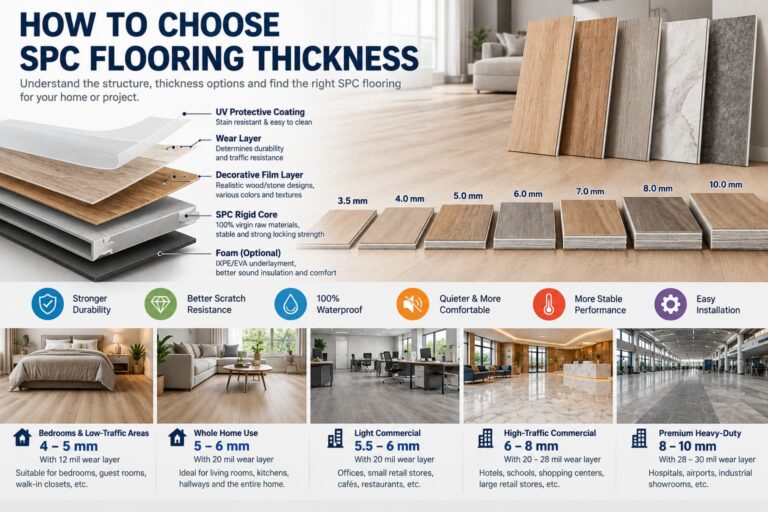
LVT flooring is available in a wide range of thicknesses, and total thickness is one of the first specifications many buyers look at when comparing products. It is also one of the easiest specifications to misunderstand. A thicker floor can provide certain advantages, but thickness alone does not determine whether one LVT product is better or more durable than another.
The appropriate thickness depends on the type of LVT flooring, installation method, room conditions, subfloor, and expected level of traffic. A Glue Down LVT Flooring product, for example, is normally much thinner than a click or rigid core LVT product, but this does not mean it is a lower-quality flooring solution. The two products are simply engineered for different installation methods and applications.
Glue Down LVT Flooring, also known as Dry Back LVT, is bonded directly to the prepared subfloor, so it does not require the same thickness or locking profile as a floating click floor. When installed correctly over a clean, dry, smooth, and properly prepared surface, relatively thin glue-down LVT can provide excellent stability and long-term performance. This is one reason Dry Back LVT remains a popular choice for commercial buildings, retail stores, offices, hotels, and large-scale projects where dimensional stability and the ability to replace individual tiles or planks are important.
LVT Click Flooring and other rigid core LVT products are generally thicker because they incorporate a locking system and a more structured core. These products are commonly installed as floating floors, meaning they are not fully bonded to the subfloor. The additional thickness and rigid construction help provide strength and dimensional stability to the plank or tile, while also contributing to a more solid and comfortable feeling underfoot.
SPC flooring, commonly known as Stone Plastic Composite or Stone Polymer Composite flooring, generally uses a dense rigid core and is often thicker and more stable than traditional flexible LVT. This construction provides a firm feel and good dimensional stability, making SPC flooring a popular option for residential and commercial applications, including kitchens, hallways, living areas, offices, and open-plan spaces. Some SPC and rigid core products also include an integrated IXPE or other underlay. This contributes to the overall product thickness, but it serves a different function from the protective wear layer.
The key point for buyers is that total thickness and surface durability are not the same thing. Total thickness refers to the complete depth of the flooring from the top surface to the backing. Long-term resistance to scratches, scuffs, stains, and daily wear is more closely related to the wear layer, surface treatment, construction quality, and correct installation.
For example, a 6mm LVT Click Flooring product with a relatively light wear layer does not automatically outperform a 2.5mm Glue Down LVT Flooring product with a stronger commercial-grade wear layer. In the same way, a very thick LVT product installed over an unsuitable or poorly prepared subfloor can still move, become unstable, or develop installation problems. Product specification and installation conditions need to work together.
For many residential applications, thicker rigid core LVT or SPC flooring can be attractive because it provides a solid underfoot feel, convenient click installation, and good dimensional stability. However, for large commercial areas, retail projects, offices, hotels, and developments where a firmly bonded floor is preferred, Glue Down LVT Flooring can be a more suitable professional solution.
For importers, wholesalers, distributors, contractors, and flooring retailers, evaluating LVT thickness should therefore be part of a broader product assessment. Instead of asking only how thick the floor is, buyers should also consider the construction, wear layer, surface finish, installation method, and intended application.
When sourcing LVT flooring from a manufacturer or supplier, it is useful to consider three basic questions:
Thickness certainly matters, but it should never be judged in isolation. A well-specified LVT flooring product is the result of matching the right construction, wear layer, surface finish, installation method, and subfloor preparation to the actual requirements of the project. An experienced LVT Flooring Manufacturer can also help importers and project buyers select the appropriate specification rather than simply choosing the thickest product available.
The wear layer is one of the most important specifications to check when sourcing LVT flooring. It is the transparent protective layer positioned above the printed design layer, helping protect the floor from everyday foot traffic, scuffs, stains, scratches, marks, and gradual surface abrasion. For importers, wholesalers, distributors, contractors, and flooring retailers, understanding the wear layer is essential when comparing different LVT flooring products and selecting the right specification for a particular market or project.
The wear layer should not be confused with the total thickness of the flooring. An LVT product may be 2mm, 3mm, 5mm, 6mm, or 8mm thick overall, while the wear layer represents only a small part of the total construction. Total thickness affects the overall structure, installation method, dimensional stability, and feel underfoot, whereas the wear layer has a more direct influence on the floor’s resistance to everyday surface wear and its ability to maintain its appearance over time.
In simple terms, the wear layer helps preserve the appearance of the LVT flooring. Without adequate surface protection, the printed wood, stone, marble, or tile design would be much more vulnerable to scratches, scuffs, stains, and abrasion. Generally, a stronger wear layer makes the product more suitable for busy residential areas, family homes, properties with children or pets, and commercial environments where the flooring is exposed to regular foot traffic and furniture movement.
LVT wear layers are commonly measured in millimetres, although some international markets also use mil as a unit of measurement. Common wear layer specifications include 0.2mm, 0.3mm, 0.5mm, 0.55mm, and 0.7mm. The appropriate wear layer depends on the complete product construction and intended application, but these specifications provide a useful reference when buyers compare different LVT flooring suppliers and manufacturers.
For lighter residential applications, such as guest bedrooms or areas with limited foot traffic, a thinner wear layer may be sufficient. For kitchens, hallways, living rooms, open-plan spaces, and homes with children or pets, a thicker and more durable wear layer is generally a better choice. In commercial applications, the wear layer becomes even more important because the flooring may need to withstand repeated foot traffic, shoes, cleaning routines, rolling furniture, and other daily demands.
When sourcing LVT flooring from a professional manufacturer, buyers should therefore look at the wear layer together with total thickness, core construction, surface treatment, installation method, and the intended application. A thicker wear layer does not automatically mean that every product is suitable for every project, but choosing the correct wear layer is an important part of achieving the expected durability and long-term appearance of LVT flooring.
Here is a simple guide to common LVT wear layer thicknesses:
| Wear Layer | Typical Suitability | Best Used For |
|---|---|---|
| 0.2mm | Light domestic use | Guest bedrooms, low-traffic rooms and occasional-use spaces |
| 0.3mm | General domestic use | Bedrooms, dining rooms and moderate-use living areas |
| 0.5mm | Heavy domestic use | Kitchens, hallways, living rooms, open-plan spaces and family homes |
| 0.55mm+ | Heavy domestic and light commercial use | Busy homes, home offices, small shops, salons and rental properties |
| 0.7mm | Commercial-grade performance | High-traffic commercial spaces, offices, retail areas and demanding interiors |
A thicker wear layer is not necessarily required for every room or application, but it can provide additional protection where the flooring is expected to experience heavier use. A hallway, for example, may be exposed to outdoor shoes, dirt, grit, and repeated foot traffic throughout the day, while a bedroom normally experiences much lighter use. Choosing exactly the same LVT flooring specification for both areas may not always be necessary, but using an under-specified product in a busy environment can lead to premature surface wear and unnecessary replacement costs.
For importers, wholesalers, distributors, and contractors, it is also important to remember that the wear layer is only one part of the overall durability equation. The quality of the surface coating, design layer, core construction, dimensional stability, backing, installation system, and even the condition of the subfloor can all influence how an LVT floor performs over time. A well-designed LVT flooring product needs these components to work together rather than relying on wear layer thickness alone.
Installation also plays an important role. Even a high-quality LVT product can perform poorly if it is installed over an unsuitable or poorly prepared subfloor. Glue Down LVT Flooring requires a properly prepared surface to achieve a stable bond, while LVT Click Flooring and rigid-core products depend on accurate fitting and suitable subfloor conditions. Following the manufacturer’s installation recommendations is therefore an important part of achieving the expected performance.
A good LVT floor should always be selected as a complete specification. The wear layer tells you about the level of surface protection, but the best results come from matching the wear layer with the appropriate total thickness, core construction, surface finish, installation method, subfloor conditions, and expected level of traffic. When sourcing LVT flooring, working with an experienced manufacturer or supplier can help buyers select a specification that offers the right balance between performance, application, and cost.
The core of an LVT floor plays an important role in how the product feels, fits, and performs after installation. While the decorative surface and wear layer are highly visible and important to buyers, the core is what provides much of the flooring’s structure. Its construction can influence dimensional stability, density, impact resistance, rigidity, comfort underfoot, and, depending on the product, which installation method is most suitable.
This is also where LVT flooring can become slightly confusing for buyers. Different products may be marketed under the broader category of luxury vinyl flooring while having very different internal constructions. A flexible Glue Down LVT Flooring product, a rigid-core LVT Click Flooring plank, and an SPC vinyl floor may all be considered part of the wider resilient flooring category, but they are not identical products and are designed for different applications.
For importers, wholesalers, distributors, contractors, and flooring retailers, understanding the main core constructions makes it easier to compare products from different LVT Flooring Manufacturers and Suppliers. The right core depends on factors such as the room, expected foot traffic, subfloor conditions, installation method, and project requirements. Choosing the appropriate construction at the sourcing stage can help ensure that the finished floor delivers the stability, durability, and performance expected by the end customer.
Flexible LVT is one of the most established forms of Luxury Vinyl Tile Flooring. Compared with rigid-core products, it is generally thinner, more flexible, and commonly installed using the glue-down or Dry Back LVT method. Because of its relatively thin construction and direct-bond installation, flexible LVT remains an important product category for many commercial flooring projects and residential applications.
With Glue Down LVT Flooring, the planks or tiles are bonded directly to the prepared subfloor using a suitable flooring adhesive. When the substrate has been correctly prepared and the installation is carried out according to the manufacturer’s recommendations, flexible LVT can provide a highly stable and precise finished surface. It is particularly useful in commercial environments because individual planks or tiles can usually be removed and replaced when necessary, without having to replace the entire floor. The fully bonded installation can also help minimize movement across larger areas.
The main point buyers should understand is that flexible LVT depends heavily on proper subfloor preparation. Because the product is relatively thin and flexible, uneven areas, bumps, cracks, or other imperfections in the substrate may become visible through the finished flooring over time. This effect is commonly referred to as “telegraphing.” For this reason, professional preparation of the subfloor, including checking flatness and moisture conditions and selecting the appropriate adhesive, is an important part of a successful Glue Down LVT installation.
Flexible LVT can be an excellent choice for importers, wholesalers, distributors, contractors, and commercial flooring projects where a firmly bonded and easily maintainable floor is required. It may be thinner than many rigid-core click products, but thickness alone does not determine durability. When a quality flexible LVT product is combined with the correct wear layer, suitable adhesive, properly prepared subfloor, and professional installation, it can provide reliable long-term performance.
For buyers sourcing Dry Back LVT from a professional LVT Flooring Manufacturer or Supplier, it is therefore important to evaluate the complete specification rather than focusing only on total thickness. Product construction, wear layer, surface finish, adhesive compatibility, installation requirements, and intended application should all be considered before selecting the final product.
Rigid core LVT is designed to provide a firmer, more structured feel than traditional flexible vinyl flooring. It generally features a thicker and more rigid construction and is commonly manufactured with an interlocking click-lock system. This combination makes rigid core LVT a popular choice for residential renovations as well as a wide range of commercial and interior projects where convenient installation and dimensional stability are important.
One of the main advantages of rigid core LVT is its relatively straightforward installation compared with Glue Down LVT Flooring. Instead of applying adhesive across the subfloor, the planks or tiles are connected through a click-lock system to create a floating floor. This can make installation faster and more convenient, particularly for residential projects and renovation applications. Rigid construction can also provide a more stable and substantial feeling underfoot and may be somewhat more forgiving of minor substrate variations than thin flexible LVT.
However, rigid core flooring should not be treated as a solution for a seriously uneven subfloor. The substrate should still be clean, dry, sufficiently level, sound, and stable before installation. Proper preparation helps prevent movement, gaps, excessive stress on the locking system, and other installation problems. Professional LVT Flooring Manufacturers and Suppliers should provide clear installation recommendations according to the specific product construction.
Rigid core LVT is commonly installed as a floating floor, meaning that the flooring is not permanently bonded to the subfloor. Instead, the individual planks or tiles are securely connected through the locking system and installed with the required expansion clearance around the perimeter and other fixed objects. Depending on the product, an integrated IXPE or other underlay may also be included to improve underfoot comfort, reduce sound transmission, and simplify the installation process.
For importers, wholesalers, distributors, contractors, and flooring retailers, rigid core LVT offers a practical combination of performance, appearance, and installation convenience. It combines the water-resistant characteristics and realistic designs associated with Luxury Vinyl Flooring with a firmer core construction and modern click installation. For projects where fast installation, stable performance, and an attractive wood or stone appearance are priorities, LVT Click Flooring can be an effective solution.
When sourcing rigid core LVT from a Chinese LVT Flooring Manufacturer, buyers should look beyond total thickness and also evaluate the core construction, wear layer, locking system, surface finish, dimensions, underlay options, and intended application. These specifications work together to determine the overall performance and suitability of the finished flooring.
SPC stands for Stone Plastic Composite or Stone Polymer Composite, and it has become one of the most widely used constructions within rigid core LVT flooring. Known for its dense and highly structured core, SPC LVT offers a firm and stable flooring solution that is widely used in residential, commercial, and renovation projects around the world.
An SPC core is typically made using a carefully formulated combination of limestone-based mineral material, PVC and stabilisers. This creates a dense and rigid board that provides good dimensional stability compared with more flexible vinyl constructions. The rigid core also helps the flooring maintain its shape under everyday use, making SPC LVT a popular option for areas where stability, durability, moisture resistance, and easy maintenance are important.
For homeowners, contractors, importers, wholesalers, and flooring distributors, SPC LVT is particularly attractive for kitchens, hallways, utility rooms, living areas, open-plan interiors, rental properties, offices, retail spaces, and other areas exposed to regular foot traffic. Its dense core provides a firm feel underfoot and works well with modern click-lock installation systems.
Compared with WPC or traditional flexible LVT, SPC flooring generally feels harder and more rigid when walked on. This is not necessarily a disadvantage. The firm construction is one of the reasons SPC has become so popular in the global Luxury Vinyl Flooring market. It provides a solid foundation for click systems and can offer reliable dimensional stability when the product is correctly specified and installed.
Many SPC LVT products are manufactured as floating floors with click-lock systems such as Unilin or Valinge-style profiles. Some products are also supplied with an integrated IXPE or other underlay. An attached underlay can improve underfoot comfort, help reduce impact sound, and simplify installation by eliminating the need to purchase and install a separate underlay, depending on the project requirements.
For buyers sourcing SPC LVT from a professional LVT Flooring Manufacturer in China, product construction and consistency are especially important. Core density, thickness, wear layer, surface treatment, locking profile, dimensions, and backing construction should all be considered when comparing different suppliers. A well-balanced SPC product should combine a stable rigid core with an appropriate wear layer and surface finish for the intended application.
SPC is not automatically better than every other type of LVT flooring. Flexible Glue Down LVT, Self-Adhesive LVT, Loose Lay LVT, and other constructions each have their own advantages and application areas. However, when strength, dimensional stability, water resistance, easy maintenance, and convenient click installation are key priorities, SPC LVT remains one of the most practical and widely requested rigid core flooring solutions available today.
WPC stands for Wood Plastic Composite or Wood Polymer Composite. Like SPC, WPC is a type of rigid core vinyl flooring, but its core construction is generally lighter and provides a slightly softer and more cushioned feel underfoot. For buyers comparing different types of Luxury Vinyl Flooring, WPC can be an attractive option when comfort is considered as important as stability and durability.
One of the main characteristics of WPC flooring is its more comfortable feel compared with the firmer construction of SPC. This can make WPC particularly appealing for bedrooms, living rooms, apartments, hospitality interiors, and other areas where people spend a considerable amount of time standing or walking. Depending on the product construction and whether an integrated underlay is included, WPC can also provide improved acoustic performance and help create a quieter indoor environment.
The softer and lighter construction of WPC comes with certain trade-offs. Compared with dense SPC flooring, WPC generally has a less rigid core and may not provide the same level of firmness and impact resistance in demanding applications. For busy commercial environments, high-traffic areas, or projects where maximum rigidity and dimensional stability are priorities, SPC LVT may be the more suitable option.
However, this does not mean WPC is unsuitable for demanding projects. A properly designed WPC product with an appropriate wear layer, stable core construction, quality surface treatment, and suitable click-lock system can provide reliable performance in many residential and selected commercial applications. The final choice should always be based on the complete product specification and the requirements of the project.
For importers, wholesalers, distributors, contractors, and flooring retailers, comparing WPC and SPC based only on the core name can be misleading. Total thickness, wear layer, core density, locking system, surface finish, underlay, plank dimensions, and installation requirements can all affect the actual performance of the flooring.
As an experienced LVT Flooring Manufacturer and Supplier, MNS Floor can provide different rigid core flooring constructions according to the requirements of different markets and projects. WPC, SPC, and other LVT products can be developed with different thicknesses, wear layers, dimensions, colours, surface textures, and packaging options for OEM and private-label programs.
Ultimately, WPC is a practical choice when a buyer wants the stability and easy installation associated with rigid core LVT while placing greater emphasis on comfort and a softer underfoot feel. The best flooring is not necessarily the one with the strongest core, but the one whose complete construction is correctly matched to the application, installation conditions, and expected level of use.
| Core Type | Best For | Main Strength | What to Consider |
|---|---|---|---|
| Flexible LVT | Glue-down domestic or commercial installations | Very stable when bonded to a well-prepared subfloor | Requires excellent subfloor preparation to avoid imperfections showing through |
| Rigid Core LVT | Domestic renovations, click installations and busy homes | Stronger structure and more solid feel than flexible vinyl | Still needs a clean, dry, level and stable subfloor |
| SPC LVT | Kitchens, hallways, utilities, open-plan spaces and commercial areas | Dense, rigid and dimensionally stable construction | Can feel firmer underfoot than softer vinyl products |
| WPC LVT | Living rooms, bedrooms and comfort-focused domestic spaces | Softer, warmer and more cushioned feel underfoot | Usually less dense than SPC, so may not be the first choice for very heavy-use areas |
When choosing between different LVT core constructions, it is usually better to start with the application rather than the product name. Different spaces have different flooring requirements, and there is no single LVT core that is automatically the best choice for every project.
A busy hallway, entrance area, or open-plan space may benefit from the firm and stable construction of SPC LVT, particularly where regular foot traffic and dimensional stability are important. A large commercial project may be better suited to professionally installed Glue Down LVT Flooring, where the flooring is bonded directly to a properly prepared subfloor and individual planks or tiles can be replaced when required.
For bedrooms, living rooms, apartments, and other areas where underfoot comfort is a higher priority, WPC or other suitable rigid-core constructions can provide a softer and more comfortable flooring experience. Meanwhile, flexible LVT remains a practical option for projects that require a thinner profile, precise bonded installation, or easy replacement of individual tiles and planks.
For importers, wholesalers, distributors, contractors, flooring retailers, and project buyers, the most suitable LVT Flooring is therefore the product that matches the actual conditions of the space. Expected foot traffic, moisture exposure, subfloor condition, installation method, wear layer, total thickness, surface finish, and required level of comfort should all be considered together.
The best LVT core is not simply the one with the highest density or greatest thickness. It is the construction that provides the right balance of stability, durability, comfort, installation efficiency, and cost for the intended application. Working with an experienced LVT Flooring Manufacturer and Supplier can make it easier to select the right specification for different markets, projects, and end-use requirements.
One of the major strengths of LVT flooring is the wide range of formats and designs available. Unlike some flooring products that are closely associated with a particular appearance, Luxury Vinyl Tile Flooring can be manufactured to reproduce the natural look of hardwood, stone, concrete, marble, ceramic, and a wide range of decorative patterns. This design flexibility makes LVT suitable for everything from traditional homes and modern apartments to rental properties, hotels, retail stores, offices, commercial developments, and large renovation projects.
LVT is available in both plank and tile formats, allowing buyers to choose a shape that works best for the intended application. LVT tile flooring can create the appearance of natural stone or ceramic tiles, while wood-effect vinyl planks can reproduce the character of oak, walnut, herringbone, or other popular timber designs. More decorative formats, including herringbone and chevron patterns, can also be produced for projects where the flooring itself is intended to become an important part of the interior design.
The format you choose affects more than the appearance of the finished floor. Plank or tile dimensions can influence how large or compact a room feels, how the pattern flows through the space, the amount of cutting and installation work required, and the potential material waste during installation. Larger planks, for example, can create a clean and contemporary appearance, while smaller tiles or patterned formats can provide a more traditional or decorative character.
For LVT Flooring Importers, Wholesalers, Distributors, Contractors, and Flooring Retailers, format flexibility can also be important when developing products for different markets. Customer preferences can vary considerably between countries and regions, so having the ability to customize plank dimensions, tile sizes, colours, textures, and patterns can provide greater flexibility when building a product range.
As a professional LVT Flooring Manufacturer and Supplier in China, MNS Floor can develop different LVT formats according to project requirements and market preferences. Standard wood-look planks and stone-look tiles can be combined with customized sizes, colours, surface textures, and decorative patterns, making LVT a versatile solution for both standard product lines and OEM flooring programs.
Ultimately, the right LVT format should balance design requirements with installation conditions and project practicality. By considering the size of the room, the desired visual effect, installation method, material usage, and target market, buyers can select an LVT flooring format that not only looks attractive but also works efficiently throughout the project.
VT plank flooring is designed to recreate the natural appearance of real wood flooring. It is typically produced in long, narrow planks that replicate the look of oak, walnut, pine, smoked wood, grey wood and rustic timber. For many homeowners, wood-look LVT is one of the most familiar types of luxury vinyl flooring, combining the warmth and character of natural wood with the practical benefits of vinyl.
LVT wood planks work particularly well in living rooms, bedrooms, dining areas, hallways and open-plan kitchen and living spaces. The plank format creates a natural, continuous appearance across larger areas and can help connect different rooms visually, especially when the same flooring design is used throughout the space.
The direction in which LVT planks are installed can also influence how a room looks and feels. Installing the planks along the longest wall can make a room appear longer and more spacious, while laying them towards a window or primary source of natural light can guide the eye through the room and emphasize the length of the flooring.
For homeowners who appreciate the appearance of engineered wood but want a flooring option that is more water-resistant and easier to maintain, wood-effect LVT planks can be a practical alternative. With realistic wood textures, colours and grain patterns, LVT plank flooring can provide a natural-looking finish while offering the durability and low-maintenance characteristics associated with vinyl flooring.
LVT tile flooring is designed to recreate the appearance of natural stone and ceramic surfaces, including slate, marble, limestone, concrete and other popular tile designs. Also known as luxury vinyl tile flooring, LVT offers a practical way to achieve the look of a tiled floor while adding the comfort and everyday performance associated with modern vinyl flooring. It is widely used in kitchens, bathrooms, utility rooms, entrance areas, living spaces and contemporary open-plan interiors.
One of the main advantages of LVT flooring is that it can provide the visual appeal of ceramic or natural stone without some of the disadvantages associated with traditional hard flooring. LVT is generally warmer and more comfortable underfoot, while its resilient surface can feel less harsh during everyday use. LVT tiles are also relatively easy to cut and work with during installation, making them suitable for a range of room layouts and renovation projects.
Stone-effect LVT flooring is particularly popular in spaces where a clean, practical and contemporary appearance is required. Concrete-effect and large-format LVT tiles can complement modern kitchens, commercial interiors and minimalist designs, while marble-effect LVT can create a more decorative and premium appearance without the upkeep typically associated with real marble. Depending on the product construction, waterproof LVT flooring can also be a practical choice for areas where moisture resistance is important.
LVT tile flooring can be installed in a variety of layouts, including straight, staggered and more decorative patterns. The final installation method depends on the LVT format and product type, such as glue down LVT flooring, dry back LVT or other installation systems. This flexibility allows designers, contractors and homeowners to choose an LVT floor that matches both the desired appearance and the practical requirements of the space.
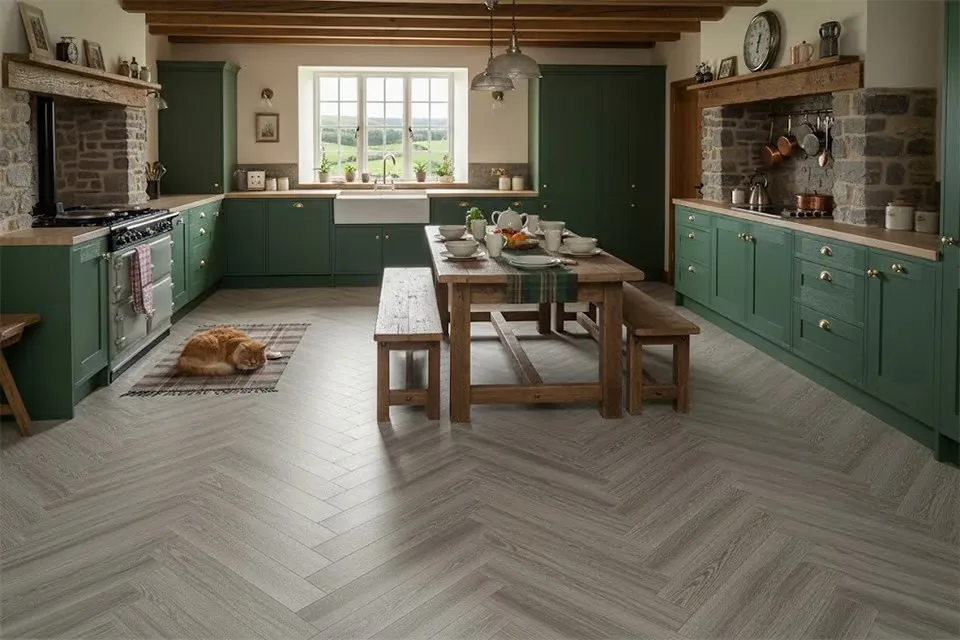
Herringbone LVT flooring is designed to recreate the classic appearance of traditional parquet flooring while offering the practical benefits of modern luxury vinyl. Instead of being installed in a simple straight or staggered layout, the smaller LVT planks are arranged in a distinctive zig-zag pattern. This creates greater visual movement and texture, making herringbone LVT a more decorative alternative to conventional straight plank flooring.
Herringbone LVT works particularly well in hallways, living rooms, dining rooms, bedrooms and open-plan interiors where the floor is intended to become an important part of the overall design. Wood-effect finishes such as natural oak, smoked oak and warm timber tones can give the room a premium, architectural appearance while retaining the practical characteristics of LVT flooring.
For customers who like the timeless character of parquet but prefer the easier maintenance and moisture resistance offered by vinyl flooring, herringbone LVT can be an attractive alternative. Depending on the product construction and specification, it can be used in residential renovations, period properties, contemporary interiors and commercial spaces where both appearance and everyday practicality are important.
One of the main considerations when choosing herringbone LVT flooring is installation. Compared with standard LVT plank flooring, a herringbone pattern requires more careful planning and accurate setting out to maintain the alignment of the design. Installation can also involve more cutting and may result in a higher level of material waste. For larger projects, it is therefore important to calculate the required quantity carefully and allow additional material for cutting and installation. Using an experienced flooring installer can also help achieve a clean and consistent herringbone pattern.
Chevron LVT flooring is a popular patterned luxury vinyl flooring option that recreates the elegant appearance of traditional parquet flooring. Like herringbone LVT, it uses smaller planks to create a distinctive geometric floor pattern. The key difference is the shape and arrangement of the planks: chevron LVT planks are typically cut at an angle so that their ends meet to form a continuous V-shaped pattern.
This angled arrangement gives chevron LVT a clean, directional appearance that is often considered more refined and contemporary than a traditional herringbone pattern. The strong V-shaped lines can create a sense of movement across the floor and naturally guide the eye through a room. For this reason, chevron vinyl flooring can be particularly effective when the flooring design is intended to make a strong architectural or decorative statement.
Chevron LVT flooring works well in hallways, living rooms, lounges, dining areas, boutique retail spaces, hospitality interiors and open-plan commercial or residential projects. When the pattern is carefully aligned with the shape of the room, it can also make narrower or elongated spaces feel more structured and visually organised.
As with herringbone LVT, chevron LVT requires more precise planning and installation than a conventional straight plank or tile layout. The starting point, direction and alignment of the pattern need to be established carefully before installation begins. Because the angled cuts can generate more off-cuts, it is also important to allow additional material when calculating the order quantity. For larger projects, professional installation can help maintain consistent V-shaped lines and achieve the intended finished appearance.
The best LVT flooring format depends on the style of the property, the size and shape of the room, and the role the floor is expected to play in the overall interior design. Straight LVT planks are one of the most versatile choices and can create a simple, continuous appearance. LVT tile flooring is well suited to kitchens, bathrooms, utility areas and contemporary interiors, while herringbone LVT adds classic parquet-style detail and visual movement. Chevron LVT creates a sharper, more directional pattern for a more distinctive and architectural look.
Room size should also be considered when selecting an LVT floor format. In larger rooms and open-plan spaces, standard plank and tile formats can help create a clean and continuous visual effect. In smaller rooms or selected feature areas, herringbone and chevron LVT can add character and make the flooring itself a design element. However, the scale of the pattern should be chosen carefully. A highly detailed pattern may have less visual impact in a very small room, particularly when much of the floor is covered by furniture.
Appearance is only one part of choosing the right LVT flooring. The product’s construction, including the core, wear layer, overall thickness and surface finish, should be considered alongside the intended application. The installation method is also important, whether the project requires glue down LVT, dry back LVT, loose lay LVT or LVT click flooring. Choosing a suitable product for the room and installing it correctly are essential for achieving both the desired appearance and long-term flooring performance.
Ultimately, the best LVT flooring is not simply the pattern that looks most attractive. It is the format and specification that suit the room, installation requirements, expected foot traffic and overall design of the project.
The installation method is one of the most important factors to consider when choosing LVT flooring. It affects how the floor is fitted, the level of subfloor preparation required, installation time, long-term performance and how easily individual sections can be repaired or replaced. The fitting method can also determine whether a project is suitable for DIY installation or whether it is better completed by an experienced flooring professional.
There is no single best LVT installation method for every room or project. Click LVT flooring, glue down LVT, floating LVT and loose lay LVT each offer different advantages and are suited to different applications. The right option depends on several factors, including the construction and thickness of the LVT, room size and layout, subfloor condition, expected foot traffic, moisture requirements and the level of stability required.
For renovation projects, it is also worth considering what may happen after installation. Some LVT flooring systems are easier to remove or replace in individual areas, while others provide a more permanent installation. By considering installation requirements together with the product specification and intended use of the room, buyers can select an LVT flooring system that offers the right balance of appearance, installation efficiency and long-term performance.
Click LVT flooring uses an interlocking system that allows individual planks or tiles to connect securely without being glued directly to the subfloor. In most applications, click LVT is installed as a floating floor, meaning the flooring is laid over the prepared subfloor rather than permanently bonded to it. The click-lock system helps create a stable, continuous surface while making installation more straightforward than traditional glue-down LVT.
LVT click flooring is a popular choice for residential renovations because it can generally be installed more quickly and with less mess than a full adhesive installation. It is particularly common in rigid core LVT and SPC flooring, where the stronger, more dimensionally stable construction provides a suitable base for a click-lock mechanism. Depending on the product specification, click LVT can be used in living rooms, bedrooms, hallways, kitchens and open-plan interiors.
Some click LVT products are supplied with an integrated underlay, which can simplify the installation process and provide additional underfoot comfort or sound-reduction benefits. However, the need for a separate underlay depends on the product design, so the manufacturer’s installation instructions should always be followed.
Although click LVT is relatively convenient to install, proper subfloor preparation remains essential. The subfloor should be clean, dry, sufficiently level and structurally sound before installation. Floating click LVT also normally requires an appropriate expansion gap around the perimeter of the room to allow for natural movement. Fixed heavy furniture or unsuitable underlay can restrict this movement and may affect the performance of the flooring.
Overall, click LVT flooring can be a practical solution for projects where installation speed, convenience and a stable feel underfoot are important. However, the final choice should take into account the product construction, room conditions, expected traffic and the manufacturer’s specific installation requirements.
Floating LVT flooring refers to an LVT floor that is installed without being fully bonded to the subfloor. The flooring sits over the prepared subfloor and is allowed to move as a single surface. Most click LVT flooring is installed as a floating floor, but “floating” describes the installation method rather than the type of locking mechanism used.
Because a floating LVT floor can respond to changes in temperature and room conditions, adequate expansion gaps around the perimeter are an important part of the installation. These gaps allow the flooring to accommodate normal movement and are typically concealed with skirting boards, beading or suitable flooring trims once the installation is complete.
Floating LVT can be a practical option for residential renovations and other projects where a relatively fast installation is preferred and the subfloor is suitable for a floating system. Unlike glue-down LVT flooring, it does not require the entire floor to be permanently bonded to the subfloor, which can make future removal or replacement easier in some applications.
However, floating LVT flooring is not suitable for every room or installation condition. Heavy fixed furniture, kitchen islands, built-in units and areas exposed to significant or uneven heat can restrict the natural movement of a floating floor. If the flooring becomes trapped or is prevented from expanding and contracting as intended, it can affect the stability and long-term performance of the installation.
For this reason, the room layout, subfloor condition, furniture arrangement and environmental conditions should all be considered before choosing floating LVT. Following the manufacturer’s installation instructions is also essential, particularly regarding expansion gaps, suitable underlay and restrictions on fixed installations.
Glue-down LVT flooring, also known as dryback LVT, is installed by bonding each plank or tile directly to the prepared subfloor with a suitable flooring adhesive. Unlike floating LVT, the flooring is permanently bonded to the surface beneath it, creating a stable and secure installation. This makes glue-down LVT a popular choice for commercial flooring projects, large open areas and applications where a precise, professional finish is required.
Because dryback LVT is fully adhered to the subfloor, it does not move as a floating floor does. This can provide excellent dimensional stability in busy environments and high-traffic areas such as retail stores, offices, hospitality spaces, corridors and other commercial interiors. Glue-down LVT can also work well in large open-plan residential spaces where a firm, continuous installation is preferred.
Another advantage of glue-down LVT flooring is that individual planks or tiles can often be replaced if they become damaged. With the correct installation and a suitable product, a damaged section may be removed and replaced without taking up a large area of the surrounding floor. This makes dryback LVT particularly practical for commercial environments where maintenance and localized repairs are important.
However, successful glue-down LVT installation depends heavily on subfloor preparation. The subfloor should be smooth, sufficiently level, clean, dry and structurally sound. Unevenness, cracks, contaminants or other surface imperfections can affect the finished appearance and may become visible through the LVT over time. This effect is commonly referred to as “telegraphing,” particularly when thinner LVT products are used.
Depending on the project, moisture testing, surface preparation, smoothing or levelling compounds and a compatible adhesive may be required before installation. The adhesive should always be selected according to the LVT product, subfloor and site conditions, following the flooring manufacturer’s recommendations.
Compared with click LVT flooring, glue-down LVT is generally less suitable for DIY installation because it requires more careful preparation, adhesive application and setting out. When correctly specified and professionally installed, however, glue-down or dryback LVT can provide a highly stable, durable and professional flooring solution for both commercial and residential applications.
Loose lay LVT flooring is designed to remain in position through a combination of the product’s weight, friction-based backing and, depending on the product and installation conditions, perimeter adhesive or tackifier. Unlike glue-down LVT, the individual planks or tiles are not normally fully bonded across the entire subfloor. This makes loose lay vinyl flooring a specialist option for projects where flexibility and ease of access are important.
One of the main advantages of loose lay LVT is the potential for easier maintenance and replacement. Individual planks or tiles can often be lifted and replaced without removing a large section of the surrounding floor. This can be particularly useful in offices, retail stores, exhibition areas and other commercial spaces where flooring may need to be accessed, repaired or replaced quickly.
Loose lay LVT products are often designed with a relatively substantial and stable construction to help minimise movement during everyday use. As with other LVT installation methods, the subfloor needs to be clean, dry, sufficiently flat and structurally sound. Proper installation is important because an unsuitable or uneven subfloor can increase the risk of movement, gaps or visible irregularities.
Loose lay LVT is not necessarily the first choice for every residential project. For many homeowners, click LVT flooring and glue-down LVT remain the more common options, depending on the room and installation requirements. Loose lay LVT is better viewed as a specialist flooring solution where easy access, flexible maintenance and faster replacement are more important than a fully bonded installation.
For commercial and renovation projects, the ability to lift individual LVT planks or tiles can be a significant practical advantage. However, the suitability of loose lay LVT should always be assessed against the manufacturer’s installation requirements, expected traffic, room conditions and subfloor quality.
| Fitting Method | Best For | Main Advantage | What to Consider |
|---|---|---|---|
| Click LVT | Domestic renovations, kitchens, living rooms, bedrooms and hallways | Fast, clean and convenient installation | Needs correct expansion gaps, suitable subfloor and compatible underlay if required |
| Floating LVT | Homes where the floor does not need to be bonded down | Easier to install and remove than fully bonded flooring | Can be affected by heavy fixed furniture, poor expansion or unsuitable subfloors |
| Glue-down LVT | Commercial spaces, large areas, complex layouts and long-term installations | Very stable, precise and professional finish | Requires excellent subfloor preparation and usually professional fitting |
| Loose lay LVT | Commercial areas, temporary spaces or rooms where easy replacement is useful | Individual tiles or planks can often be lifted and replaced easily | Needs a very suitable subfloor and is not always the best option for domestic use |
When choosing an LVT flooring installation method, it is important to look beyond installation speed and convenience. Different systems are designed for different applications. Click LVT flooring can be a practical choice for residential renovations where straightforward installation is a priority, while glue-down or dryback LVT can provide greater stability for demanding commercial environments. Floating LVT can offer installation flexibility, whereas loose lay LVT may be particularly useful where individual planks or tiles need to be accessed, removed or replaced.
The right installation method depends on the relationship between the LVT product, the subfloor and the intended use of the room. Factors such as subfloor condition, room size, expected foot traffic, moisture exposure, furniture layout, maintenance requirements and future repairs should all be considered before installation.
Choosing the correct fitting system is just as important as selecting the right colour, pattern or surface finish. A well-specified LVT floor can provide the desired appearance while also delivering reliable performance and easier maintenance throughout its service life. By matching the installation method to the product and project requirements, homeowners, designers, contractors and commercial buyers can avoid common installation problems and achieve a more successful finished floor.
One of the main reasons buyers choose LVT flooring is its excellent resistance to everyday moisture. Unlike natural wood and many wood-based flooring products, LVT is made primarily from vinyl-based materials that do not absorb water in the same way. This makes waterproof LVT flooring a practical choice for kitchens, bathrooms, utility rooms, entrance areas and busy family spaces where occasional spills and moisture are part of everyday life.
In general, the vinyl flooring material itself is highly water resistant and, when the product is designed and specified as waterproof, the LVT surface will not swell or warp in the same way as wood-based flooring when exposed to normal spills. This makes LVT flooring easy to maintain in homes where wet shoes, pet bowls, cooking splashes and bathroom moisture are common.
However, there is an important difference between a waterproof flooring material and a fully waterproof flooring installation. Even when the LVT itself is waterproof, the performance of the finished floor depends on the installation system, subfloor condition, joints, perimeter details and suitability of the room.
Water that remains on the floor for extended periods can potentially enter through joints, poorly finished edges or openings around fixed fixtures. Moisture trapped beneath the flooring may then affect the subfloor, adhesive or installation system, even when the LVT planks or tiles themselves remain unaffected. This is why correct installation is particularly important in bathrooms, utility rooms and entrance areas.
Click LVT flooring and SPC flooring are popular choices for moisture-prone rooms because they combine a water-resistant or waterproof vinyl surface with a convenient floating installation system. However, they still need to be installed according to the manufacturer’s instructions. Depending on the product and room conditions, details such as expansion gaps, suitable trims, perimeter treatment and careful finishing around toilets, baths, shower trays and doorways may need to be considered.
Glue-down LVT can also be an excellent option where moisture resistance and long-term floor stability are important. Because dryback LVT is bonded directly to the prepared subfloor, it can provide a stable and professional finish. However, the subfloor must be suitably dry and properly prepared, and the correct adhesive and installation system should be used for the specific project.
It is also important to distinguish a standard bathroom from a fully waterproof wet room. LVT flooring should not be considered a replacement for proper wet-room construction, waterproofing membranes or tanking systems. Areas exposed to frequent standing water, open showers or significant moisture require the complete room construction to be designed for those conditions.
For most kitchens, bathrooms and utility rooms, a suitable LVT floor can be a practical and attractive solution. It can reproduce the appearance of wood, stone, marble or ceramic tile while offering a warmer, softer and easier-to-clean surface than many traditional hard flooring materials.
Overall, LVT is a strong flooring option for areas where everyday moisture resistance is important. The key is to select a product that is suitable for the intended application and to combine it with the correct subfloor preparation, installation method and finishing details. A waterproof LVT product can resist water effectively, but proper installation is what helps the complete flooring system perform reliably over time.
LVT flooring has become increasingly popular because it combines attractive design with practical everyday performance. It can recreate the appearance of natural wood, stone, marble, concrete or ceramic tile while offering a comfortable, durable and relatively easy-to-maintain flooring surface. This combination makes luxury vinyl tile flooring suitable for a wide range of residential and commercial interiors.
One of the key benefits of LVT flooring is its versatility. Buyers can choose from different plank and tile formats, surface finishes, colours and installation methods to suit different rooms and design requirements. Depending on the product specification, LVT can also provide excellent wear resistance and moisture resistance, making it a practical choice for areas with regular foot traffic and everyday spills.
However, LVT flooring is not automatically the right solution for every room, application or budget. Its performance depends on the quality and construction of the product, including the core, overall thickness, wear layer, surface finish and dimensional stability. The installation method and quality of subfloor preparation are equally important.
A well-specified and correctly installed LVT floor can provide reliable long-term performance and maintain its appearance for many years. On the other hand, choosing a product that is unsuitable for the application or installing it over an inadequately prepared subfloor can lead to problems with appearance, stability or durability.
For this reason, choosing LVT flooring should involve more than simply selecting a colour or design. The product specification, intended use, installation method and expected level of traffic should all be considered together to achieve the best balance of appearance, performance and value.
One of the biggest advantages of LVT flooring is its resistance to everyday moisture. Because LVT is made primarily from vinyl-based materials, it is well suited to kitchens, bathrooms, utility rooms, entrance areas and other spaces where occasional spills or moisture are common. This makes luxury vinyl tile flooring a practical choice for modern homes where easy cleaning, everyday convenience and family use are important.
LVT flooring is also more comfortable underfoot than many traditional ceramic or natural stone floors. It generally feels warmer and slightly softer, with a degree of resilience that can make everyday use more comfortable. This can be particularly beneficial in kitchens and family living spaces where people spend long periods standing or where children and pets regularly use the floor.
Another major benefit of LVT is its wide range of realistic designs. Modern LVT flooring can reproduce the appearance of oak, walnut, stone, marble, concrete and ceramic tile with a high level of visual detail. Depending on the product specification, features such as embossed textures, bevelled edges, natural colour variation and registered embossing can further enhance the appearance by matching the surface texture more closely with the printed design.
LVT is also relatively easy to maintain. Unlike some natural flooring materials, it generally does not require regular sanding, sealing or polishing. For most residential applications, routine sweeping or vacuuming followed by damp mopping with a suitable flooring cleaner is sufficient. This makes easy-maintenance LVT flooring particularly attractive for busy households, rental properties, offices and other spaces where simple day-to-day care is important.
Durability is another important consideration when choosing LVT flooring. The wear layer plays a major role in determining how well the surface can withstand everyday foot traffic and abrasion. Selecting an appropriate wear layer can make LVT suitable for hallways, kitchens, open-plan living areas, home offices and selected commercial applications. For homes with children, pets or frequent visitors, durable LVT flooring can offer a practical balance between appearance and everyday performance.
Finally, LVT flooring offers considerable versatility in both design and installation. It is available in plank and tile formats as well as decorative patterns such as herringbone and chevron. Depending on the product, buyers can also choose from installation systems including click LVT, floating LVT, glue-down or dryback LVT and loose lay LVT. This flexibility allows LVT to be specified for a wide range of interior styles, room types, traffic levels and project requirements.
Taken together, these benefits explain why LVT flooring has become a popular alternative to traditional wood, stone and ceramic flooring. It combines design flexibility, comfort, practical maintenance, moisture resistance and durability in a single flooring category, while offering a wide range of options for different residential and commercial applications.
Although LVT flooring offers many practical advantages, it is important to understand that product quality can vary considerably. Two products may both be described as LVT, yet differ significantly in their wear layer, core construction, dimensional stability, locking system, surface finish and expected service life. For this reason, choosing an LVT floor based on price alone can be a false economy, particularly in high-traffic areas where the flooring will be subjected to greater daily wear.
Subfloor preparation is another important consideration. LVT flooring performs best when installed over a clean, dry, sufficiently level and structurally sound subfloor. This is especially important with glue-down or dryback LVT, where imperfections in the subfloor can become visible through the finished flooring. Unevenness, moisture or inadequate preparation can contribute to visible irregularities, movement, joint problems or adhesive failure. Rigid core and click LVT can be more tolerant of minor imperfections than some thinner flexible products, but they still require a suitable and properly prepared subfloor.
LVT is durable, but it is not completely resistant to damage. Sharp objects, abrasive grit, dragging heavy furniture and unsuitable castor wheels can scratch or mark the surface. Pet claws and high levels of concentrated traffic can also contribute to wear over time. Using suitable furniture pads, protective mats and appropriate castors, together with regular cleaning, can help protect the flooring and maintain its appearance.
Another consideration is the difference between realistic appearance and natural materials. High-quality LVT can reproduce the colour, grain and texture of natural wood, stone and other materials with impressive accuracy, but it remains a manufactured vinyl flooring product. Buyers who particularly value the natural variation, ageing characteristics and ability to sand and refinish real timber may prefer engineered wood flooring or another natural flooring material. LVT can provide a convincing wood-effect appearance, but it does not offer exactly the same material characteristics as genuine wood.
Floating LVT also has specific installation requirements. Click and other floating systems generally need appropriate expansion gaps and must be allowed to move as intended. Heavy fixed furniture, kitchen islands, unsuitable trims or incorrect installation details can restrict movement and place additional stress on the flooring system. If the floor is prevented from moving correctly, problems such as lifting, gaps or stress around locking joints may occur.
There are also environmental considerations when choosing LVT flooring. As a synthetic vinyl-based product, LVT has different environmental characteristics from natural wood-based flooring. Manufacturers are increasingly focusing on areas such as responsible material selection, product safety, manufacturing standards and recycling, but the environmental profile of LVT should still be considered alongside the priorities of the project and buyer.
Overall, the disadvantages of LVT flooring are closely linked to product selection, installation quality and the expectations of the buyer. Choosing the correct specification, preparing the subfloor properly and following the manufacturer’s installation and maintenance recommendations can significantly reduce many of the potential problems associated with LVT.
| Pros of LVT Flooring | Cons of LVT Flooring |
|---|---|
| Excellent moisture resistance for kitchens, bathrooms and utility rooms | Quality varies significantly between products and brands |
| Available in realistic wood, stone, concrete and tile designs | Requires suitable subfloor preparation, especially for glue-down installation |
| Warmer and softer underfoot than ceramic or natural stone tiles | Can be damaged by sharp objects, dragged furniture or poor maintenance habits |
| Easy to clean and maintain in busy homes | Does not offer the natural character or refinishing potential of real wood |
| Good durability when the correct wear layer is chosen | Floating floors need correct expansion gaps and should not be restricted |
| Available in plank, tile, herringbone and chevron formats | Cheaper products may look flatter, less realistic or wear more quickly |
| Can be more affordable than natural stone or engineered wood | Synthetic construction may not appeal to buyers prioritising natural materials |
Overall, LVT flooring can be an excellent choice for buyers who value practical performance, moisture resistance, easy maintenance and flexible design. It is particularly well suited to kitchens, bathrooms, hallways, open-plan interiors and busy family homes, as well as many commercial environments. However, not all LVT products are designed to deliver the same level of performance, so product specification should always be considered rather than choosing based on appearance or price alone.
When selecting LVT flooring, the product should be matched to the specific requirements of the room. Factors such as expected foot traffic, subfloor condition, moisture exposure, wear layer, core construction, overall thickness and installation method can all influence the finished result.
A well-specified and correctly installed LVT floor can provide an effective balance of design, durability, comfort and everyday usability. The key is to choose the right LVT product for the application and ensure that the flooring is installed and maintained according to the manufacturer’s recommendations.
LVT and laminate flooring are often compared because both are popular alternatives to natural wood flooring. They can both reproduce the appearance of timber and offer practical, cost-effective flooring solutions for residential and commercial interiors. However, LVT flooring and laminate are constructed from very different materials, and those differences can affect their moisture resistance, comfort, durability, installation requirements and long-term performance.
The main difference between LVT and laminate flooring is the core construction. LVT is made from multiple vinyl-based layers and can be produced with different constructions, including flexible LVT and rigid core products such as SPC and WPC flooring. Laminate flooring typically uses a high-density fibreboard (HDF) core, combined with a printed decorative layer and a protective wear layer.
This difference in construction is important because it influences how each flooring type responds to moisture, everyday wear, impact and changes in room conditions. It can also affect the feel underfoot, installation method and suitability for different areas of a property.
When comparing LVT vs laminate flooring, it is therefore important to look beyond the appearance. Although both can provide realistic wood-effect designs, their underlying construction gives them different performance characteristics. The better choice depends on the room, moisture exposure, expected traffic, subfloor conditions, installation requirements and the priorities of the buyer.
LVT flooring generally has an advantage over laminate flooring in areas where moisture is a regular concern. Because LVT is made primarily from vinyl-based materials, it does not absorb water in the same way as wood-based flooring. When the product is correctly specified as waterproof or highly water resistant, it can be a practical choice for kitchens, bathrooms, utility rooms, entrance areas and busy family spaces where everyday spills are likely.
Modern laminate flooring has also improved considerably, and some products are specifically designed with enhanced water resistance. However, traditional laminate construction typically relies on a wood-based HDF core. If water reaches the joints or penetrates the core, the material can absorb moisture and may swell or become damaged. As a result, laminate flooring for kitchens and bathrooms needs to be selected carefully, with particular attention paid to the manufacturer’s water-resistance rating, installation requirements and warranty conditions.
When comparing LVT vs laminate flooring for moisture-prone areas, LVT is generally the more practical choice. Waterproof LVT flooring can provide the appearance of wood, stone or tile without relying on a wood-based core, making it particularly suitable for bathrooms, utility rooms, kitchens and other areas where regular exposure to moisture is expected. However, the complete installation still needs to be correctly specified and installed, as water resistance depends on more than the flooring surface alone.
When comparing LVT vs laminate flooring, both can offer good durability, but they measure and achieve surface performance in different ways. Laminate flooring is commonly classified using AC abrasion ratings. Products rated AC4 or AC5 are designed to provide a high level of abrasion resistance, with AC5 laminate generally intended for heavy domestic use and selected commercial applications.
LVT flooring is typically evaluated through factors such as wear layer thickness, surface coating and overall product construction. For example, LVT with a 0.5 mm or 0.55 mm wear layer can be a suitable specification for many busy residential applications, including hallways, kitchens and open-plan living areas. However, wear layer thickness should not be considered in isolation. The quality of the wear layer, protective coating, surface finish, core construction and relevant test performance can all influence the durability of an LVT floor.
For households with children, pets, outdoor shoes and frequent furniture movement, both LVT and laminate flooring can provide reliable everyday performance when the appropriate product is selected. Laminate may offer an advantage in certain applications where high scratch and abrasion resistance is the primary concern, particularly with higher AC-rated products. LVT, on the other hand, can offer advantages in areas where moisture resistance, comfort underfoot and easier maintenance are higher priorities.
The key when choosing between LVT and laminate is therefore to compare the actual product specification rather than relying solely on terms such as “luxury vinyl” or a general durability claim. Looking at the wear layer, surface protection, construction, test ratings and intended application provides a more useful indication of how the flooring is likely to perform in everyday conditions.
Both LVT and laminate flooring can provide highly realistic designs, making either option suitable for buyers who want the appearance of natural wood without choosing solid timber flooring. Laminate has traditionally been strong in wood-effect designs, using a high-resolution decorative layer over a rigid HDF core to reproduce the appearance of individual timber planks.
LVT flooring has also developed significantly in terms of both wood and stone-effect designs. High-quality LVT can combine detailed printed patterns with textured surfaces, bevelled edges and registered embossing, where the surface texture is aligned with the printed wood grain or stone design. These features can create a more convincing visual and tactile representation of natural materials.
One of the advantages of luxury vinyl tile flooring is the breadth of available design formats. In addition to wood-effect planks, LVT can reproduce the appearance of marble, slate, limestone, concrete and ceramic tiles. It is also available in decorative formats such as herringbone and chevron, giving designers and homeowners more flexibility when creating distinctive interior schemes.
For wood-effect flooring, both LVT and laminate can deliver attractive and realistic results, and the choice often comes down to performance requirements and personal preference. When the project calls for stone, marble, concrete or tile-effect flooring—particularly in areas where moisture resistance is important—LVT flooring can offer a broader combination of design flexibility and practical performance.
The feel of a floor underfoot can be an important factor when comparing LVT vs laminate flooring. Laminate generally has a firmer, more rigid feel because of its board-based construction. This can give it a solid, wood-like sensation underfoot, particularly in thicker laminate products, which some buyers prefer when they want the feel of a traditional floating wood floor.
LVT flooring is generally more resilient and comfortable underfoot than ceramic or natural stone tile. Flexible LVT can provide a softer feel, while rigid core LVT, including SPC flooring, offers a firmer and more stable surface. Even so, LVT can still feel slightly more forgiving underfoot than many hard flooring materials. Products supplied with integrated underlay may also provide additional cushioning and help reduce impact or room noise, depending on the construction and specification.
The better choice ultimately depends on the priorities of the buyer and the requirements of the room. Laminate may be more appealing to those who prefer a firm, board-like and wood-inspired feel. LVT can be a better fit for buyers who prioritise a warmer, more resilient and moisture-resistant flooring surface, particularly in kitchens, bathrooms and busy family areas.
When comparing the comfort of LVT and laminate, it is also worth considering the complete flooring system rather than the surface material alone. Product thickness, core construction, underlay, subfloor condition and installation method can all influence how a finished floor feels and sounds in everyday use.
Both LVT and laminate flooring are available with click-lock systems and are commonly installed as floating floors, making them popular choices for residential renovations. However, their installation requirements and the range of fitting options available can differ depending on the product construction.
Laminate flooring is typically installed over a suitable underlay and does not require adhesive across the entire subfloor. The subfloor should be clean, dry, sufficiently level and stable, and appropriate expansion gaps need to be maintained around the perimeter. Even water-resistant laminate products require careful attention to joints, edges and manufacturer installation instructions to help prevent moisture from reaching the wood-based core.
Click LVT flooring can also be installed as a floating floor over a properly prepared subfloor. Many rigid core LVT products are designed to provide a stable installation for residential applications, while some products include an integrated underlay. However, the specific installation requirements vary between products, so expansion allowances, underlay requirements and subfloor tolerances should always be checked before fitting.
Glue-down LVT provides another installation option that is less commonly available with laminate. With this system, dryback LVT is bonded directly to the prepared subfloor, creating a stable and secure installation. The trade-off is that glue-down LVT generally requires more extensive subfloor preparation, moisture testing where appropriate and careful adhesive application, making it more suitable for experienced installers and many commercial projects.
Overall, laminate can be an attractive click-flooring solution for many residential applications, particularly where a board-based floating floor is preferred. LVT offers greater installation flexibility, with click, floating, glue-down and loose lay systems available depending on the product. This can make LVT flooring particularly versatile for moisture-prone areas, renovation projects and commercial applications.
| Factor | LVT Flooring | Laminate Flooring |
|---|---|---|
| Core material | Vinyl, rigid core, SPC or WPC construction | High-density fibreboard core |
| Water resistance | Usually stronger because vinyl-based materials do not absorb water like wood-based cores | Varies by product, but the wood-based core can be vulnerable if moisture penetrates the joints |
| Scratch resistance | Good when the correct wear layer and surface coating are chosen | Often very strong, especially with AC4 and AC5 rated products |
| Best room suitability | Kitchens, bathrooms, utilities, hallways, living spaces and busy family homes | Bedrooms, living rooms, dining rooms, hallways and dry areas of the home |
| Feel underfoot | Softer, warmer and more forgiving than ceramic or stone | Firmer and more board-like, closer to a floating wood floor feel |
| Design options | Wood, stone, marble, concrete, tile, plank, herringbone and chevron designs | Strong wood-effect designs, with some stone and tile-effect options available |
| Fitting options | Click, floating, glue-down and loose lay options depending on product type | Usually click-fitted as a floating floor |
| Maintenance | Easy to clean and well suited to homes where spills are common | Easy to maintain, but standing water and excessive wet cleaning should be avoided |
Neither LVT nor laminate flooring is automatically the better choice for every project. The right flooring depends on the room, the expected level of traffic and the performance characteristics that matter most to the buyer.
LVT flooring is often the more versatile option when moisture resistance, comfort and easy everyday maintenance are important. It is particularly well suited to kitchens, bathrooms, utility rooms, entrance areas and open-plan family spaces. LVT also offers a wide range of stone, concrete, marble and tile-effect designs, providing the appearance of hard flooring without the same cold or rigid feel associated with ceramic or natural stone.
Laminate flooring can be an excellent choice when the priority is a cost-effective, durable and realistic wood-effect floor for a relatively dry interior. Higher-rated products, such as AC5 laminate, can provide strong abrasion resistance for busy residential areas and selected commercial applications where surface durability is an important consideration.
For many buyers, the question is therefore not simply “LVT or laminate?” but “which flooring is right for this room?” LVT generally offers greater flexibility in moisture-prone areas and provides a wider range of installation and design options, while laminate can deliver excellent value and strong abrasion resistance in dry living spaces.
The best choice should ultimately be based on the complete product specification rather than the flooring category alone. Comparing factors such as moisture resistance, wear performance, comfort, construction, installation method, maintenance requirements and budget can help buyers select the flooring that is most suitable for their particular application.
LVT and engineered wood flooring are often compared because both can create a warm, attractive and high-quality interior. Both are available in realistic wood-effect designs and can work well in living rooms, bedrooms, hallways and open-plan spaces. However, they are fundamentally different flooring products with different material characteristics and performance profiles.
LVT flooring is a manufactured, multi-layer vinyl flooring product designed to reproduce the appearance of natural materials such as oak, walnut, stone, marble and tile. Depending on the product, LVT can be produced as flexible vinyl flooring or with a rigid core construction, including SPC and other rigid-core formats.
Engineered wood flooring, by contrast, is a genuine wood flooring product. It typically consists of a real hardwood or timber top layer bonded to a multi-layer structural core, with the grain and character of real wood forming part of the finished surface. Unlike LVT, engineered wood is therefore a natural timber product rather than a synthetic imitation.
The choice between LVT and engineered wood ultimately comes down to priorities. Buyers who value genuine natural wood, authentic grain variation and the ability to develop character over time may prefer engineered wood flooring. Those who prioritise moisture resistance, easier maintenance, installation flexibility and practical everyday performance may find LVT flooring more suitable.
When comparing LVT vs engineered wood flooring, it is therefore important to look beyond appearance. Although both can create an attractive wood-inspired interior, their differences in material, construction, moisture performance, maintenance and long-term use can make one a better choice than the other depending on the room and project requirements.
One of the defining features of engineered wood flooring is its genuine timber surface. Each board contains natural variations in grain, colour, tone, texture and pattern, so no two pieces are exactly alike. These natural differences give engineered wood flooring its distinctive character and an authentic appearance that appeals to buyers who value the look and feel of real timber.
LVT flooring takes a different approach. Instead of using a real wood surface, it uses a high-resolution decorative layer to reproduce the appearance of timber. Premium wood-effect LVT can achieve a highly realistic result, particularly when combined with embossed textures, bevelled edges and registered embossing that follows the printed wood grain. Even with these advanced design features, however, LVT remains a manufactured reproduction rather than genuine wood.
The difference becomes particularly important when considering moisture and everyday maintenance. LVT flooring is generally more resistant to moisture and everyday spills than engineered wood because it does not contain a natural timber surface or wood-based core in the same way. Engineered wood is more dimensionally stable than solid hardwood flooring, but it still contains genuine timber and therefore requires appropriate care in environments with higher moisture, humidity or frequent spills.
For buyers who prioritise natural variation, authentic timber character and the material qualities of real wood, engineered wood flooring can be an appealing choice. For those who want a convincing wood appearance combined with greater moisture resistance and easier everyday maintenance, wood-effect LVT can provide a practical alternative.
When natural character and authenticity are the main priorities, engineered wood flooring has a clear advantage. Because each board has a genuine timber surface, natural grain patterns, knots, colour variation and subtle differences in texture are part of the finished floor. Over time, real wood can also change in tone and develop a distinctive patina, giving the floor additional character as it ages.
LVT flooring offers a different type of design consistency. Because the appearance is created through a controlled decorative layer, manufacturers can produce a more predictable colour, pattern and overall finish across large quantities of flooring. This consistency can be a significant advantage for large residential developments, commercial projects and buyers who want a uniform interior design.
High-quality wood-effect LVT can reproduce the visual characteristics of natural timber with a high degree of realism. Surface embossing, registered embossing, detailed printing and bevelled edges can all enhance the appearance. However, the visual character is created through manufacturing and design technology rather than the natural variation of genuine wood.
For buyers who value authentic timber, natural variation and the way a real wood floor develops character over time, engineered wood flooring is generally the stronger choice. For those who want a consistent wood-effect appearance combined with practical benefits such as moisture resistance, easier maintenance and greater design flexibility, LVT flooring can be a more suitable alternative.
Moisture resistance is one of the areas where LVT flooring has a clear practical advantage over engineered wood. Vinyl-based LVT is well suited to areas where everyday moisture and spills are likely, including kitchens, bathrooms, utility rooms, entrance areas and busy family spaces. When the product is specified as waterproof for the intended application and installed correctly, waterproof LVT flooring can provide a practical solution for moisture-prone interiors.
Engineered wood flooring can also be used successfully in many areas of a home, including living rooms, bedrooms, dining rooms, hallways and, with the right product and installation conditions, some kitchens. However, it is generally less suitable for bathrooms, wet rooms and areas where standing water or prolonged moisture exposure is expected. The manufacturer’s installation and maintenance requirements should always be followed.
Because engineered wood contains genuine timber, changes in moisture and humidity can affect the wood over time. Poorly controlled conditions or water exposure may contribute to expansion, contraction, cupping, surface marking or other changes in appearance. Proper subfloor preparation, installation, humidity control and routine maintenance are therefore important when using engineered wood flooring.
LVT flooring is generally more forgiving in everyday moisture-prone environments because its vinyl-based construction does not respond to water in the same way as natural timber. This makes LVT a particularly practical choice for kitchens, bathrooms and family spaces where spills, wet footwear and regular cleaning are part of everyday use.
For buyers comparing LVT vs engineered wood flooring, the choice is therefore strongly influenced by the environment. Engineered wood can provide the authentic character of real timber in suitable rooms, while LVT offers greater flexibility where moisture resistance and easier everyday care are higher priorities.
LVT flooring is generally easier to maintain than engineered wood flooring. For most applications, routine care involves sweeping or vacuuming to remove dirt and grit, followed by damp mopping with a cleaner suitable for the specific LVT product. Unlike real wood flooring, LVT does not normally require regular oiling, sanding, sealing or refinishing, which can make it particularly convenient for busy households, rental properties, offices and commercial interiors.
Engineered wood flooring requires more careful maintenance because it contains a genuine timber surface. Cleaning products should be suitable for the specific wood flooring finish, and excessive moisture should be avoided. Maintenance requirements can also vary depending on whether the floor has a lacquered, oiled or other protective finish. The appearance of scratches, dents and other marks may also vary according to the timber species, grade and surface treatment.
However, engineered wood has an important long-term advantage that LVT does not: some engineered wood floors can be sanded and refinished. Whether this is possible depends largely on the thickness of the genuine wood wear layer and the manufacturer’s recommendations. When the construction allows sufficient sanding, an engineered wood floor may be refreshed or refinished several times during its service life.
LVT flooring cannot be sanded or refinished in the same way as genuine timber. If an individual LVT plank or tile becomes damaged, it may often be possible to replace that section, depending on the installation method and product. Once the LVT surface has reached the end of its practical service life, however, replacement rather than sanding is normally the appropriate solution.
For buyers comparing LVT vs engineered wood flooring, the choice therefore depends on priorities. LVT offers simpler everyday maintenance and convenient local replacement, while engineered wood requires more care but can offer the possibility of refinishing when the construction and wood wear layer allow it.
Both LVT and engineered wood flooring can provide a comfortable walking surface, but they offer distinctly different underfoot experiences because of their construction and material characteristics.
Engineered wood has the firm, solid feel of genuine timber. The natural wood surface can add a sense of warmth and substance to a room, and the overall feel can be influenced by the flooring thickness, subfloor construction and compatible underlay system used during installation.
LVT flooring generally offers a more resilient and slightly softer feel underfoot. Flexible LVT tends to feel softer, while rigid core LVT, including SPC flooring, provides a firmer and more stable surface. Compared with ceramic tile, natural stone and other very hard flooring materials, LVT can feel more forgiving during everyday use. This can be particularly noticeable in kitchens and other areas where people spend long periods standing.
The difference is not simply about comfort—it can also reflect different buyer priorities. Engineered wood offers the distinctive feel and natural character of genuine timber, while LVT provides a practical, resilient and easy-to-maintain surface designed for everyday living.
For buyers comparing LVT vs engineered wood flooring, the better choice depends on the experience they want from the floor as well as the practical requirements of the room. Those who value the natural feel of real wood may prefer engineered timber, while buyers prioritising comfort, moisture resistance and everyday practicality may find LVT flooring more suitable.
LVT flooring is often more affordable than engineered wood flooring, although the price of LVT can vary considerably depending on the product construction, wear layer, surface finish, core, brand and overall specification. Premium LVT can occupy the higher end of the vinyl flooring market, but it can still provide a cost-effective solution for buyers who want an attractive, durable and relatively low-maintenance floor without choosing genuine timber.
Engineered wood flooring generally has a higher purchase price because it contains a genuine wood surface and uses a multi-layer timber construction. For premium residential interiors, character properties and spaces where natural materials are an important part of the design, the authentic appearance and long-term character of engineered wood may justify the additional investment.
However, the best value is not determined by the purchase price alone. Installation requirements, subfloor preparation, maintenance, expected service life and the possibility of repairing or refinishing the floor can all influence the overall cost of ownership. LVT may provide strong practical value in kitchens, utility rooms, rental properties and busy commercial spaces, while engineered wood may offer greater design and material value in living rooms, bedrooms, reception areas and other premium interiors.
For buyers comparing LVT vs engineered wood flooring, it is therefore useful to consider value rather than price alone. LVT can deliver a strong combination of design flexibility, moisture resistance, durability and easy maintenance, while engineered wood offers the natural character and refinishing potential associated with genuine timber. The right investment depends on the priorities, environment and expected use of the project.
| Factor | LVT Flooring | Engineered Wood Flooring |
|---|---|---|
| Material | Synthetic layered flooring with a printed design layer | Real wood top layer over a stable engineered core |
| Appearance | Realistic imitation of wood, stone, concrete or tile | Natural wood grain, knots, tone variation and character |
| Moisture resistance | Strong moisture resistance and suitable for many kitchens, bathrooms and utility rooms | More moisture-sensitive and not usually recommended for bathrooms or wet areas |
| Maintenance | Low maintenance, easy to clean and does not need sanding or sealing | Needs more careful cleaning and finish-specific maintenance |
| Repair and refinishing | Cannot be sanded; damaged tiles or planks may need replacing | Some products can be sanded and refinished, depending on the real wood wear layer |
| Feel underfoot | Softer and more forgiving, especially compared with hard tile surfaces | Firm, natural and wood-like underfoot |
| Best rooms | Kitchens, bathrooms, utility rooms, hallways, rental properties and busy family spaces | Living rooms, bedrooms, dining rooms, reception rooms and premium interior schemes |
| Main appeal | Practicality, moisture resistance, easy maintenance and design flexibility | Authenticity, natural material value and long-term character |
LVT flooring is often the better choice when practicality, easy maintenance and moisture resistance are the main priorities. It is well suited to kitchens, bathrooms, utility rooms, hallways and busy family areas where everyday spills, cleaning and regular foot traffic are common. LVT also offers a wide range of wood, stone, marble and tile-effect designs, allowing buyers to achieve the desired appearance without the same maintenance requirements as genuine timber or natural stone.
Engineered wood flooring is generally the stronger choice when authenticity, natural character and material quality are the most important considerations. Because it uses a genuine timber surface, it provides natural grain variation, knots, colour differences and the potential to develop character over time. In living rooms, bedrooms, dining rooms and design-led interiors, engineered wood can create a distinctive natural finish that wood-effect LVT can reproduce visually but cannot completely replicate as a material.
The choice does not always have to be either LVT or engineered wood throughout an entire property. In many homes and projects, the two flooring types can be used in different areas according to their strengths. LVT may be a practical choice for kitchens, bathrooms and utility rooms, while engineered wood can be used in living rooms, bedrooms, dining areas or reception spaces where the character of genuine timber is a priority.
Ultimately, there is no single flooring type that is best for every application. When comparing LVT vs engineered wood flooring, the right choice depends on the room, moisture exposure, expected traffic, maintenance requirements, design preferences and long-term expectations. LVT offers a strong combination of practicality, versatility and easy maintenance, while engineered wood provides the authentic character and natural qualities of real timber.
One of the main reasons LVT flooring has become so popular is its versatility across different rooms and applications. Its combination of moisture resistance, realistic wood and stone designs, easy maintenance and practical durability makes it suitable for many areas where natural wood, ceramic tile or laminate flooring may not always offer the same balance of performance and convenience.
LVT can be used in bedrooms, living rooms, dining areas, kitchens, bathrooms, hallways, utility rooms and open-plan interiors, provided that the product is suitable for the specific application. Different LVT formats and installation systems also make it possible to choose between wood-effect planks, tile designs, herringbone and chevron patterns, as well as click, glue-down, dryback and loose lay installation methods.
However, choosing LVT flooring for a particular room involves more than selecting a colour or design. The demands placed on the floor can vary significantly from one area to another. A bedroom may experience relatively light foot traffic, while a hallway can be exposed to shoes, dirt and frequent movement. A bathroom requires greater attention to moisture and installation details, while an open-plan living area may require a combination of durability, comfort and visual continuity.
For the best results, the LVT construction, wear layer, thickness, surface finish and fitting method should be matched to the way the room will actually be used. Selecting the right specification for each application can help ensure that the flooring not only looks appropriate but also delivers reliable long-term performance.
Kitchens are one of the most popular applications for LVT flooring because the floor needs to cope with everyday spills, dropped food, frequent cleaning, foot traffic and changing room conditions. LVT combines moisture resistance, practical durability and easy maintenance, making it a convenient flooring solution for busy kitchens and open-plan kitchen-living spaces.
Wood-effect LVT flooring can create a warmer and more welcoming kitchen while maintaining a contemporary appearance. Oak, walnut and other timber-inspired designs can work particularly well in open-plan interiors where the same flooring continues from the kitchen into the dining or living area. For a more modern or architectural look, stone-effect, marble-effect and tile-effect LVT can provide the appearance of hard flooring with a more comfortable surface underfoot.
Both click LVT and glue-down LVT can be suitable for kitchens, depending on the product specification, subfloor condition and installation requirements. Rigid core LVT, including SPC flooring, can provide a stable floating installation, while dryback or glue-down LVT offers a directly bonded solution that can be particularly useful where a precise, permanent installation is required.
Installation planning is especially important around kitchen cabinets and fixed units. Floating LVT generally needs to remain free to move according to the manufacturer’s requirements, so heavy fixed units, kitchen islands and built-in furniture should not automatically be installed over the flooring. In many installations, kitchen units are fitted first and the flooring is then installed around them, with appropriate expansion allowances, perimeter details and finishing trims.
For buyers choosing the best flooring for a kitchen, LVT offers a useful combination of design flexibility, moisture resistance, comfort and easy cleaning. However, the correct product construction and installation method should always be selected according to the kitchen layout, subfloor and expected level of use.
LVT flooring can be an excellent bathroom flooring option when the right product is selected and installed correctly. Vinyl-based LVT offers strong moisture resistance and is generally warmer and more resilient underfoot than ceramic or natural stone tile. This makes it particularly suitable for en-suite bathrooms, cloakrooms, family bathrooms and utility areas where everyday splashes and regular cleaning are expected.
Wood-effect LVT can create a warmer, more residential bathroom design, while stone-effect, marble-effect and tile-effect LVT can provide a more contemporary or traditional appearance. Waterproof LVT flooring can also offer a practical alternative to natural materials where easy cleaning and moisture resistance are important considerations.
Bathroom installation requires particular attention to detail. The LVT product should be approved or specified for bathroom use, and the subfloor must be clean, dry, stable and suitable for the chosen installation method. Perimeter details and transitions should be planned carefully, while precise cutting and appropriate finishing are important around toilets, baths, shower trays, doorways and pipe penetrations.
It is also important to distinguish between waterproof flooring and a fully waterproof bathroom or wet-room system. LVT itself may be highly water resistant or waterproof, but the flooring does not replace the tanking, membrane or waterproofing system required for areas exposed to frequent or continuous water. Water should not be allowed to accumulate beneath the flooring or penetrate vulnerable joints and edges.
For a standard bathroom, a suitable LVT product can provide an attractive and practical flooring solution. For wet rooms, walk-in showers and open shower areas, however, the complete waterproofing system, drainage, substrate and installation details need to be considered alongside the floor covering itself.
Hallways are among the hardest-working areas in many homes and buildings. They often receive concentrated foot traffic and are exposed to outdoor shoes, grit, rainwater, pets, bags, luggage, and everyday movement between different rooms. In commercial buildings, entrance corridors and circulation areas can experience even greater traffic, making the flooring specification particularly important.
For this reason, hallways usually benefit from a well-balanced LVT flooring specification. A suitable wear layer, stable core construction, durable surface finish, and easy-clean surface can all contribute to better long-term performance. SPC LVT is often a strong choice where rigidity, density, and dimensional stability are priorities, while Glue Down LVT Flooring can also be an excellent solution when a firmly bonded and highly stable installation is required.
The installation method should also be considered. Click LVT Flooring can provide a convenient floating installation for many residential and renovation projects, while Dry Back LVT is often preferred for projects where the flooring needs to be fully bonded to the subfloor. The best option will depend on the condition of the substrate, project requirements, expected traffic, and installation conditions.
The design and format of the flooring can make a noticeable difference to the appearance of a hallway as well. Wood-effect LVT planks can help create a sense of length and make a narrow hallway appear more visually extended. Larger plank formats can provide a clean and contemporary appearance, while herringbone LVT flooring can add a more decorative and sophisticated character to entrances and corridors.
If a patterned format such as herringbone or chevron is selected, careful layout planning becomes especially important. Doorways, room transitions, corners, and changes in direction should be considered before installation begins so that the pattern flows naturally through the space and creates a neat finished result.
For LVT Flooring Manufacturers, Suppliers, Importers, Wholesalers, and Flooring Distributors, hallway applications are also an opportunity to develop products with different wear layers, dimensions, surface textures, and colours for specific markets. A well-selected LVT product can combine durability and easy maintenance with the design flexibility that customers increasingly expect from modern Luxury Vinyl Tile Flooring.
In living rooms, appearance and comfort are often just as important as durability. This is one of the areas where LVT flooring offers considerable design flexibility. Modern Luxury Vinyl Tile Flooring can reproduce the natural appearance of oak, walnut, smoked wood, grey timber, rustic finishes, and many other popular flooring styles, making it easier to coordinate the floor with different interior designs and furniture styles.
LVT is particularly practical in open-plan living spaces where the flooring continues from the living room into a kitchen, dining area, or entrance. Using the same LVT flooring throughout the space can create a continuous and visually consistent appearance, while the water-resistant characteristics of vinyl make it a practical alternative to natural wood in areas where occasional spills or moisture may occur.
For most living rooms, plank LVT flooring remains one of the most versatile choices. Wood-look planks can create a familiar and natural appearance while offering the maintenance advantages of vinyl flooring. Depending on the interior style, herringbone LVT and chevron LVT can provide a more decorative and premium appearance, particularly in modern apartments, high-end residential developments, hotels, and interior renovation projects.
The construction of the flooring can also influence comfort. Rigid core LVT provides a firm and stable feel underfoot, while WPC constructions may offer a slightly softer and more cushioned experience. Some LVT Click Flooring products are manufactured with integrated IXPE or other backing materials, which can help improve underfoot comfort and reduce sound transmission, depending on the specific product construction.
For LVT Flooring Importers, Wholesalers, Distributors, and Flooring Retailers, living rooms also offer a broad opportunity to develop different product ranges. Wood-look LVT can be supplied in multiple plank sizes, colours, textures, and surface finishes to meet the preferences of different markets. OEM and private-label programs can also allow buyers to develop their own colour collections and packaging for specific customer groups.
Whether the goal is a warm natural wood appearance, a contemporary grey interior, or a more distinctive herringbone design, LVT provides the flexibility to combine visual appeal with practical everyday performance. Choosing the right plank format, surface finish, core construction, and installation method can help create a living-room floor that is both attractive and suitable for long-term use.
Bedrooms are generally lower-traffic areas than kitchens, hallways, and entrance spaces, which gives buyers more flexibility when choosing an LVT flooring specification. In these rooms, comfort, warmth, appearance, and the overall atmosphere of the space often become more important than selecting the highest possible wear resistance.
Wood-effect LVT is particularly popular for bedrooms because it can create a calm and natural appearance without the maintenance requirements associated with real timber flooring. Oak, walnut, natural wood, warm beige, and soft grey tones can all work well with different interior styles. Lighter colours can also help smaller bedrooms appear brighter and more spacious, while deeper wood tones can create a warmer and more traditional atmosphere.
The construction of the flooring can also influence how comfortable the room feels. Rigid core LVT provides a stable and solid surface, while WPC and other constructions with a slightly softer feel may be preferred by customers who place greater emphasis on comfort underfoot. LVT Click Flooring with an integrated IXPE or other underlay can also provide additional cushioning and help reduce sound transmission, depending on the product specification.
Because bedrooms generally experience less foot traffic than kitchens, hallways, retail areas, or commercial spaces, the highest commercial-grade wear layer is not always necessary. A suitable residential wear layer can provide sufficient protection for normal bedroom use while helping buyers maintain a reasonable balance between product performance and cost.
However, the required specification can change depending on how the bedroom is used. Rental apartments, student accommodation, children’s bedrooms, guest rooms, and bedrooms that double as home offices may experience considerably more daily activity. In these cases, choosing a stronger wear layer and a more durable surface finish can provide additional protection and reduce the need for frequent repairs or replacement.
For LVT Flooring Manufacturers and Suppliers, bedrooms also provide an opportunity to offer a wider range of designs and specifications. Importers, wholesalers, distributors, and flooring retailers can select different plank dimensions, colours, textures, wear layers, and installation systems according to the needs of their target market.
Ultimately, the best LVT flooring for a bedroom does not need to be the thickest or most heavily specified product available. A well-designed floor with the right combination of appearance, wear layer, core construction, comfort, and installation method can provide an attractive and practical solution for everyday bedroom use.
Dining rooms need a flooring surface that can cope with regular chair movement, occasional food and drink spills, furniture, and frequent cleaning. LVT flooring is a practical choice for this type of space because it combines a durable surface with easy day-to-day maintenance. At the same time, the wide range of colours, textures, and patterns available from LVT Flooring Manufacturers makes it possible to create anything from a relaxed family dining area to a more formal and sophisticated interior.
Wood-effect LVT planks are a popular option for dining rooms because they provide the warmth and character of a traditional timber floor while offering the practical advantages of vinyl. Natural oak, walnut, rustic wood, and contemporary grey tones can all work well with different furniture styles. For customers looking for something more decorative, herringbone LVT flooring can introduce a more refined appearance and create a distinctive focal point without the maintenance requirements of real wood.
The installation method should also be considered when selecting LVT for a dining room. Glue Down LVT Flooring can provide a firmly bonded surface and is particularly suitable for projects where long-term stability is important. LVT Click Flooring offers a floating installation and can be a convenient option for residential renovations and other projects where installation efficiency is a priority.
Although LVT is designed to withstand everyday use, simple protective measures can help preserve the surface for longer. Felt pads under dining chairs and heavier furniture can reduce the risk of scratches and surface marks, especially in dining areas where chairs are moved repeatedly. Spills should also be cleaned promptly using suitable cleaning products recommended for the specific LVT flooring.
For importers, wholesalers, distributors, flooring retailers, and contractors, dining-room applications provide plenty of scope for different LVT designs and specifications. Depending on the target market, buyers can select from different plank sizes, wear layers, colours, surface textures, and installation systems to create a product range suited to residential and light commercial projects.
With the right specification and basic care, LVT flooring can provide a durable, attractive, and easy-to-maintain surface for dining rooms while offering much greater design flexibility than many traditional flooring options.
Utility rooms can be surprisingly demanding areas for flooring. They are often exposed to moisture, cleaning products, laundry baskets, appliances, dirt, and frequent movement, all within a relatively compact space. For this reason, LVT flooring can be a practical choice, offering good water resistance, easy maintenance, and a wide range of designs that can suit both modern and traditional utility-room interiors.
Stone-effect and tile-effect LVT are particularly suitable for utility rooms where a clean and practical appearance is preferred. LVT tile flooring can reproduce the look of ceramic, slate, concrete, or natural stone while providing a warmer and more comfortable surface than many traditional hard flooring materials. Wood-effect LVT can also be used where buyers want the utility room to maintain a consistent appearance with adjoining areas of the property.
The core construction and installation method should be considered carefully. Rigid Core LVT and SPC LVT can provide a firm and stable surface, making them popular choices for areas where appliances and regular activity are involved. Glue Down LVT Flooring can also be suitable where a fully bonded installation is preferred, particularly when the project requires a highly stable finished surface.
Subfloor preparation is especially important in utility rooms. The substrate should be clean, dry, level, and structurally sound before installation. Any significant unevenness can affect the finished appearance and, in the case of click systems, may place unnecessary stress on the locking joints. Moisture conditions should also be checked according to the flooring manufacturer’s installation recommendations.
Appliance positioning requires some additional planning. Washing machines, tumble dryers, and other heavy appliances can create concentrated loads and may move slightly during operation. With floating LVT Click Flooring, the installation should be planned carefully so that the flooring is not improperly trapped beneath fixed units or subjected to excessive pressure that could restrict the floor’s normal movement. Following the manufacturer’s installation instructions is particularly important when installing around fitted cabinets and appliances.
For LVT Flooring Suppliers, Importers, Wholesalers, and Contractors, utility rooms are a good example of why product selection should be based on application rather than appearance alone. Water resistance, wear layer, core construction, installation method, surface finish, and subfloor conditions all need to be considered together.
When correctly specified and installed, LVT flooring can provide a durable, attractive, and easy-to-maintain solution for utility rooms, combining practical performance with the design flexibility expected from modern Luxury Vinyl Tile Flooring.
Home offices have become an increasingly common feature of homes and residential developments around the world, and LVT flooring can be a practical choice where easy maintenance, durability, and a professional appearance are important. From a dedicated study to a small workspace within a bedroom or living room, LVT offers a wide range of wood-look, stone-look, and contemporary designs that can complement different interior styles.
One of the main considerations in a home office is repeated chair movement. Office chairs with castors can place concentrated and repeated pressure on a relatively small area of the floor, particularly when the chair is moved backwards and forwards throughout the day. Over time, this type of movement can contribute to surface wear, especially when the flooring specification is designed for lighter residential use.
A suitable chair mat, soft castors, or protective furniture pads can help reduce direct friction between the chair and the LVT surface. It is also important to select a flooring product with a wear layer appropriate for the expected level of use. For customers who work from home every day or use a home office for extended periods, a stronger wear layer can provide additional protection and help maintain the appearance of the flooring.
The installation method can also influence the choice. LVT Click Flooring and rigid core LVT can provide a stable floating surface and are convenient for many residential renovation projects. Glue Down LVT Flooring can provide an even more firmly bonded installation and may be considered where particularly high stability is required, provided the subfloor is properly prepared.
For LVT Flooring Manufacturers, Suppliers, Importers, Wholesalers, and Flooring Retailers, home-office applications also create opportunities to offer designs that combine residential comfort with a more professional appearance. Natural wood effects, modern grey tones, herringbone patterns, and minimalist stone designs can all work well in contemporary workspaces.
Ultimately, the right LVT flooring for a home office depends on how the room will be used. For occasional computer work, a standard residential specification may be sufficient. For a full-time workspace with daily chair movement, choosing an appropriate wear layer, durable surface finish, and suitable installation system can provide better long-term performance and value.
LVT flooring is widely used in commercial interiors because it combines design flexibility, practical maintenance, and reliable durability when the product is correctly specified and installed. Retail stores, salons, offices, showrooms, hotels, restaurants, rental properties, and other commercial environments can all benefit from the wide range of LVT products available today.
One of the main advantages of commercial LVT flooring is its ability to create different visual effects without limiting the practical requirements of the space. Wood-look LVT can provide the appearance of natural timber in offices and hospitality interiors, while stone-look or concrete-effect LVT can create a more contemporary appearance in retail stores, showrooms, and commercial developments. Plank, tile, herringbone, and other formats also give designers and project buyers greater flexibility when developing an interior scheme.
In commercial applications, the wear layer becomes particularly important because flooring may be exposed to significantly more foot traffic than a typical residential room. Shoes, furniture movement, cleaning equipment, rolling chairs, and daily customer activity can all contribute to surface wear. Selecting a suitable wear layer and surface finish according to the expected traffic level can help maintain the appearance and performance of the floor over a longer period.
The installation method is another important consideration. Glue Down LVT Flooring is often preferred for commercial projects because it creates a firmly bonded and stable finished surface when installed over a properly prepared subfloor. Individual LVT tiles or planks can also be removed and replaced if localized damage occurs, which can be useful in retail, office, and hospitality environments where keeping the entire floor operational is important.
However, Glue Down LVT is not the only solution for commercial flooring. Commercial-grade LVT Click Flooring, rigid core LVT, and SPC flooring can also be suitable for certain applications where installation efficiency, dimensional stability, and floating installation are preferred. The best option depends on the building, subfloor, expected traffic, project schedule, and maintenance requirements.
For importers, wholesalers, distributors, contractors, and commercial flooring specialists, working with an experienced LVT Flooring Manufacturer and Supplier can make product selection much easier. Technical specifications such as wear layer, total thickness, core construction, surface treatment, dimensions, locking system, and installation requirements should all be reviewed before placing a project order.
With the right product and installation method, commercial LVT flooring can provide a practical combination of durability, easy maintenance, and attractive design. This makes it a versatile flooring solution for commercial spaces where appearance and everyday performance need to work together.
| Room | Why LVT Works Well | Suggested Specification |
|---|---|---|
| Kitchen | Handles everyday spills, cleaning and high foot traffic well | Rigid core, SPC or quality glue-down LVT with a strong wear layer |
| Bathroom | Water-resistant material and warmer underfoot than ceramic tiles | Bathroom-suitable LVT with careful edge, pipe and perimeter detailing |
| Hallway | Practical for shoes, grit, pets and repeated daily traffic | SPC or durable LVT with a 0.5mm+ wear layer where possible |
| Living Room | Offers realistic wood effects with easier maintenance than natural materials | Plank, herringbone or chevron LVT depending on the desired look |
| Bedroom | Comfortable, quiet and available in warm wood-effect designs | Comfort-focused click LVT or rigid core product with suitable backing |
| Dining Room | Easy to clean after spills and suitable for regular furniture use | Wood-effect plank or herringbone LVT with furniture protection pads |
| Utility Room | Practical for moisture, appliances and regular cleaning | Water-resistant LVT with stable fitting and suitable appliance planning |
| Home Office | Professional appearance and easy maintenance | Durable wear layer with a chair mat or soft castors for office chairs |
| Commercial Space | Durable, design-led and easier to maintain than many natural floors | Commercial-grade wear layer and glue-down or suitable commercial click system |
LVT flooring can be used successfully in almost every room of a home and in many commercial environments, but it should not be treated as a one-size-fits-all flooring product. The ideal LVT for a busy hallway may be very different from the specification required for a quiet bedroom, while a commercial retail space may have completely different performance requirements again.
The most suitable LVT flooring should be selected according to the actual conditions of the space. Foot traffic, moisture exposure, furniture movement, subfloor condition, design preference, required wear resistance, and installation method can all influence the final product choice. A residential room with light traffic may not require the same wear layer or construction as a busy commercial environment.
This is particularly important for importers, wholesalers, distributors, contractors, flooring retailers, and project buyers who source LVT flooring in larger quantities. Instead of selecting a product based only on colour, appearance, or price, buyers should consider the complete technical specification and how the flooring will be used after installation.
A professional LVT Flooring Manufacturer and Supplier can help match different constructions to different applications, from flexible Glue Down LVT and Self Adhesive LVT to Loose Lay, LVT Click Flooring, rigid core, and SPC LVT. Different thicknesses, wear layers, plank sizes, colours, surface textures, and packaging options can also be developed according to the requirements of individual markets and projects.
In the end, choosing the right LVT is less about finding one “best” product and more about finding the right specification for the space. When the construction, wear layer, installation system, design, and application are properly matched, LVT flooring can deliver a strong combination of appearance, durability, practicality, and long-term value.
Many LVT flooring products can be used with underfloor heating, making them a practical choice for modern residential and commercial projects where comfort, efficient heat distribution, and attractive interior design are important. However, not every LVT product has exactly the same performance requirements. Compatibility depends on the specific flooring construction, heating system, installation method, adhesive, and overall floor build-up, so buyers should always check the manufacturer’s technical recommendations before installation.
One advantage of LVT is its relatively thin construction compared with many traditional floor coverings. This can allow heat to transfer efficiently from the underfloor heating system through the finished floor surface. As a result, LVT flooring is often considered for kitchens, bathrooms, living areas, bedrooms, open-plan interiors, apartments, hotels, and other projects where underfloor heating forms part of the overall building design.
Both Glue Down LVT Flooring and certain LVT Click Flooring products can be suitable for underfloor heating, provided that the particular product has been tested and approved for use with the selected heating system. For commercial projects, the specification may also need to take into account higher foot traffic, furniture loads, temperature changes, and long-term maintenance requirements.
Underfloor heating should therefore be considered as part of the complete flooring specification rather than something added after the LVT has already been selected. The maximum surface temperature, subfloor stability, moisture condition, underlay, adhesive, expansion requirements, and installation method should all be considered together. Correct preparation is especially important because temperature changes can place additional demands on both the flooring and the installation system.
For importers, wholesalers, distributors, contractors, flooring retailers, and project developers, it is useful to discuss underfloor heating requirements with an experienced LVT Flooring Manufacturer or Supplier before confirming an order. A professional supplier should be able to provide technical information regarding total thickness, wear layer, core construction, dimensional stability, adhesive requirements, and recommended installation conditions.
At MNS Floor, we can support different LVT flooring solutions for residential, commercial, and project applications, with specifications that can be developed according to the requirements of different markets. If your project includes underfloor heating, sharing the heating system and installation requirements with us in advance allows us to recommend the most appropriate LVT construction for your application.
LVT flooring generally performs best when an underfloor heating system is operated within the temperature limits recommended for the specific product. Excessive or rapidly changing heat can place additional stress on the flooring, particularly when the temperature increases too quickly or goes beyond the manufacturer’s specified maximum.
For this reason, buyers and installers should always check the technical data provided by the LVT Flooring Manufacturer or Supplier before installation. Many LVT products specify a maximum floor surface temperature of around 27°C, although the actual limit can vary depending on the construction, adhesive, backing system, and individual product specification. The manufacturer’s instructions should always take priority over a general temperature guideline.
When an underfloor heating system is used for the first time, it is generally better to increase the temperature gradually rather than immediately setting the system to a high level. A controlled increase allows the LVT flooring, adhesive, subfloor, and heating system to adjust progressively and can help reduce unnecessary thermal stress within the complete floor assembly.
A reliable thermostat and properly controlled heating system are therefore important parts of the installation. The goal is not simply to make the floor as warm as possible, but to maintain a stable and comfortable temperature within the recommended operating range. Sudden and repeated temperature changes should be avoided wherever possible.
For commercial and residential projects, the heating system should also be considered before the LVT flooring is selected. Importers, wholesalers, contractors, developers, and flooring distributors should communicate the underfloor heating requirements to their LVT Flooring Supplier in advance. This allows the flooring construction, adhesive, underlay where applicable, and installation method to be checked for compatibility before production and installation.
At HS Floor, we can provide different LVT Flooring solutions for international markets and project applications, including Glue Down LVT Flooring and LVT Click Flooring. When a project involves underfloor heating, we recommend confirming the complete technical requirements before placing the order so that the selected LVT specification is suitable for the intended installation environment.
Click LVT Flooring can be a suitable option for underfloor heating when the specific product is approved for this application. Rigid core and SPC LVT are commonly chosen because their stable construction works well with floating click installation.
Underlay should be selected carefully. If the LVT Click Flooring already has an integrated underlay, adding another layer may be unnecessary and could affect the stability of the locking system or reduce heat transfer. Where a separate underlay is required, it should be specifically compatible with both LVT flooring and underfloor heating.
For floating LVT floors, correct installation is also important. Appropriate expansion gaps should be maintained around the room perimeter, and the flooring should not be tightly trapped beneath permanent heavy fixtures. Following the product installation instructions helps ensure stable performance during normal heating and cooling cycles.
Glue Down LVT Flooring can also be an excellent choice for projects with underfloor heating. Since the LVT is bonded directly to the subfloor, it provides a stable finished surface and can allow efficient heat transfer.
The key is using an adhesive approved for underfloor heating and ensuring the subfloor is properly prepared. Concrete substrates should be checked for moisture before installation.
During installation, the heating system should normally be turned off and only restarted gradually after the adhesive has cured, following the LVT Flooring Manufacturer’s installation recommendations.
Both electric and water-based underfloor heating systems can be suitable for LVT Flooring when the complete installation is properly designed.
Water-based systems are often used in larger residential projects, new-build properties and commercial developments because they provide steady and even heat distribution. Electric systems are commonly found in smaller areas such as kitchens and bathrooms, but they require careful installation to avoid concentrated hot spots.
Regardless of the system used, heat should be distributed evenly beneath the LVT. The heating system, subfloor and flooring specification should work together to maintain stable temperatures and reliable long-term performance.
Before choosing LVT Flooring for a project with underfloor heating, make sure the flooring and heating system are compatible. Check the manufacturer’s recommended temperature limit, confirm that the subfloor is dry, level and stable, and use only suitable underlay or adhesive where required.
For floating Click LVT, allow the correct expansion space. After installation, the heating system should be restarted gradually according to the product’s installation instructions. These simple checks can help ensure reliable performance and prevent avoidable installation problems.
LVT flooring can work very well with underfloor heating when the right product and installation system are selected. The key is to check compatibility, follow the recommended temperature limits, and use suitable installation materials.
By considering the LVT, subfloor, heating system, and fitting method together, buyers can achieve a comfortable floor with stable and reliable long-term performance.
Subfloor preparation is essential for achieving good LVT flooring performance. Even a high-quality LVT product can experience problems if the surface underneath is uneven, damp, dusty, or unstable.
The required preparation depends on the flooring construction. Glue Down LVT generally requires a particularly smooth and well-prepared surface because it is bonded directly to the subfloor. Click and rigid core LVT can tolerate minor imperfections more easily, but the base should still be clean, dry, level, and stable.
Taking care of the subfloor before installation helps reduce movement, surface imperfections, adhesive problems, and premature wear, giving the LVT flooring a more stable and professional finish.
Because many LVT flooring products are relatively thin, the condition of the subfloor can have a direct effect on the finished appearance and performance. Small ridges, cracks, dips, or debris may become noticeable after installation and can contribute to uneven wear.
This is especially important with Glue Down LVT, which follows the surface beneath it closely. Any unevenness can become visible through the finished floor, a problem commonly known as “telegraphing.”
Rigid core and SPC Click LVT can tolerate minor imperfections better, but the subfloor still needs to provide stable support for the locking system. Excessive movement or unevenness may put stress on the joints and affect long-term performance.
For any LVT Flooring Manufacturer, Supplier, Contractor, or Project Buyer, proper subfloor preparation should therefore be considered an essential part of the complete flooring system, not simply an installation detail.
A suitable subfloor for LVT flooring should provide a clean, dry, level, sound, stable, and reasonably smooth surface. Dust, grease, paint, old adhesive residue, loose materials, and other contaminants should be removed before installation. Any movement, cracks, damaged areas, or uneven sections should also be repaired.
The preparation method depends on the existing substrate. Concrete floors may require moisture testing and levelling treatment, while timber subfloors may need loose boards secured or additional panels installed. Existing tile floors should be checked for stability, levelness, and suitability before installing new LVT.
For Glue Down LVT Flooring, achieving a smooth and well-prepared surface is particularly important because imperfections can transfer through the finished floor. Click LVT and SPC flooring can be more forgiving, but proper subfloor preparation is still essential for stable installation and long-term performance.
Concrete is widely used as a subfloor for LVT flooring in residential and commercial projects. Before installation, the concrete should be checked for moisture, strength, cleanliness, and overall surface condition.
Excess moisture or an incomplete damp-proof system can create installation problems, particularly with Glue Down LVT, where moisture may affect the adhesive bond or become trapped beneath the flooring. Proper moisture testing should therefore be completed before work begins.
The surface should also be sufficiently smooth and level. Small ridges, dips, or rough areas may become noticeable after installation, so a suitable smoothing or levelling compound can be used where necessary to provide a stable base for the LVT flooring.
Timber subfloors can be suitable for LVT flooring when they are properly prepared and provide a stable base. Loose, uneven, or squeaky boards should be secured before installation to reduce movement beneath the finished floor.
For some projects, a suitable flooring-grade plywood or preparation board can be installed over the timber to create a smoother and more consistent surface. This can be particularly helpful when installing Glue Down LVT.
Moisture and ventilation should also be considered, especially with suspended timber floors. A stable, dry, and well-prepared timber subfloor helps support reliable LVT installation and long-term performance.
Some buyers wonder whether LVT can be installed directly over existing flooring. In some situations, this may be possible, but it depends on the condition of the existing floor, the type of LVT being installed and the manufacturer’s installation requirements.
Existing ceramic or porcelain tiles may be suitable if they are firmly bonded, stable, clean and sufficiently level. However, deep or uneven grout lines may need to be filled or smoothed before installation. Otherwise, they can affect the finished appearance or, with thinner and more flexible LVT, potentially become visible through the flooring over time.
Old vinyl, laminate and carpet generally require more careful consideration. Damaged, loose or uneven flooring may need to be removed rather than used as a base. Carpet in particular is normally unsuitable because it can compress and move beneath the new floor.
The safest approach is to treat the existing flooring as a subfloor that needs to be assessed, rather than assuming it can simply be covered. Before installing LVT, the surface should be clean, dry, level, sound and stable, with any cracks, movement, uneven areas or other defects properly addressed.
When the existing floor does not meet these conditions, removing it or using an appropriate floor preparation system can help create a more suitable base for the new LVT flooring.
| Fitting Method | Subfloor Requirement | Why It Matters |
|---|---|---|
| Glue-down LVT | Very smooth, dry, level and sound subfloor | Imperfections can show through the surface and poor preparation can affect adhesive performance |
| Click LVT | Clean, dry, level and stable subfloor | Unevenness can place pressure on the locking system and cause movement or gaps |
| Rigid Core / SPC LVT | Stable and level subfloor with no major dips or raised areas | Rigid products can tolerate minor imperfections better than flexible LVT, but still need proper support |
| Loose lay LVT | Flat, clean and stable subfloor | The product relies on contact with the surface beneath it to reduce movement |
Some of the most common LVT installation problems begin before the flooring is even taken out of the box. Typical mistakes include:
These issues can affect the appearance, stability and long-term performance of an LVT floor, even when the flooring itself is high quality. In many cases, installation problems are attributed to the floor covering when the underlying cause is actually an unsuitable or poorly prepared subfloor.
Good LVT installation starts with the surface underneath. Taking the time to inspect, clean, level and properly prepare the subfloor can help prevent problems later and give the finished floor a more stable and durable foundation.
Subfloor preparation is not the most exciting part of buying a new floor, but it is one of the most important. A premium LVT product installed over a poor subfloor can still fail, while a well-prepared subfloor can help a good product perform as intended for many years.
Before choosing a fitting method, it is worth assessing the subfloor carefully. If the surface is uneven, damp or unstable, those issues should be corrected before installation begins. The best LVT results come from treating the product, subfloor and fitting method as one complete flooring system.
Choosing the right LVT flooring is not simply a matter of selecting the colour you like most. Colour and design are important, but the floor also needs to suit the room, the level of use, the subfloor and the installation method. The best LVT floor is the one that looks right and performs correctly in the space where it is fitted.
A good way to approach the decision is to work from practical requirements first, then narrow down the design. This helps avoid one of the most common buying mistakes: choosing a floor based on appearance, only to find later that the specification is not ideal for the room.
The room should always guide the specification. A bathroom, hallway and bedroom all place different demands on flooring.
For kitchens, bathrooms and utility rooms, moisture resistance and easy cleaning are usually high priorities. LVT is well suited to these areas, but the fitting method and edge details still need careful planning.
For hallways and entrances, durability is especially important. These spaces handle shoes, grit, pets, bags and repeated foot traffic, so a stronger wear layer and stable core are usually worth choosing.
For bedrooms and low-traffic rooms, comfort, warmth and appearance may matter more than maximum durability. A softer-feeling rigid core product or LVT with integrated underlay can be a good choice.
For commercial spaces, the decision should focus on wear layer, fitting method, maintenance and repairability. Glue-down LVT is often a strong option because it creates a stable finish and allows individual tiles or planks to be replaced if required.
The wear layer should be chosen according to how hard the floor will work. A guest bedroom will not need the same surface protection as a hallway, kitchen or shop floor.
As a general guide, lighter domestic rooms can often use a lower wear layer, while busy homes and commercial spaces should use a stronger one. A 0.5mm wear layer is a sensible benchmark for many busy domestic areas, while 0.55mm and above may be more suitable for heavier use or light commercial settings.
It is worth remembering that the wear layer protects the design layer, but it does not make the floor indestructible. Good maintenance habits, furniture protection and correct installation still matter.
The core affects stability, feel and fitting suitability. For many modern homes, rigid core and SPC LVT are popular because they offer a firm, stable structure and often use convenient click systems.
SPC is particularly useful where density and dimensional stability matter, such as hallways, kitchens, utilities and open-plan spaces. Flexible dryback LVT can be excellent for glue-down installations, especially where a professional finish is required, but it needs a very well-prepared subfloor.
WPC or softer rigid core products may suit rooms where comfort and sound are more important than maximum density, such as bedrooms or living rooms.
The best core depends on the room and the fitting method. It should not be chosen by name alone.
The fitting method should suit both the project and the subfloor.
Click LVT is often chosen for domestic renovations because it is faster and more convenient to install. It can be a strong choice where the subfloor is suitable and a floating floor is appropriate.
Glue-down LVT is usually more installation-intensive, but it can create a highly stable and professional finish. It is often preferred for commercial spaces, large areas and projects where long-term performance and repairability are important.
Loose lay LVT is more specialist and may suit some commercial environments where easy access or replacement is useful.
The key is not to assume that one fitting method is always better. A click product may be ideal for one home, while a glue-down product may be more suitable for another.
Once the practical requirements are clear, the design format can be chosen more confidently.
Plank LVT is the most popular option for wood-effect flooring and works well across living rooms, bedrooms, kitchens and open-plan areas. Tile-effect LVT is ideal for stone, slate, marble, concrete and ceramic looks, especially in kitchens, bathrooms and utilities.
Herringbone LVT creates a more decorative, classic floor and can work particularly well in hallways, living rooms and dining areas. Chevron LVT gives a sharper, more directional pattern that can suit contemporary or design-led interiors.
Patterned formats usually require more planning, more cutting and a higher waste allowance than standard plank or tile layouts. This should be factored into the order and installation plan.
If the room has underfloor heating, compatibility must be checked before buying. Many LVT products can be used with underfloor heating, but not all are suitable.
The product, underlay, adhesive and heating system all need to work together. The maximum surface temperature should be controlled, and the heating should be introduced gradually after installation.
This is especially important with floating floors and glue-down installations, where incorrect heat management can affect stability or adhesive performance.
The right LVT should match how the home is used. A household with children, pets, frequent visitors or heavy daily foot traffic may need a more robust surface than a quiet bedroom or spare room.
Furniture pads, suitable cleaning products, entrance mats and regular sweeping can all help extend the life of the floor. If office chairs are used, a chair mat or soft castors are sensible additions.
LVT is easy to maintain compared with many natural materials, but it still performs best when it is treated properly.
Samples are especially useful with LVT because online images cannot always show colour, texture, sheen or surface detail accurately. A floor that looks warm in a product image may appear cooler in a north-facing room, while a grey or pale floor may change noticeably depending on natural and artificial light.
Testing samples at home allows you to compare the floor against walls, kitchen units, furniture, skirting boards and lighting conditions. It is also the best way to judge the surface feel and finish before committing to a full order.
For a considered purchase, samples should be viewed in the actual room at different times of day.
Before choosing an LVT floor, ask the following:
The best LVT flooring choice is rarely based on one specification alone. Thickness, wear layer, core, fitting method, subfloor and design all work together. When these elements are matched correctly, LVT can provide a highly practical and attractive floor for many years of everyday use.
LVT is a practical and versatile flooring choice, but many buying mistakes happen because customers focus too heavily on the visible design and not enough on the specification behind it. A floor may look right in a product photo, but if the wear layer, core, fitting method or subfloor requirements are wrong for the room, the finished result may not perform as expected.
Avoiding these common mistakes can help you choose a floor that looks good, fits correctly and stands up to daily use.
Colour is important, but it should not be the only deciding factor. A warm oak plank, pale stone tile or contemporary grey herringbone may look ideal, but the product still needs to suit the room and level of use.
Before deciding, check the wear layer, total thickness, core type, fitting method and room suitability. A floor for a hallway or kitchen needs to work harder than a floor for a spare bedroom, even if the design looks similar.
One of the most common misunderstandings is assuming that thicker LVT is always more durable. Thickness can influence the floor’s feel, structure and fitting method, but surface durability is more closely linked to the wear layer and protective coating.
A thinner glue-down LVT with a strong wear layer can be more suitable for some demanding environments than a thicker click product with a weaker wear layer. Always compare total thickness and wear layer separately.
The wear layer protects the printed design from daily wear. If the floor will be used in a busy kitchen, hallway, utility room, rental property or commercial space, the wear layer should be strong enough for that level of traffic.
Choosing too low a wear layer for a high-use room can be a false economy. The floor may still look good when first installed, but it may show signs of wear sooner than expected.
“LVT” is a broad category. Flexible dryback LVT, rigid core LVT, SPC click flooring and loose lay vinyl can all sit under the luxury vinyl flooring umbrella, but they do not perform in exactly the same way.
Some products are designed for domestic use, while others are suitable for heavier traffic or commercial areas. Some are better suited to professional glue-down fitting, while others are designed for faster floating installation. The product type should match the project.
A poor subfloor can undermine even a good-quality LVT floor. The surface beneath the flooring should be clean, dry, level, sound, and stable.
Glue-down LVT is especially dependent on preparation because imperfections can show through the surface. Click and rigid core LVT may be more forgiving, but they still need proper support. Unevenness can place stress on the locking system and cause movement or joint issues.
The fitting method should suit the room, the subfloor, and the expected use. Click LVT is convenient and popular for domestic settings, but it is not always the best solution for every space. Glue-down LVT is more labour-intensive, but it can be the better choice for commercial areas, large spaces, or projects requiring a very stable bonded finish.
A floating floor also needs space to move. It should not be trapped under heavy fixed furniture or installed without the correct expansion allowance.
Many LVT products are suitable for bathrooms and underfloor heating, but this should never be assumed. Product guidance should be checked before purchase.
Bathrooms require careful edge details, pipework cutting, and perimeter finishing. Underfloor heating requires temperature control, suitable underlay or adhesive, and gradual heating after installation. The product, heating system and installation method all need to be compatible.
Straight plank and tile layouts usually require a waste allowance for cuts, edges and mistakes. Patterned floors such as herringbone and chevron normally need more waste because there is more cutting and pattern alignment involved.
Ordering too little can delay the project and may create batch-matching issues if additional flooring is needed later. It is better to calculate carefully before ordering, especially for complex layouts.
LVT is durable, but it is not immune to damage. Heavy furniture, dragging chairs, castor wheels, grit and sharp objects can all affect the surface.
Furniture pads, entrance mats, suitable cleaning products and chair mats in office areas can help protect the floor. These are simple steps, but they make a meaningful difference to long-term appearance.
Online product images are useful, but they cannot fully show colour, texture, sheen or how the floor looks in a specific room. Natural light, artificial lighting, wall colours and furniture can all change how a floor appears.
Samples allow buyers to compare finishes at home and make a more confident decision. They are especially important when choosing between similar oak tones, grey shades, stone effects or patterned formats.
The best way to avoid buying the wrong LVT floor is to work backwards from the room. Start with where the floor is being fitted, how much traffic it will receive, whether moisture is likely, what the subfloor is like and which fitting method is most appropriate. Only then should the final colour and design be chosen.
A good LVT floor is not just the one that looks right online. It is the one that suits the room, the installation and the way the space will be used.
Choosing the right LVT flooring is easier when you can compare products properly, understand the specifications and get practical support before ordering. Luxury vinyl flooring can vary significantly from one product to another, so it is worth buying from a flooring specialist rather than treating LVT as a simple commodity purchase.
MNS Flooring offers a wide range of luxury vinyl flooring online, with options designed to suit different rooms, budgets, fitting methods and interior styles. Whether you are looking for a wood-effect plank, a stone-effect tile, a herringbone design or a more contemporary finish, the aim is to make it easier to find a floor that suits both the look of the room and the practical demands of everyday use.
MNS’s luxury vinyl flooring range sits under the Hanshan brand. This includes practical and design-led LVT options for homeowners, landlords, interior designers and trade customers looking for a durable, easy-to-maintain floor.
The MNS range is particularly useful for buyers who want the appearance of natural materials with the practical benefits of vinyl. Wood-effect designs can create the warmth of oak or other timber styles, while stone, tile and modern finishes can suit kitchens, bathrooms, utilities and contemporary living spaces.
As with any LVT purchase, the key is to compare more than colour. Thickness, wear layer, core construction, fitting system and room suitability should all be considered before making a final choice.
One of the most useful steps before buying LVT is ordering samples. A flooring colour can look different online compared with how it appears in your own home, especially once natural light, artificial lighting, wall colours, furniture and kitchen units are taken into account.
MNS offers free samples, allowing customers to compare different LVT options before placing a full order. This is particularly helpful when choosing between similar wood tones, grey shades, stone effects or textured finishes.
Samples also help buyers judge the surface feel, sheen, and overall realism of the product. For a floor that may cover a large part of the home, this is a small but important step.
The online room visualiser is another useful tool when narrowing down flooring choices. It can help customers see how different floor styles may look in a room setting before ordering.
This is especially valuable when comparing plank, tile, herringbone and chevron formats. A design that looks subtle in a sample may feel much more prominent across a full floor, while a darker or lighter shade can change the perceived size and mood of the room.
The room visualiser should not replace samples, but it can help reduce uncertainty before making a shortlist.
MNS Flooring offers a large flooring range both online and in its London showroom. This gives customers flexibility depending on how they prefer to buy.
Many customers are happy to browse, compare and order online. Others prefer to visit the showroom to see and feel flooring in person before making a decision. For higher-value flooring projects, this can be particularly useful because it allows buyers to compare different materials, finishes and formats more confidently.
The London showroom is open 7 days a week, making it a practical option for customers who want in-person advice or want to compare several flooring types before committing.
LVT can look straightforward at first, but the right choice depends on several details: room type, subfloor condition, wear layer, fitting method, underfloor heating compatibility and expected traffic.
Buying from a flooring specialist gives customers access to more informed support. This matters when choosing between click and glue-down LVT, deciding whether SPC is suitable, checking whether a floor is appropriate for a kitchen or bathroom, or understanding how much waste to allow for patterned formats.
For trade customers, landlords or homeowners managing larger projects, this can help reduce the risk of ordering the wrong product or underestimating installation requirements.
MNS also offers several practical buying benefits that can make a flooring project easier to manage:
These details matter because flooring projects often need coordination. Delivery timing, stock availability, fitting schedules, and budget control can all affect the success of the project.
Trust is especially important when buying flooring online. MNS has a 4.7/5 review score across Trustpilot and Google, with more than 1,000 combined reviews. This gives customers added reassurance when ordering flooring for a home, rental property, or commercial space.
The company’s website was launched in 2009, giving MNS Flooring over 17 years of online trading experience. That long-standing presence is important in a market where buyers need confidence in product quality, service and after-sales support.
The best LVT purchase is not made by choosing the cheapest floor or the first colour that looks appealing. It comes from comparing suitable products, checking the technical specifications, using samples, planning the installation, and choosing a supplier that can support the decision properly.
MNS Flooring brings together product range, practical buying tools, expert support and established customer trust. For buyers looking for luxury vinyl flooring that suits the room, budget and long-term use, that combination can make the selection process more informed and more reliable.
LVT flooring is worth considering if you want a floor that combines realistic design, moisture resistance, easy maintenance, and practical day-to-day durability. It is one of the most versatile flooring options available, especially for modern homes where kitchens, dining areas, living spaces and utility areas often need to work together as one connected interior.
Its main strength is balance. LVT can replicate the appearance of wood, stone, concrete or tile, but it is generally easier to maintain than natural materials and better suited to moisture-prone spaces than many wood-based floors. This makes it particularly useful in kitchens, bathrooms, hallways, utility rooms, rental properties and busy family homes.
However, LVT should not be treated as a one-size-fits-all solution. The best results depend on choosing the right specification. A suitable wear layer, stable core, correct fitting method and properly prepared subfloor are all essential. A premium-looking product can still perform poorly if it is installed over an unsuitable base or used in the wrong room.
For many buyers, rigid core or SPC LVT will be the most practical choice because it offers a strong, stable feel and is commonly available with click fitting systems. For commercial spaces or projects where maximum stability and repairability matter, glue-down LVT may be the better option. For design-led interiors, plank, tile, herringbone and chevron formats give plenty of flexibility.
LVT is usually a stronger option than laminate where water resistance is a key concern. It is often more practical than engineered wood in bathrooms, utility rooms and high-moisture areas. However, laminate can still be excellent for dry rooms where scratch resistance and value are priorities, while engineered wood remains the better choice for buyers who want a genuine natural wood surface.
The most important point is to choose LVT for the right reasons. It is not simply a cheaper substitute for wood or stone. A well-made LVT floor is a practical, design-led flooring product in its own right. When the product is correctly specified and properly installed, it can deliver a strong combination of style, comfort, durability and everyday usability.
For homeowners, landlords, designers and trade customers, LVT is often one of the most reliable choices when the brief calls for a good-looking floor that is easy to live with. Choose carefully, check the technical details, use samples before ordering and make sure the installation method suits the room. That is how to get the best value from Luxury Vinyl Tile.
If you are considering LVT flooring for your home or commercial space, these frequently asked questions cover the key points buyers often want to understand before choosing a product.
LVT stands for Luxury Vinyl Tile. It is a modern layered vinyl flooring product designed to replicate the appearance of materials such as wood, stone, concrete, ceramic or marble, while offering practical benefits such as moisture resistance, easy cleaning and good durability.
LVT is a type of vinyl flooring, but it is more advanced than traditional sheet vinyl. Older vinyl flooring was usually supplied in rolls, while LVT is normally supplied as individual tiles or planks. LVT also tends to offer better design realism, stronger construction and more fitting options, including click, floating and glue-down installations.
LVT itself is generally waterproof as a material because vinyl does not absorb water like wood-based flooring. This makes it a strong choice for kitchens, bathrooms, utility rooms and entrance areas. However, the finished floor still depends on correct installation, edge detailing and subfloor preparation. A waterproof material does not automatically mean the whole room is waterproof.
LVT is usually better than laminate in moisture-prone rooms such as bathrooms, kitchens and utility rooms. Laminate can be excellent in dry areas, especially where scratch resistance and value are priorities. The better choice depends on the room. LVT is usually more versatile where water resistance and easy cleaning are important, while laminate can be a strong option for bedrooms, living rooms and dry hallways.
LVT is usually better than laminate in moisture-prone rooms such as bathrooms, kitchens and utility rooms. Laminate can be excellent in dry areas, especially where scratch resistance and value are priorities. The better choice depends on the room. LVT is usually more versatile where water resistance and easy cleaning are important, while laminate can be a strong option for bedrooms, living rooms and dry hallways.
The best thickness depends on the product type and fitting method. Glue-down LVT is often thinner because it is bonded directly to the subfloor, while click and rigid core LVT are usually thicker because they include a locking system and structural core. Thickness matters, but it should not be judged alone. Wear layer, core type, fitting method and subfloor condition are just as important.
The best thickness depends on the product type and fitting method. Glue-down LVT is often thinner because it is bonded directly to the subfloor, while click and rigid core LVT are usually thicker because they include a locking system and structural core. Thickness matters, but it should not be judged alone. Wear layer, core type, fitting method and subfloor condition are just as important.
SPC flooring is a type of rigid core LVT. SPC stands for Stone Plastic Composite or Stone Polymer Composite. It uses a dense, rigid core that gives the floor good stability and a firm feel underfoot. SPC is especially popular for kitchens, hallways, utilities, open-plan spaces and busy homes.
Yes, suitable LVT can be used in bathrooms because the material itself is highly water-resistant. However, bathroom installation needs careful attention around edges, pipework, toilets, baths and shower trays. For wet rooms or areas exposed to standing water, the full waterproofing system of the room should be considered, not just the floor covering.
Many LVT products can be used with underfloor heating, but suitability should always be checked before installation. The product, underlay, adhesive and heating system must all be compatible. Temperature control is important, and the heating should usually be introduced gradually after installation.
Many LVT products can be used with underfloor heating, but suitability should always be checked before installation. The product, underlay, adhesive and heating system must all be compatible. Temperature control is important, and the heating should usually be introduced gradually after installation.
It depends on the product. Some click LVT products have an integrated underlay, while others may require a separate underlay that is suitable for LVT. Glue-down LVT does not usually use underlay because it is bonded directly to the subfloor. Using the wrong underlay can affect stability, locking performance and warranty, so always follow product guidance.
The lifespan of LVT depends on the quality of the product, the wear layer, the fitting method, the level of foot traffic and how well the floor is maintained. A well-specified and properly installed LVT floor can last for many years in normal domestic use. Busy commercial spaces may need a stronger specification and a suitable maintenance plan.